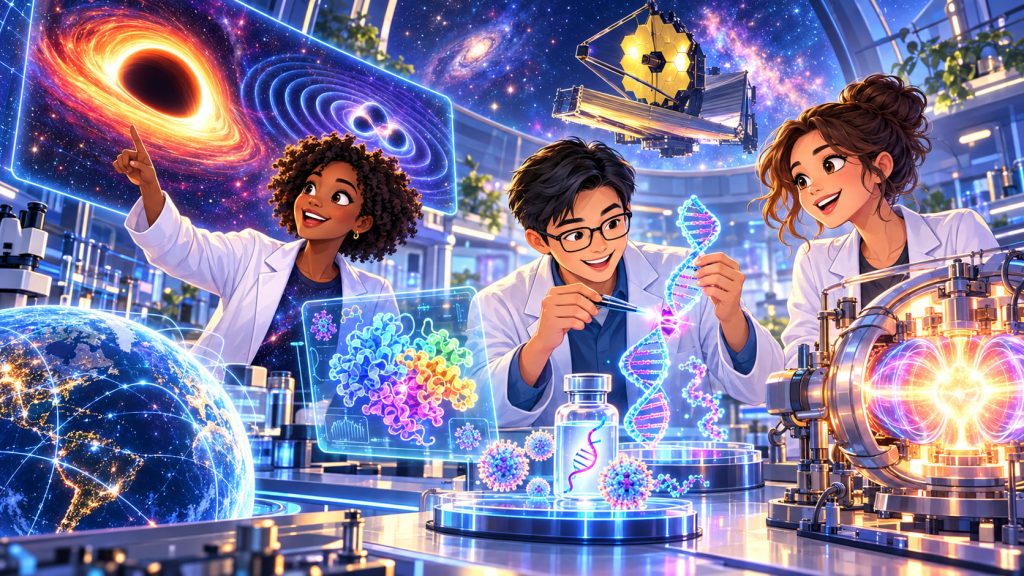
Over the past decade, science has achieved breakthroughs that once seemed impossible. Scientists have photographed black holes, developed revolutionary genetic treatments, unlocked the structures of millions of proteins, and brought humanity closer to controlled nuclear fusion.
These discoveries have transformed astronomy, medicine, genetics, artificial intelligence, and our understanding of the universe.
Some are already saving lives. Others are opening entirely new fields of research that could shape civilization for generations.
Here are eight major scientific discoveries and breakthroughs from 2016 to 2026 that have changed our understanding of the world.
1. Gravitational Waves Open a New Window on the Universe
In 2017, astronomers witnessed an extraordinary cosmic event: two neutron stars colliding approximately 130 million light-years from Earth.
The collision produced gravitational waves, tiny distortions in spacetime predicted by Albert Einstein.
Although gravitational waves had first been directly detected in 2015, this event marked a historic milestone.
Scientists observed gravitational waves and electromagnetic radiation from the same cosmic catastrophe.
The discovery also provided compelling evidence that neutron star collisions produce heavy elements, including gold and platinum.
For the first time, astronomers could study a single cosmic event using both gravitational waves and light.
This achievement established multi-messenger astronomy as a powerful new way to investigate the universe.
2. The First Photograph of a Black Hole
In April 2019, humanity saw the first image of a black hole.
The Event Horizon Telescope collaboration captured the shadow of a supermassive black hole located in the galaxy Messier 87, approximately 55 million light-years away.
This enormous object has a mass approximately 6.5 billion times greater than our Sun.
The image revealed a bright ring of superheated material surrounding a dark central region.
Because light cannot escape from inside a black hole’s event horizon, scientists photographed its shadow rather than the black hole itself.
In 2022, astronomers released another historic image showing Sagittarius A*, the supermassive black hole at the center of our Milky Way.
These observations provided extraordinary visual evidence supporting Einstein’s theory of general relativity.
3. Artificial Intelligence Revolutionizes Protein Research
Proteins are essential molecular machines responsible for countless processes inside living organisms.
Their functions depend heavily on their complex three-dimensional structures.
For decades, predicting how proteins fold from their amino acid sequences remained one of biology’s greatest challenges.
In 2020, Google DeepMind introduced AlphaFold2, an artificial intelligence system capable of predicting many protein structures with remarkable accuracy.
By 2022, its database contained predictions for more than 200 million proteins.
Scientists gained access to structural information that would previously have required enormous amounts of experimental research.
These predictions are valuable for investigating diseases, developing medicines, studying enzymes, and understanding biological processes.
In 2024, Demis Hassabis and John Jumper received the Nobel Prize in Chemistry alongside David Baker, whose pioneering work focused on computational protein design.
The Royal Swedish Academy of Sciences recognized protein structure prediction as the solution to a scientific challenge that had occupied researchers for approximately 50 years.
Artificial intelligence had become a powerful instrument for scientific discovery rather than merely a tool for processing information.
4. mRNA Vaccines Transform Modern Medicine
The COVID-19 pandemic accelerated one of the most important biomedical developments in modern history.
In December 2020, the first mRNA vaccines against COVID-19 received emergency authorization.
Unlike many traditional vaccines, mRNA vaccines deliver genetic instructions that allow human cells to temporarily produce a specific viral protein.
The immune system recognizes this protein and develops protective responses.
This achievement built upon decades of research, particularly discoveries by Katalin Karikó and Drew Weissman concerning modified messenger RNA.
Their work earned them the 2023 Nobel Prize in Physiology or Medicine.
The success of mRNA vaccines established a flexible platform that could accelerate the development of future vaccines and treatments.
Researchers are investigating additional applications, including vaccines against other infectious diseases and experimental cancer therapies.
5. Scientists Complete the Human Genome
The original Human Genome Project transformed genetics, but substantial gaps remained in the reference genome published in the early 2000s.
In 2022, the Telomere-to-Telomere Consortium published the first gap-free sequence of a human genome covering all chromosomes except the Y chromosome, which was completed in 2023.
Scientists finally decoded previously inaccessible regions containing highly repetitive DNA.
These regions include important structures involved in chromosome organization and cellular division.
The achievement improved our understanding of human genetic variation and created new opportunities to investigate inherited diseases.
In 2023, researchers also introduced a draft human pangenome reference incorporating genome sequences from 47 genetically diverse individuals.
Instead of relying entirely on a single reference genome, scientists began developing a more comprehensive representation of human genetic diversity.
6. The James Webb Space Telescope Reveals the Early Universe
When the James Webb Space Telescope began scientific operations in 2022, it transformed humanity’s ability to observe distant galaxies and planetary atmospheres.
Its powerful infrared instruments allow astronomers to investigate objects whose light has traveled across billions of years.
Webb has helped identify galaxies that existed only a few hundred million years after the Big Bang.
These observations are reshaping scientific understanding of how the earliest galaxies formed and evolved.
The telescope has also revolutionized exoplanet research.
In 2022, Webb detected clear evidence of carbon dioxide in the atmosphere of WASP-39 b, a giant planet approximately 700 light-years away.
By examining how starlight passes through distant planetary atmospheres, scientists can identify chemical compounds on worlds beyond our solar system.
7. CRISPR Gene Editing Becomes a Medical Reality
For decades, scientists dreamed of treating inherited diseases by directly modifying the genetic instructions inside human cells.
That possibility became a clinical reality in 2023.
The first CRISPR-based treatment received regulatory approval in the United Kingdom and subsequently in the United States.
The treatment, known as Casgevy, is designed for patients with sickle cell disease and certain other inherited blood disorders.
Doctors collect blood-forming stem cells from patients and use CRISPR technology to modify their DNA.
The edited cells are then returned to the body, where they can produce red blood cells containing increased levels of fetal hemoglobin.
This helps prevent the painful complications associated with sickle cell disease.
Although treatment remains complex and expensive, gene editing has moved from experimental laboratory research into approved clinical medicine.
8. Nuclear Fusion Achieves a Historic Energy Breakthrough
In December 2022, scientists at the Lawrence Livermore National Laboratory achieved a milestone in nuclear fusion research.
Using powerful lasers, researchers compressed a tiny capsule containing hydrogen isotopes until its contents underwent nuclear fusion.
The experiment delivered approximately 2.05 megajoules of laser energy to the target and produced 3.15 megajoules of fusion energy.
For the first time, a controlled fusion experiment generated more fusion energy than the laser energy delivered to its target.
This achievement demonstrated a fundamental principle underlying the possibility of future fusion power.
However, the experiment did not produce more electricity than the entire facility consumed.
Scientists had achieved a major experimental milestone, although practical commercial fusion power still required substantial technological advances.
Interesting Facts
- The first black hole ever imaged has a mass approximately 6.5 billion times greater than our Sun.
- AlphaFold’s database contains predicted structures for more than 200 million proteins.
- The original Human Genome Project left approximately 8% of the human genome unresolved.
- The James Webb Space Telescope observes infrared radiation that can reveal distant galaxies and the chemical composition of planetary atmospheres.
- CRISPR technology was adapted from a natural defense mechanism used by bacteria against viruses.
- The 2022 fusion experiment generated approximately 54% more fusion energy than the laser energy delivered to its target.
- Gravitational waves allow astronomers to investigate cosmic events that conventional telescopes cannot fully observe.
Glossary
- Gravitational Waves — Ripples in spacetime generated by accelerating massive objects, particularly violent cosmic events.
- Neutron Star — An extremely dense stellar remnant formed after certain massive stars explode.
- Event Horizon — The boundary surrounding a black hole beyond which nothing, including light, can escape.
- Multi-Messenger Astronomy — The study of astronomical events using different signals, including gravitational waves, electromagnetic radiation, and particles.
- AlphaFold — An artificial intelligence system developed to predict the three-dimensional structures of proteins.
- mRNA — Messenger RNA, a molecule that carries genetic instructions used by cells to manufacture proteins.
- Human Genome — The complete set of genetic information contained in human DNA.
- Pangenome — A collection of genome sequences representing genetic diversity across multiple individuals.
- Exoplanet — A planet orbiting a star outside our solar system.
- CRISPR — A genome-editing technology that allows scientists to make targeted changes to DNA.
- Nuclear Fusion — The process in which light atomic nuclei combine to form heavier nuclei, releasing energy.
- Fusion Ignition — A condition in which energy released by fusion reactions is sufficient to sustain further fusion under the relevant experimental conditions.