For more than a century, astronomers explored the universe primarily by studying light. Telescopes revealed distant galaxies, exploding stars, and mysterious black holes, but some of the universe’s most powerful events remained almost impossible to observe.
Then scientists discovered an entirely new way to investigate the cosmos.
In 2015, researchers detected gravitational waves for the first time, confirming a remarkable prediction Albert Einstein had made nearly 100 years earlier.
These incredibly subtle ripples in spacetime are produced by some of the most violent events in the universe, including collisions between black holes and neutron stars.
Gravitational waves have opened a completely new era of astronomy, allowing scientists to observe cosmic events that traditional telescopes cannot detect.
What Are Gravitational Waves?
Gravitational waves are disturbances in the fabric of spacetime that travel outward from accelerating massive objects.
According to Einstein’s general theory of relativity, space and time form a unified structure called spacetime.
Massive objects such as stars and planets curve this structure, producing the effects we experience as gravity.
When extremely massive objects accelerate in certain ways, they can generate ripples that spread across the universe.
These ripples travel at the speed of light.
As a gravitational wave passes through a region of space, it temporarily stretches distances in one direction while compressing them in another.
The effect is extraordinarily small.
By the time gravitational waves from distant cosmic events reach Earth, the changes they produce can be thousands of times smaller than the diameter of a proton.
Detecting such tiny distortions represents one of the greatest achievements in modern experimental physics.
Einstein’s Prediction That Took a Century to Confirm
Albert Einstein predicted gravitational waves in 1916 as a consequence of his general theory of relativity.
However, proving their existence presented enormous technological challenges.
Unlike electromagnetic radiation, gravitational waves interact extremely weakly with matter.
They can travel through entire galaxies without being significantly absorbed or scattered.
Scientists spent decades developing instruments sensitive enough to detect their effects.
In the 1970s, astronomers Russell Hulse and Joseph Taylor discovered a binary pulsar whose orbit gradually shrank in a way consistent with energy being carried away by gravitational waves.
Their discovery provided important indirect evidence and earned them the 1993 Nobel Prize in Physics.
Direct confirmation finally arrived decades later.
The Historic Discovery of 2015
On September 14, 2015, two detectors belonging to the Laser Interferometer Gravitational-Wave Observatory, known as LIGO, recorded an extraordinary signal.
Scientists determined that the waves originated from two black holes merging approximately 1.3 billion light-years away.
The black holes had masses approximately 36 and 29 times that of our Sun.
During their collision, they formed a larger black hole with a mass of about 62 solar masses.
The equivalent of approximately three solar masses was converted into gravitational-wave energy.
For a fraction of a second, the event released more power than the combined electromagnetic radiation emitted by all the stars in the observable universe.
The discovery was officially announced on February 11, 2016.
Humanity had detected gravitational waves directly for the first time and observed the merger of two black holes.
In 2017, Rainer Weiss, Barry Barish, and Kip Thorne received the Nobel Prize in Physics for their decisive contributions to LIGO and gravitational-wave detection.
How Scientists Detect Gravitational Waves
Gravitational waves cannot be observed using ordinary optical telescopes.
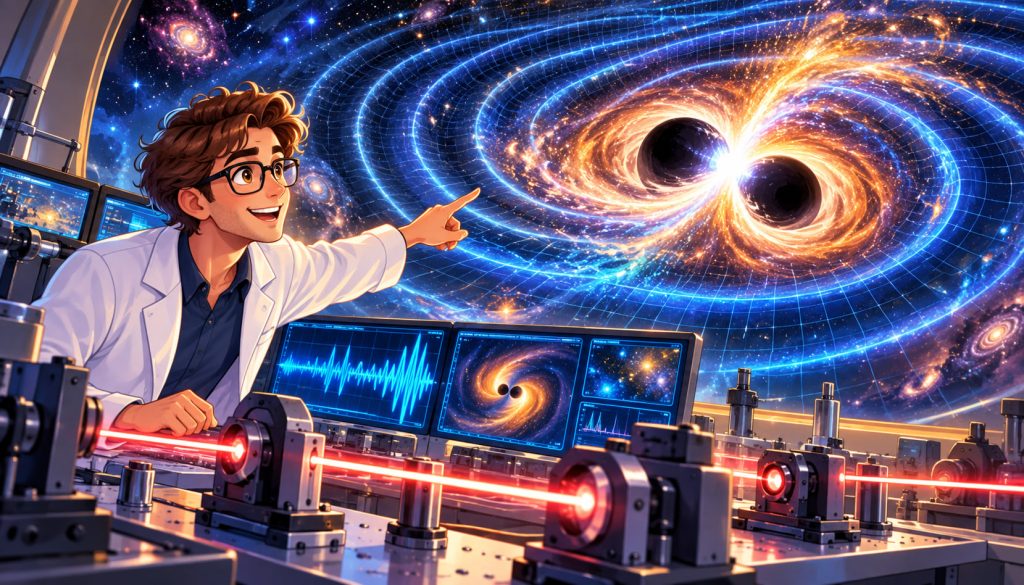
Instead, scientists use sophisticated instruments called laser interferometers.
LIGO operates two major observatories in the United States, located in Louisiana and Washington state.
Each detector has two perpendicular arms extending four kilometers.
Laser beams travel through these arms, reflect from highly polished mirrors, and return to a central measurement system.
When a gravitational wave passes through the detector, it produces an incredibly small difference in the relative lengths of the two arms.
Scientists analyze changes in the interference pattern formed by the returning laser beams.
These instruments must also distinguish genuine cosmic signals from vibrations caused by earthquakes, machinery, and other environmental disturbances.
LIGO can measure changes in distance far smaller than the size of an atomic nucleus.
Neutron Star Collisions Reveal Where Gold Comes From
One of the most extraordinary gravitational-wave discoveries occurred on August 17, 2017.
Astronomers detected gravitational waves from two neutron stars merging approximately 130 million light-years from Earth.
Unlike the first detected black hole collision, this event also produced electromagnetic radiation observable by conventional telescopes.
Scientists detected a short gamma-ray burst and subsequently observed the aftermath across multiple wavelengths.
The collision generated a brilliant explosion known as a kilonova.
Observations provided compelling evidence that neutron star mergers produce heavy chemical elements through rapid neutron capture.
These elements include gold, platinum, and other precious metals.
The discovery helped explain how some of the heaviest elements in the periodic table are created.
Gravitational-wave astronomy had connected the violent deaths of stars with the cosmic origins of familiar elements found on Earth.
Expert Perspective: A New Way to Explore the Universe
Nobel Prize-winning physicist Kip Thorne, one of the pioneers of gravitational-wave research, has emphasized how these observations allow scientists to explore the previously inaccessible aspects of the universe.
Traditional astronomy relies heavily on electromagnetic radiation.
However, black hole mergers can produce exceptionally powerful gravitational waves without generating significant visible light.
Gravitational-wave detectors therefore provide information unavailable through conventional telescopes.
Together, these different observational methods offer a more complete understanding of cosmic events.
This approach is known as multi-messenger astronomy.
What Gravitational Waves Tell Us About Black Holes
Before gravitational-wave detection, scientists primarily studied black holes by observing their effects on surrounding matter and light.
Gravitational waves now provide direct information about black hole mergers.
Researchers can estimate the masses, spins, and orbital characteristics of colliding objects by analyzing the signals they produce.
They can also investigate whether black holes behave as predicted by general relativity.
The final stages of a merger generate distinctive vibrations in the newly formed black hole, known as ringdown.
Studying these signals allows physicists to test fundamental theories of gravity under extreme conditions.
Every newly detected merger provides another opportunity to investigate the physical laws governing the universe.
The Future of Gravitational-Wave Astronomy
Gravitational-wave research is rapidly developing into an international scientific effort.
Alongside the American LIGO observatories, Europe’s Virgo detector and Japan’s KAGRA detector contribute to the global network.
Operating multiple observatories helps scientists distinguish genuine signals from local disturbances and identify the regions of the sky where cosmic events occurred.
Future space-based observatories promise even greater discoveries.
The European Space Agency is developing the Laser Interferometer Space Antenna, or LISA, a space mission designed to detect gravitational waves at frequencies inaccessible to ground-based detectors.
LISA will use three spacecraft separated by millions of kilometers to measure incredibly small changes in their relative distances.
It could reveal mergers between supermassive black holes and investigate gravitational-wave sources throughout the universe.
Meanwhile, pulsar timing arrays are searching for extremely low-frequency gravitational waves by monitoring the precise arrival times of signals from rapidly rotating neutron stars.
The next generation of observatories could reveal cosmic phenomena that humanity has never directly observed.
Interesting Facts
- Einstein predicted gravitational waves in 1916, almost a century before their first direct detection in 2015.
- Gravitational waves travel at the speed of light, approximately 300,000 kilometers per second.
- The first detected gravitational-wave signal lasted only a fraction of a second in LIGO’s most sensitive frequency range.
- The 2015 black hole merger converted approximately three solar masses into gravitational-wave energy.
- The famous first gravitational-wave signal is commonly called a chirp because its frequency and amplitude rapidly increase as two black holes approach each other.
- Gravitational waves can pass through ordinary matter with remarkably little interaction.
- The 2017 neutron star collision allowed scientists to observe gravitational waves and electromagnetic radiation from the same event.
- Gravitational-wave observatories can investigate black holes that emit little or no detectable electromagnetic radiation.
Glossary
- Gravitational Waves — Ripples in spacetime generated by accelerating massive objects.
- Spacetime — The four-dimensional structure combining the three dimensions of space with time.
- General Relativity — Einstein’s theory describing gravity as the curvature of spacetime.
- Black Hole — A region of spacetime where gravity is so strong that nothing can escape from inside its event horizon.
- Neutron Star — An extremely dense stellar remnant formed after the collapse of certain massive stars.
- LIGO — The Laser Interferometer Gravitational-Wave Observatory, which achieved the first direct detection of gravitational waves.
- Laser Interferometer — An instrument that measures extremely small changes in distance using the interference of laser beams.
- Kilonova — A luminous explosion associated with the merger of neutron stars or certain mergers involving neutron stars and black holes.
- Binary System — Two astronomical objects gravitationally bound to each other.
- Multi-Messenger Astronomy — The study of astronomical events using different kinds of signals, including gravitational waves, electromagnetic radiation, and particles.
- Ringdown — The final stage of a black hole merger, when the newly formed black hole settles into a stable configuration.
- Pulsar — A rapidly rotating neutron star that emits beams of electromagnetic radiation detectable as regular pulses.