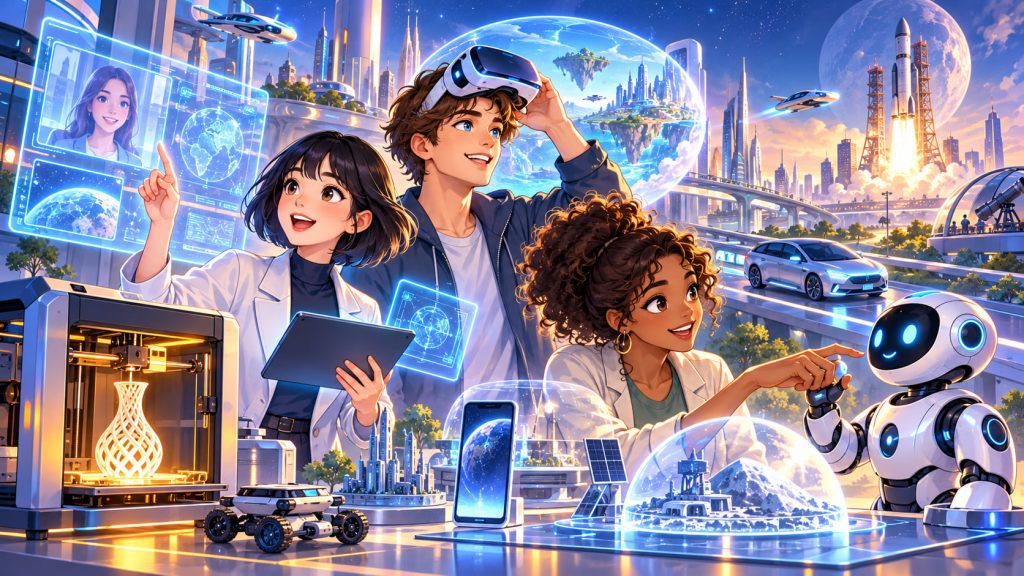
Science fiction has imagined artificial intelligence, video calls, space travel, intelligent robots, virtual worlds, wearable computers, and machines capable of creating objects on demand. Many ideas that once seemed impossible are now ordinary parts of modern life.
That does not mean science-fiction writers secretly knew exactly what the future would look like. The relationship is more interesting.
Science fiction often takes existing scientific discoveries, combines them with emerging social trends, and pushes them several decades forward through extrapolation. Sometimes reality later produces something remarkably similar.
In other cases, engineers who grew up reading science fiction deliberately try to build technologies inspired by it.
Science fiction does not simply predict the future. It can also help create it.
Jules Verne and the Journey to the Moon
Jules Verne published From the Earth to the Moon in 1865, more than a century before humans walked on the lunar surface.
His travelers depart from the United States in a projectile launched from Florida and later return to Earth by landing in the ocean.
The real Apollo missions also launched from Florida and ended with spacecraft splashing down in the ocean.
The similarities are striking, but Verne did not accurately predict the technology itself. His enormous cannon would have subjected passengers to forces humans could not survive. Apollo used multistage rockets instead.
This is an important distinction. Science fiction often anticipates the destination or concept while getting the engineering completely wrong.
Communicators Became Smartphones
The handheld communicators seen in Star Trek during the 1960s looked extraordinary at a time when telephones were normally attached to walls or desks.
Portable cellular phones eventually became real, followed by smartphones that are vastly more capable than fictional communicators.
Modern phones combine wireless communication, navigation, cameras, video calls, entertainment, translation, digital payments, and internet access.
The resemblance does not mean Star Trek invented mobile telecommunications. Radio communication already existed, and engineers were developing cellular concepts.
But fictional devices helped make personal wireless communication feel imaginable.
This relationship between imagination and engineering is sometimes described as technological inspiration.
Video Calling Left Fiction Behind
Video communication appeared repeatedly in twentieth-century science fiction.
Stanley Kubrick’s 2001: A Space Odyssey, released in 1968, showed long-distance video communication decades before internet video calling became an everyday consumer technology.
Today, smartphones and laptops can establish high-resolution video connections almost instantly across continents.
The technological foundation combines cameras, broadband networks, compression algorithms, microphones, and packet switching, in which digital information is divided into manageable units and transmitted through networks.
What once required expensive specialized equipment now fits inside an ordinary pocket device.
Tablets Look Surprisingly Familiar
Another memorable element of 2001: A Space Odyssey is the use of flat electronic displays resembling modern tablets.
Tablet computers existed experimentally in different forms for decades, but mass-market devices eventually produced something remarkably close to science-fiction depictions: thin portable screens used for reading, entertainment, communication, and work.
Modern devices use touchscreen interfaces instead of the keyboards and switches that dominated early computing.
Science fiction was especially successful at imagining the experience of portable computing even when it could not predict the exact processors, software, or networks that would make it possible.
Artificial Intelligence Is No Longer Pure Fiction
Intelligent machines are among the oldest recurring themes in science fiction.
Isaac Asimov explored robots capable of sophisticated reasoning. Arthur C. Clarke and Stanley Kubrick presented HAL 9000 as a conversational artificial intelligence in 2001. Later works imagined computers able to speak, understand natural language, create content, and assist humans.
Modern generative artificial intelligence can write text, produce images, analyze documents, generate computer code, translate languages, and communicate conversationally.
However, today’s AI is very different from the fully autonomous minds frequently shown in fiction.
Large AI systems can produce convincing answers without possessing human consciousness or dependable common sense. They may also make factual errors.
Science fiction anticipated conversational machines more successfully than it anticipated exactly how machine intelligence would work.
Robots Are Becoming Normal Machines
Fictional robots range from friendly assistants to dangerous humanoid machines.
Real robotics has developed along a less dramatic but highly practical path.
Industrial robots assemble vehicles, robotic systems move products through warehouses, autonomous machines inspect dangerous environments, and surgical robots assist physicians with precise procedures.
Modern robots increasingly combine cameras and other sensors with computer vision, allowing software to identify and interpret visual information.
Humanoid robots are also advancing, although creating machines capable of matching human flexibility, balance, dexterity, and general intelligence remains extremely difficult.
Cyberspace Became Everyday Life
William Gibson’s 1984 novel Neuromancer popularized the word “cyberspace” and imagined vast digital environments connecting people and information.
The modern internet is not identical to Gibson’s fictional network, but billions of people now spend substantial portions of their lives inside digital systems.
Banking, entertainment, work, relationships, education, shopping, and social interaction can all occur through connected networks.
Modern virtual reality pushes the resemblance further by placing users inside interactive computer-generated environments.
What once appeared to be a separate imaginary digital universe has increasingly become an ordinary extension of physical life.
Machines Can Now Print Physical Objects
Science fiction frequently imagines devices capable of producing objects automatically.
Modern additive manufacturing, commonly called 3D printing, does something less spectacular but conceptually similar.
Instead of cutting an object from a larger piece of material, a 3D printer builds it progressively, usually layer by layer.
The technology is used for prototypes, specialized industrial components, dental products, customized medical devices, architectural models, and even parts for spacecraft.
Researchers have also developed experimental techniques for printing biological structures using cells and biomaterials.
We do not have fictional machines capable of instantly producing almost anything, but the boundary between digital designs and physical manufacturing has become increasingly thin.
Self-Driving Vehicles Are Partly Here
Autonomous cars appeared in science fiction long before sophisticated computerized driving systems became practical.
Today, vehicles can automatically maintain lanes, adjust speed, park, detect obstacles, and perform increasingly complex driving tasks.
Some commercial services operate autonomous vehicles without a human driver in limited geographic areas.
However, full autonomy everywhere remains a far more difficult problem.
Snow, unusual road layouts, unpredictable human behavior, construction zones, and rare situations create challenges that are difficult for automated systems to handle reliably.
Once again, science fiction identified the direction more easily than the timetable.
What Science Fiction Got Wrong
Many famous predictions remain unrealized.
Flying cars have not become normal urban transportation. Human settlements on Mars do not yet exist. Teleportation of people remains beyond known practical physics. Faster-than-light spacecraft conflict with our current understanding of relativity.
Another famous idea, general-purpose humanoid robotics, remains far less capable than fictional portrayals suggest.
Even apparently simple household tasks require enormous amounts of perception, coordination, physical control, and adaptation.
Science fiction often underestimates mundane difficulties while overestimating spectacular ones.
Expert Perspective: Prediction Is Not the Main Purpose
Many science-fiction writers and futurists emphasize that the genre is better at exploring possibilities than forecasting exact events.
Science-fiction author David Brin has repeatedly discussed the value of speculative fiction as a way of examining possible technologies and their social consequences rather than treating stories as literal forecasts.
That distinction matters.
A novel can explore surveillance before the required cameras and computers exist. It can examine artificial intelligence before engineers know how to build it. It can ask what happens when humans live permanently in virtual environments before such environments are technically practical.
This process is closely related to speculative design: imagining possible technologies and then examining how people might use, misuse, regulate, or respond to them.
When Fiction Becomes an Engineering Blueprint
Sometimes the direction of influence runs backward.
Engineers, programmers, scientists, and entrepreneurs are also readers and viewers of science fiction.
A fictional interface can inspire a real interface. A fictional robot can motivate robotics research. An imaginary spacecraft can influence the ambitions of future aerospace engineers.
That creates a fascinating feedback loop:
science inspires fiction, fiction imagines possibilities, and those possibilities inspire new science and engineering.
This is why asking whether fulfilled science fiction is “still fiction” has no simple answer.
The original story remains fictional. The technological idea may become reality.
And once reality catches up, writers simply move the boundary again.
Interesting Facts
- Jules Verne described a crewed journey toward the Moon more than 100 years before Apollo 11.
- Star Trek introduced its famous handheld communicators before commercial mobile phones became widely available.
- 2001: A Space Odyssey depicted video communication and flat portable electronic displays in 1968.
- The term “cyberspace” became famous through William Gibson’s Neuromancer in 1984.
- Robots have become common in factories long before humanlike household robots became practical.
- Modern 3D printers can manufacture objects directly from digital models.
- Driverless commercial transportation already operates in selected real-world locations.
- Technologies that sound less spectacular than teleportation, such as reliable household robotics, can prove unexpectedly difficult to develop.
- Science fiction sometimes influences engineers who later build technologies resembling fictional concepts.
Glossary
- Extrapolation — Extending existing scientific or technological trends to imagine how they might develop in the future.
- Technological Inspiration — The influence an imagined technology can have on people who later attempt to create something similar.
- Packet Switching — A networking method that divides digital information into packets that can travel through communication networks.
- Touchscreen Interface — A system that allows users to control a device by touching its display.
- Generative Artificial Intelligence — AI capable of creating new content such as text, images, audio, or computer code.
- Computer Vision — Technology that enables computers to interpret information contained in images and video.
- Virtual Reality — Technology that creates interactive computer-generated environments experienced through specialized displays or headsets.
- Additive Manufacturing — Manufacturing objects by progressively adding material, commonly associated with 3D printing.
- Autonomous Vehicle — A vehicle capable of performing some or all driving tasks using sensors, software, and automated control.
- General-Purpose Humanoid Robotics — The development of human-shaped robots intended to perform many different physical tasks rather than one specialized function.
- Speculative Design — The practice of imagining possible technologies and systems in order to explore their potential effects on society.