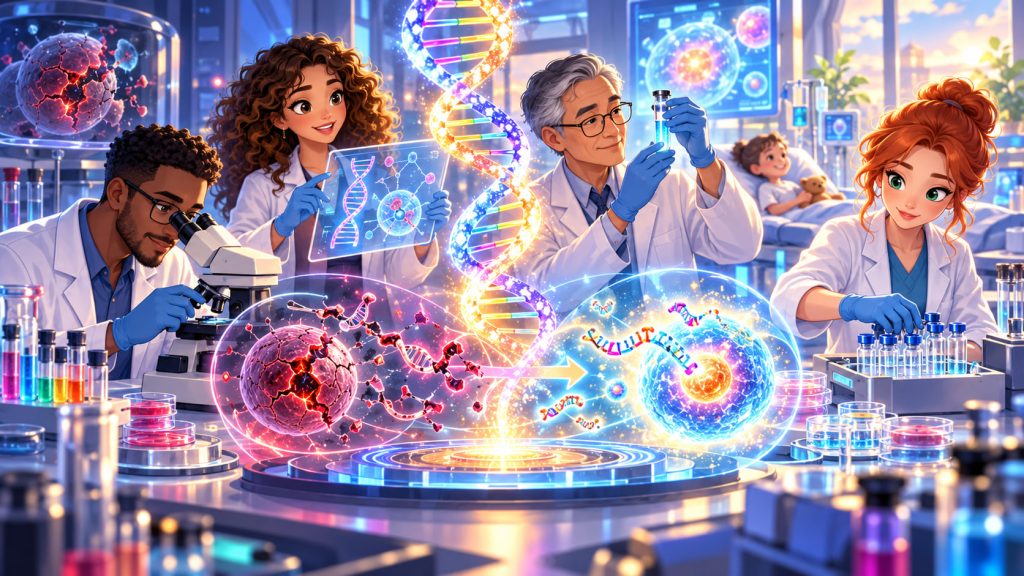
Imagine treating a serious inherited disease not by managing its symptoms for decades, but by correcting the biological instructions responsible for it.
This is the promise of gene therapy, one of the most revolutionary developments in modern medicine.
For years, genetic diseases were considered largely untreatable at their source. Doctors could relieve symptoms, prevent complications, or slow disease progression, but changing the underlying genetic problem seemed impossible.
Today, gene therapy is transforming that reality.
Scientists have developed treatments for certain forms of inherited blindness, spinal muscular atrophy, blood disorders, and immune deficiencies.
However, the journey has included tragic failures, unexpected complications, extraordinary costs, and difficult ethical questions.
Gene therapy is no longer just an experimental concept. It is an established medical technology with remarkable achievements, serious limitations, and enormous potential.
What Is Gene Therapy and How Does It Work?
Gene therapy involves modifying genetic material or its activity to treat or prevent disease.
Human DNA contains thousands of genes that provide instructions for producing proteins essential to normal biological functions.
When a gene contains a harmful mutation, the resulting protein may malfunction or disappear entirely.
Gene therapy attempts to address these problems at their biological source.
Scientists generally use several approaches:
- Introducing a working copy of a defective gene
- Editing a harmful DNA sequence
- Disabling a disease-causing gene
- Modifying gene activity to restore healthy cellular function
Many treatments rely on a viral vector, a modified virus designed to transport genetic material into cells.
Other approaches use specialized particles or directly manipulate cells outside the body.
Most existing treatments involve somatic gene therapy, meaning genetic changes are made to a patient’s body cells rather than reproductive cells.
These changes are intended to treat the individual without passing the modifications to future generations.
The First Major Successes of Gene Therapy
The earliest clinical trials began around the end of the 1980s and the beginning of the 1990s.
One of the first targets was severe combined immunodeficiency, a group of rare genetic disorders that severely weaken the immune system.
Some patients benefited from treatments involving genetically modified immune cells or blood-forming stem cells.
These early achievements demonstrated that correcting genetic defects could restore important biological functions.
A major milestone arrived in 2017.
The United States approved Luxturna, a gene therapy for certain inherited retinal diseases caused by mutations affecting both copies of the RPE65 gene.
The treatment delivers a functioning version of the gene to retinal cells.
It can improve functional vision in eligible patients, particularly their ability to navigate in dim lighting.
Luxturna demonstrated that gene therapy could move beyond laboratory experiments into regulated clinical treatment.
Spinal Muscular Atrophy: A Life-Changing Breakthrough
Spinal muscular atrophy, or SMA, is an inherited neurological disease that damages motor neurons.
Severe forms can cause progressive muscle weakness, difficulty breathing, and early death.
In 2019, Zolgensma received approval in the United States for certain young children with SMA.
The treatment uses an adeno-associated virus (AAV) vector to deliver a functional copy of the SMN1 gene.
Clinical studies demonstrated major improvements in survival and motor development, especially when treatment began before severe symptoms appeared.
Some treated children achieved developmental milestones that would have been unlikely with the natural course of severe SMA.
However, the therapy does not reverse all existing nerve damage and carries potentially serious safety risks, including liver injury.
Early diagnosis remains critical.
CRISPR: A New Era of Genetic Editing
Traditional gene therapy frequently adds a functional gene rather than directly correcting the original mutation.
Gene editing introduces another possibility.
The revolutionary CRISPR-Cas9 system allows researchers to make targeted changes to DNA.
Its development transformed genetic research and opened new possibilities for treating inherited disorders.
In 2023, the United Kingdom and the United States authorized Casgevy, the first approved treatment using CRISPR-based gene editing.
Casgevy targets sickle cell disease, a serious inherited blood disorder.
The treatment modifies a patient’s own hematopoietic stem cells, which produce blood cells.
Rather than directly repairing the sickle cell mutation, it changes a regulatory DNA region to increase fetal hemoglobin production.
Fetal hemoglobin helps prevent the abnormal red blood cell behavior responsible for painful sickle cell crises.
Clinical trials showed that most evaluable patients with sickle cell disease experienced prolonged freedom from severe pain crises.
This achievement marked a historic transition from experimental gene editing to approved human treatment.
When Gene Therapy Went Wrong
The history of gene therapy also includes serious setbacks.
In 1999, Jesse Gelsinger, an 18-year-old participant in an experimental gene therapy trial, died after developing a severe inflammatory response to an adenoviral vector.
His death exposed major safety and research oversight concerns.
Another setback emerged during early trials for certain forms of severe combined immunodeficiency.
Several children developed leukemia after receiving treatments involving integrating retroviral vectors.
The problem involved insertional mutagenesis, in which inserted genetic material disrupts important cellular regulatory regions.
These events forced researchers to reconsider vector design, patient monitoring, and long-term safety.
Modern gene therapy uses improved technologies, but dangerous immune reactions, unexpected genetic effects, and organ toxicity remain important concerns.
The greatest lesson from these failures is that successful genetic modification must also be biologically safe.
Why Is Gene Therapy Still So Difficult?
One major challenge is delivering genetic material to the correct cells.
Different tissues require different delivery strategies.
Treating blood cells outside the body is relatively manageable compared with reaching millions of cells distributed throughout the brain, heart, or muscles.
An ex vivo therapy modifies cells outside the patient before returning them to the body.
By contrast, an in vivo therapy delivers genetic material directly into the patient.
Both approaches have advantages and limitations.
Gene-editing treatments also raise concerns about off-target effects, unintended modifications in regions of DNA outside the intended target.
Scientists must investigate whether these changes could disrupt important genes or contribute to cancer.
Long-term monitoring is essential because some complications may emerge years after treatment.
The Extraordinary Cost of Genetic Medicine
Gene therapy is among the most expensive categories of medical treatment.
Some approved therapies have launched with United States list prices exceeding $2 million per patient.
Hemgenix, a gene therapy for certain adults with hemophilia B, launched with a list price of approximately $3.5 million.
Manufacturing complexity, individualized procedures, extensive testing, and small patient populations contribute to these costs.
Some treatments also require conditioning chemotherapy before genetically modified stem cells can be administered.
This procedure prepares the bone marrow but introduces additional medical risks.
Although a successful treatment may reduce decades of medical expenses, the initial financial burden creates substantial access challenges.
Expert Perspective: Beyond Editing DNA
Jennifer Doudna, a Nobel Prize-winning biochemist and pioneer of CRISPR technology, has emphasized the importance of developing safe, effective, and accessible applications of genome editing.
Her work helped establish the scientific foundation for modern precision gene-editing treatments.
A central challenge is translating powerful laboratory techniques into therapies that work reliably across different diseases and patient populations.
The future of genetic medicine depends not only on what scientists can change in DNA, but also on how safely and widely those changes can be delivered.
The Future: More Precise and Accessible Gene Editing
Researchers are now developing technologies designed to overcome the limitations of earlier gene therapies.
One promising approach is base editing, which can change certain individual DNA letters without creating the double-strand breaks typically associated with standard CRISPR-Cas9 editing.
Another emerging technique is prime editing, which may allow more flexible and precise genetic changes.
Scientists are also investigating nonviral delivery systems, improved nanoparticles, and treatments targeting a wider range of tissues.
Potential future applications include inherited metabolic disorders, neurological diseases, cardiovascular conditions, and some forms of cancer.
However, many of these approaches remain experimental.
Another important question concerns germline editing, which could produce genetic changes inherited by future generations.
Unlike treatments restricted to one patient’s body cells, heritable modifications introduce significant ethical and safety challenges.
The next major achievement may not be a single revolutionary cure, but making genetic treatments safer, simpler, and available to millions rather than thousands of patients.
Interesting Facts
- Human DNA contains approximately 3 billion base pairs in a typical single set of chromosomes.
- The first gene therapy clinical trial widely recognized in the United States began in 1990.
- Luxturna became the first FDA-approved gene therapy directly administered to treat a disease caused by a specific inherited mutation.
- Zolgensma uses a modified virus to deliver a functioning gene to affected cells.
- The first approved CRISPR-based medicine targets a genetic blood disorder without directly repairing its original disease-causing mutation.
- Some gene therapies are designed as single administrations, although their long-term benefits require continued monitoring.
- The 2020 Nobel Prize in Chemistry recognized Emmanuelle Charpentier and Jennifer Doudna for developing a method of genome editing.
- Future genetic treatments may combine artificial intelligence, advanced delivery technologies, and increasingly precise DNA-editing tools.
Glossary
- Viral Vector — A modified virus used to deliver therapeutic genetic material into cells.
- Somatic Gene Therapy — Genetic treatment targeting body cells without intentionally modifying inherited reproductive DNA.
- Adeno-Associated Virus (AAV) — A small virus adapted as a delivery system for certain gene therapies.
- CRISPR-Cas9 — A genome-editing technology that uses a guide RNA and a DNA-cutting enzyme to target specific genetic sequences.
- Hematopoietic Stem Cells — Stem cells responsible for producing red blood cells, white blood cells, and platelets.
- Insertional Mutagenesis — Genetic disruption caused when inserted DNA changes the function or regulation of nearby genes.
- Ex Vivo Therapy — Treatment involving cells that are genetically modified outside the body and then returned to the patient.
- In Vivo Therapy — Treatment involving delivery of genetic material directly into the patient’s body.
- Off-Target Effects — Unintended genetic changes occurring outside the intended editing location.
- Conditioning Chemotherapy — Medication used to prepare the bone marrow for transplantation or infusion of modified stem cells.
- Base Editing — A gene-editing technique designed to change specific DNA bases without typically cutting both DNA strands.
- Prime Editing — An advanced gene-editing method capable of making various targeted DNA sequence changes.
- Germline Editing — Genetic modification of reproductive cells or early embryos that could affect future generations.