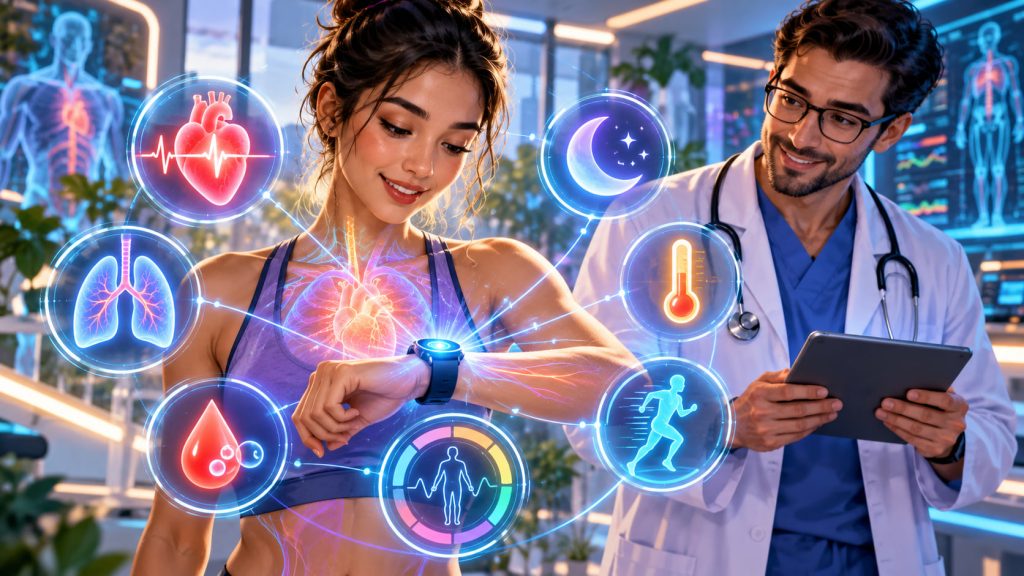
A device worn on your wrist can now monitor your heartbeat, track oxygen levels, analyze sleep patterns, and warn you about certain potential health problems.
What once seemed like futuristic medical technology has become part of everyday life.
Modern smartwatches combine optical sensors, electrical measurements, motion tracking, and artificial intelligence to monitor changes in the human body.
Some features have even received authorization from medical regulators for specific health-related purposes.
But there is an important distinction between measuring biological signals, identifying possible abnormalities, and diagnosing a disease.
Smartwatches can detect certain warning signs and provide valuable medical information, but they cannot replace comprehensive examinations or diagnose every condition they monitor.
How Smartwatches Monitor the Human Body
Most health-focused smartwatches contain several miniature sensors.
One important technology is photoplethysmography, an optical method that measures changes in blood volume beneath the skin.
Tiny light-emitting diodes illuminate the skin while sensors measure reflected light.
These signals help estimate heart rate and identify changes in circulation.
Additional sensors may include accelerometers, temperature sensors, and electrodes for recording electrical heart activity.
Algorithms combine these measurements to identify patterns associated with physical activity, sleep, and certain health conditions.
The accuracy of these systems depends on sensor quality, software, skin contact, movement, and the specific measurement being performed.
Can a Smartwatch Detect Heart Disease?
Heart monitoring is one of the most advanced medical applications of smartwatches.
Certain models can record a single-lead electrocardiogram, commonly called an ECG.
This measurement captures the electrical signals controlling the heartbeat.
Some medically authorized smartwatch ECG applications can identify patterns consistent with atrial fibrillation, an irregular heart rhythm associated with increased stroke risk.
For example, compatible Apple Watch and Samsung Galaxy Watch models offer ECG functions in supported regions.
These recordings can provide useful information for healthcare professionals.
However, a smartwatch ECG is not equivalent to a standard clinical 12-lead ECG.
A smartwatch cannot reliably detect heart attacks, blocked coronary arteries, or every dangerous heart rhythm.
Chest pain, severe breathlessness, or other possible emergency symptoms require immediate medical attention regardless of smartwatch readings.
Irregular Heartbeat Notifications
Some smartwatches also monitor pulse patterns in the background.
When repeated irregularities appear, the device may generate a notification suggesting further evaluation.
This can be particularly useful because certain rhythm abnormalities occur intermittently.
A person may feel completely normal during a medical appointment but experience irregular heartbeats at another time.
Large-scale research involving hundreds of thousands of smartwatch users has demonstrated the potential of wearable technology to identify previously unrecognized rhythm abnormalities.
However, an irregular rhythm notification is a reason to investigate, not a confirmed diagnosis.
Can Smartwatches Detect High Blood Pressure?
High blood pressure, medically known as hypertension, is a major risk factor for cardiovascular disease.
Traditional blood pressure measurement uses an inflatable cuff to assess pressure in the arteries.
Some specialized wearable devices include miniature inflatable cuffs, while certain consumer smartwatches offer blood pressure estimates or hypertension-related notifications.
In 2025, Apple received FDA clearance for a hypertension notification feature that analyzes patterns in optical heart-sensor data.
This feature does not directly measure systolic and diastolic blood pressure or diagnose hypertension.
A notification indicates that further assessment with an appropriate blood pressure monitor is advisable.
For medical decisions involving blood pressure, clinically validated measurements remain essential.
Blood Oxygen Monitoring: What Does It Reveal?
Some smartwatches estimate blood oxygen saturation using pulse oximetry.
This technology evaluates differences in how oxygenated and deoxygenated blood absorb light.
Healthy adults at sea level commonly have oxygen saturation readings around 95–100%, although individual circumstances matter.
Wearable measurements can be influenced by movement, poor circulation, skin characteristics, and sensor positioning.
Consumer smartwatch oxygen readings are therefore not always suitable for medical diagnosis.
An unusually low reading may deserve further investigation, but a normal reading cannot exclude respiratory disease.
Can Smartwatches Identify Sleep Apnea?
Certain smartwatches can identify patterns suggesting obstructive sleep apnea.
This condition involves repeated narrowing or blockage of the upper airway during sleep.
Samsung received U.S. FDA authorization for a smartwatch-based sleep apnea risk-assessment feature in 2024.
Apple also introduced an authorized sleep apnea notification feature.
These systems analyze physiological and movement-related signals collected during sleep.
They are intended to identify signs associated with moderate to severe sleep apnea in eligible users.
However, a smartwatch notification is not a substitute for a diagnostic sleep study.
Other sleep measurements, including sleep stages and sleep scores, are estimates rather than direct clinical assessments of brain activity.
Temperature Changes and Early Illness Signals
Some wearables monitor wrist or skin temperature during sleep.
These measurements can reveal deviations from an individual’s usual pattern.
Temperature changes may accompany infections, hormonal fluctuations, environmental conditions, or changes in sleep.
For example, an unusual overnight temperature increase combined with a higher resting heart rate may suggest that the body is experiencing physiological stress.
However, wrist temperature is not identical to core body temperature.
Smartwatches cannot reliably determine whether someone has influenza, COVID-19, or another infection simply from temperature changes.
Stress, Recovery, and Heart Rate Variability
Many devices calculate heart rate variability, commonly abbreviated HRV.
This describes the variation in time between successive heartbeats.
HRV is influenced by autonomic nervous system activity and may change with sleep, exercise, illness, and stress.
Smartwatches use these patterns to estimate recovery or physiological strain.
However, a low HRV reading does not independently diagnose anxiety, depression, or a specific illness.
The greatest value comes from monitoring personal trends under reasonably consistent conditions.
Can Smartwatches Measure Blood Glucose?
One of the most anticipated developments is noninvasive blood glucose monitoring.
However, ordinary smartwatches cannot independently provide clinically reliable glucose measurements without an appropriate sensing technology.
The FDA has specifically warned against products claiming to measure blood glucose directly from a smartwatch or smart ring without penetrating the skin.
Some watches can display glucose readings transmitted from a separate continuous glucose monitor.
These monitors use a sensor placed beneath the skin to measure glucose in interstitial fluid.
Displaying glucose information from an external sensor is very different from measuring blood sugar with a smartwatch alone.
Expert Perspective: Wearables as Early Warning Systems
Yale cardiologist and researcher Harlan Krumholz has highlighted the importance of technologies that make cardiovascular risk detection more accessible.
His perspective emphasizes how identifying possible hypertension earlier can encourage people to seek appropriate care before complications develop.
This reflects a broader development in digital medicine.
Smartwatches are becoming useful tools for recognizing changes that deserve professional attention.
Their effectiveness depends on clinical validation, appropriate interpretation, and integration with conventional healthcare.
The Risk of Incorrect Health Alerts
Smartwatch health monitoring is not perfect.
A false positive occurs when a device identifies a possible abnormality that is not actually present.
Such alerts can create unnecessary worry or lead to additional medical testing.
Equally important, the absence of an alert does not guarantee good health.
A smartwatch may miss an intermittent condition or fail to detect a disease outside its intended monitoring capabilities.
The safest approach is to treat smartwatch information as supporting evidence rather than a final medical judgment.
The Future of Smartwatch Diagnostics
Future smartwatches may combine improved sensors, artificial intelligence, and more sophisticated medical algorithms.
Potential developments include better cardiovascular monitoring, more precise physiological measurements, and closer integration with remote healthcare.
Long-term tracking may become especially valuable.
A gradual change in resting heart rate, sleeping patterns, or exercise tolerance can provide useful context that a single measurement cannot capture.
The most promising future is not a watch that independently diagnoses every disease, but a medically validated monitoring system that helps identify warning signs earlier and connects people with appropriate care.
Interesting Facts
- Some smartwatches can record an ECG using electrodes integrated into the device.
- A standard clinical ECG generally uses 12 leads, while common smartwatch ECG systems record a single lead.
- Optical heart sensors detect changes in blood volume rather than directly observing the heart.
- Certain smartwatch features can identify signs associated with moderate to severe obstructive sleep apnea.
- Wrist temperature naturally changes during sleep and may vary with the surrounding environment.
- Smartwatches can display glucose data from compatible external continuous glucose monitors.
- Blood pressure notifications and actual blood pressure measurements are different technologies.
- Health features may vary between smartwatch models, countries, and regulatory jurisdictions.
Glossary
- Photoplethysmography — An optical technique that detects changes in blood volume using light.
- Electrocardiogram — A recording of the electrical activity controlling the heartbeat.
- Atrial Fibrillation — An irregular heart rhythm that can increase the risk of stroke.
- Hypertension — Persistently elevated arterial blood pressure.
- Pulse Oximetry — A method of estimating blood oxygen saturation using light absorption.
- Obstructive Sleep Apnea — A disorder involving repeated obstruction of the upper airway during sleep.
- Heart Rate Variability — The variation in time intervals between consecutive heartbeats.
- Continuous Glucose Monitor — A device that tracks glucose levels through a sensor placed beneath the skin.
- Clinical Validation — The process of demonstrating that a medical technology performs appropriately for its intended clinical purpose.
- False Positive — A test result that incorrectly indicates the presence of an abnormality or medical condition.