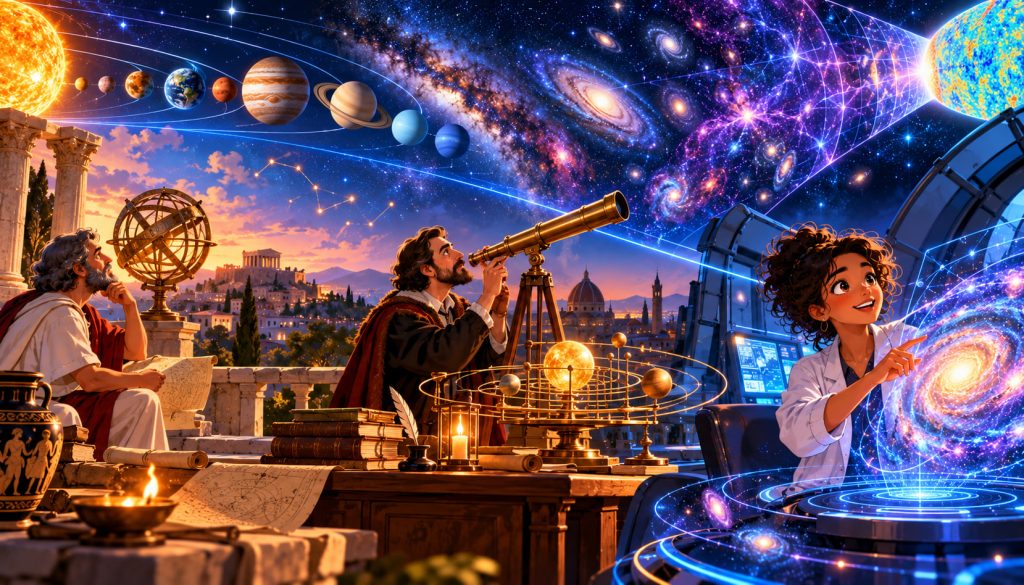
For thousands of years, humans have looked toward the night sky and wondered what exists beyond Earth. The Sun, Moon, planets, and stars inspired mythology, philosophical debates, and eventually scientific investigation.
Our ancestors once imagined a relatively small cosmos organized around Earth. Today, astronomers investigate distant galaxies, black holes, planets around other stars, and light that has traveled for billions of years.
The history of astronomy reveals one of humanity’s greatest intellectual transformations: the journey from ancient sky observations to modern scientific cosmology.
Ancient Civilizations: Discovering Order in the Sky
Early civilizations carefully recorded celestial movements.
Babylonian astronomers developed methods for predicting astronomical events. Ancient Egyptians connected star observations with calendars and agricultural activities.
Maya astronomers created sophisticated calendars based on recurring celestial cycles.
Chinese observers documented eclipses, comets, and unusual stellar events. In 1054, they recorded a brilliant explosion whose remains are now called the Crab Nebula.
Although astronomy was often connected to religion and astrology, these observations established an important principle: the sky follows patterns that humans can study and predict.
Ancient Greece: Earth at the Center of the Cosmos
Greek philosophers developed mathematical explanations for celestial movements.
Aristotle argued that Earth was spherical and occupied the center of the universe.
Claudius Ptolemy later developed an influential Geocentric Model in which the Sun, Moon, and planets moved around Earth.
His calculations explained phenomena such as Retrograde Motion, when planets appear to move backward against background stars.
However, alternative ideas existed.
Around the third century BCE, Aristarchus of Samos proposed that Earth orbited the Sun, although his model did not become widely accepted.
Medieval Astronomy: Preserving and Expanding Knowledge
Astronomical research continued across the Islamic world, India, China, and other regions.
Scholars translated earlier works, developed mathematical techniques, and improved astronomical instruments.
Al-Battani refined measurements of celestial motion, while Nasir al-Din al-Tusi introduced influential mathematical methods.
Observatories allowed increasingly precise comparisons between theoretical predictions and actual planetary positions.
These advances helped establish the scientific foundation for later astronomical revolutions.
Copernicus: Moving Earth Away From the Center
In 1543, Nicolaus Copernicus published a model placing the Sun near the center of the planetary system.
His Heliocentric Model proposed that Earth rotates daily and travels around the Sun.
This offered a more natural explanation for the apparent backward movements of planets.
Although Copernicus still relied on combinations of circular motions, his work challenged centuries of established thinking.
Earth was no longer necessarily the stationary center of the planetary system.
Galileo, Kepler, and Newton Transform Astronomy
In 1610, Galileo Galilei observed four large moons orbiting Jupiter.
He also studied Venus’s phases and the uneven lunar surface, providing important evidence against traditional assumptions about the heavens.
Johannes Kepler used observations collected by Tycho Brahe to demonstrate that planets follow an Elliptical Orbit rather than a perfect circle.
In 1687, Isaac Newton published his theory of Universal Gravitation.
The same physical law could now explain falling objects, planetary orbits, and the Moon’s motion.
Earth and the heavens became parts of one interconnected physical system.
Discovering Galaxies Beyond the Milky Way
For centuries, astronomers debated whether faint spiral-shaped objects belonged to the Milky Way.
In 1923, Edwin Hubble identified Cepheid variable stars in Andromeda.
Their predictable brightness variations helped determine its distance.
The results demonstrated that Andromeda lay far beyond the Milky Way.
It was another Galaxy containing enormous numbers of stars.
Humanity’s known universe expanded dramatically as astronomers recognized that the Milky Way was only one galaxy among many.
The Universe Is Expanding
During the 1920s, astronomers investigated the Cosmological Redshift observed in light from distant galaxies.
As space expands, the wavelengths of traveling light become stretched.
Georges Lemaître connected expanding-universe mathematics with astronomical observations in 1927.
In 1929, Hubble published evidence relating galaxy distances to recession velocities.
The universe was not a static collection of objects.
Space itself was expanding, transforming scientific understanding of cosmic history.
The Big Bang and the Age of Everything
Modern cosmology developed the Big Bang Model, describing the universe’s evolution from an extremely hot, dense early state.
The Big Bang was not an ordinary explosion into empty space. It involved the expansion of space itself.
In 1965, Arno Penzias and Robert Wilson discovered the Cosmic Microwave Background (CMB).
This ancient radiation originated when the universe became transparent approximately 380,000 years after the Big Bang.
Current measurements indicate that the universe is approximately 13.8 billion years old.
Dark Matter and Dark Energy Change the Picture Again
During the 1970s, Vera Rubin and her collaborators studied galaxy rotation and provided influential evidence for unseen matter.
Scientists call this mysterious component Dark Matter.
Its gravitational effects help explain how galaxies and large-scale structures behave.
In 1998, two research teams discovered that the expansion of the universe is accelerating.
The unknown component associated with this acceleration is called Dark Energy.
Together, these discoveries revealed that familiar atoms represent only a small fraction of the universe’s total mass-energy content.
Discovering Planets Around Other Stars
For centuries, planets orbiting other stars remained hypothetical.
In 1992, astronomers confirmed planets around a pulsar.
In 1995, Michel Mayor and Didier Queloz discovered 51 Pegasi b, the first confirmed Exoplanet orbiting a Sun-like star.
Its orbit takes approximately 4.2 Earth days.
Thousands of planets beyond our solar system have since been confirmed.
The James Webb Space Telescope, whose first scientific images were released in 2022, has further expanded humanity’s ability to investigate distant galaxies and planetary atmospheres.
Expert Perspective: An Ever-Expanding Cosmic Horizon
Astronomer Edwin Hubble’s research helped demonstrate that the Milky Way is not the entire universe and that cosmic space is expanding.
His work illustrates a central principle of scientific progress.
Better observations can transform not only what humanity knows, but also which questions scientists can meaningfully investigate.
Today’s researchers continue this transformation through space telescopes, gravitational-wave observatories, precision instruments, and powerful computer simulations.
Our understanding of the cosmos remains an evolving scientific achievement.
Interesting Facts
- Aristarchus proposed a Sun-centered planetary system roughly 1,800 years before Copernicus.
- Chinese astronomers recorded the stellar explosion associated with the Crab Nebula in 1054.
- Galileo discovered Jupiter’s four largest moons in 1610.
- Newton published his theory of gravitation in 1687.
- Edwin Hubble helped establish that Andromeda lies beyond the Milky Way.
- The universe is approximately 13.8 billion years old, while Earth formed about 4.6 billion years ago.
- The first confirmed planet orbiting a Sun-like star was discovered in 1995.
Glossary
- Geocentric Model — An astronomical model placing Earth at the center of the planetary system.
- Retrograde Motion — The apparent backward movement of a planet against background stars.
- Heliocentric Model — A planetary model in which Earth and other planets orbit the Sun.
- Elliptical Orbit — An orbital path shaped like an ellipse.
- Universal Gravitation — The gravitational attraction between objects possessing mass.
- Galaxy — A gravitationally bound system containing stars, gas, dust, and dark matter.
- Cosmological Redshift — The stretching of light wavelengths associated with expanding space.
- Big Bang Model — The scientific description of the universe’s early hot, dense state and subsequent evolution.
- Cosmic Microwave Background (CMB) — Ancient radiation remaining from the early universe.
- Dark Matter — Unidentified matter inferred primarily from its gravitational effects.
- Dark Energy — The unknown component associated with accelerated cosmic expansion.
- Exoplanet — A planet outside our solar system.