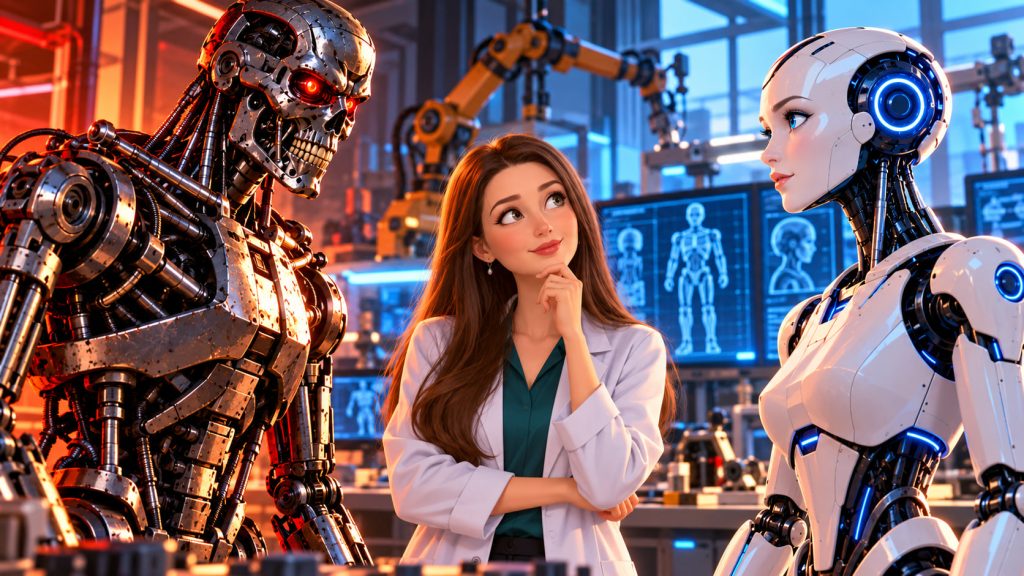
For decades, science fiction has imagined a future filled with intelligent humanoid robots. Machines that walk like humans, understand complex instructions, make independent decisions, and possess extraordinary physical strength.
The Terminator movies turned this idea into one of the most recognizable visions of artificial intelligence.
Today, that fictional world looks less distant than it once did.
Companies such as Boston Dynamics, Tesla, Figure AI, and Agility Robotics are developing increasingly sophisticated human-shaped machines.
Some can walk, carry objects, perform industrial tasks, and respond to changing environments.
But how close are we to creating a real Terminator, and what separates today’s humanoid robots from the machines portrayed in science fiction?
What Exactly Is a Humanoid Robot?
A humanoid robot is a machine designed to resemble aspects of the human body.
Most have a torso, arms, and a head-like structure. Some also have two legs and hands capable of manipulating objects.
The advantage of this design is compatibility with environments built for people.
Factories, homes, hospitals, and offices contain stairs, door handles, shelves, and equipment designed around human proportions.
A General-Purpose Robot would ideally perform many different activities without requiring a completely different machine for every task.
However, building a human-shaped body is considerably easier than reproducing the intelligence and physical adaptability of a human being.
Looking human and functioning like a human are two very different achievements.
How Advanced Are Humanoid Robots in 2026?
Modern humanoid robotics has progressed significantly.
Boston Dynamics unveiled the production version of its fully electric Atlas robot in January 2026.
The company began preparing industrial deployments, with Atlas robots entering training environments for automotive manufacturing.
Figure AI demonstrated its Figure 02 robot inside a BMW manufacturing facility.
During a 2025 deployment, Figure reported that its robots handled more than 90,000 sheet-metal components, contributing to the production of over 30,000 vehicles.
Agility Robotics has also moved beyond laboratory demonstrations.
Its Digit robots have handled more than 100,000 containers in a commercial warehouse deployment.
These achievements are important because they demonstrate practical industrial work rather than isolated demonstrations.
Nevertheless, successfully repeating a defined task is not equivalent to possessing human-level intelligence.
How Do Humanoid Robots Understand Their Surroundings?
Modern robots combine cameras, sensors, processors, and sophisticated software.
Computer Vision enables machines to identify objects, estimate distances, and interpret visual surroundings.
Advanced AI models can process spoken instructions and associate them with actions.
This combination is increasingly described as Embodied AI, where artificial intelligence interacts directly with the physical world.
For example, a robot might recognize a box, determine its location, and move it onto a shelf.
However, unfamiliar lighting, unexpected obstacles, or objects in unusual positions can still cause problems.
The physical world contains far more unpredictable situations than a carefully designed laboratory.
The Human Hand Is a Remarkable Engineering Challenge
One of the greatest obstacles to creating a truly capable humanoid is the human hand.
Human fingers can perform extraordinarily precise movements.
We can hold fragile glassware, tie shoelaces, use tools, and manipulate tiny objects.
These abilities depend on complex coordination between muscles, nerves, and sensory information.
Engineers describe independent movement capabilities as Degrees of Freedom.
The human hand has many such degrees of freedom, allowing complex combinations of movement.
Robotic hands are improving, but reproducing natural human Dexterity remains extremely difficult.
A robot that can lift a heavy container may still struggle to button a shirt.
Can Robots Learn Skills Like Humans?
Artificial intelligence is changing robotic training.
Researchers use Reinforcement Learning to help robots improve their behavior through feedback.
In virtual environments, robots can practice walking, balancing, and manipulating objects through repeated trials.
Some systems also learn from human demonstrations.
During Teleoperation, a human remotely controls a robot, providing examples of how tasks should be performed.
The resulting data can help train AI models.
However, observing human movements does not automatically teach a machine how much force to apply.
Successful manipulation also requires Tactile Sensing, which helps detect contact, pressure, and other physical interactions.
This remains a major technical challenge.
Why Walking Like a Human Is So Difficult
Human walking appears effortless, but it requires continuous adjustments.
Our brains constantly process information about balance, surface conditions, and body position.
Humanoid robots must reproduce these adjustments using sensors, control algorithms, and mechanical components called Actuators.
An actuator converts a control command into physical movement.
Modern robots can walk over uneven ground, recover from certain disturbances, and perform impressive coordinated movements.
Yet reliability is especially important outside demonstrations.
A heavy robot falling near a person could cause serious injury.
Consequently, engineers must evaluate not only movement performance but also what happens when systems fail.
Expert Perspective: What Robotics Still Cannot Reproduce
Rodney Brooks, a pioneering roboticist and co-founder of iRobot, has repeatedly highlighted the difficulty of achieving genuine human-level manipulation.
In a 2025 analysis of humanoid robotics, Brooks emphasized the importance of touch and force feedback.
His argument is that visual demonstrations alone cannot capture the rich sensory information humans use when handling objects.
This distinction explains why teaching robots to imitate human movements is not enough.
A truly versatile humanoid must understand physical contact, adapt to unexpected conditions, and operate safely around people.
Could a Robot Become as Intelligent as the Terminator?
The fictional Terminator combines advanced mobility with extraordinary perception, independent planning, and the ability to handle unfamiliar situations.
Today’s humanoid robots possess selected pieces of these capabilities.
Some can recognize objects, interpret instructions, navigate controlled environments, and complete repetitive tasks.
However, no publicly demonstrated humanoid system has matched the broad adaptability portrayed in the films.
Artificial intelligence can generate convincing language and solve complex digital problems without possessing reliable physical judgment.
An intelligent chatbot connected to a robotic body would not automatically become a fully autonomous machine.
The missing ingredient is dependable, flexible intelligence across an enormous range of real-world situations.
Could Humanoid Robots Become Dangerous?
Robots do not need fictional consciousness to create real safety risks.
Mechanical failures, software errors, cybersecurity vulnerabilities, and inappropriate deployment can already cause harm.
A separate concern involves Autonomous Weapons, systems designed to select and engage targets with varying degrees of human involvement.
Military automation raises questions about accountability, human control, and compliance with international humanitarian law.
However, industrial humanoid robots and autonomous weapons are not interchangeable technologies.
Most commercial humanoid development focuses on manufacturing, logistics, research, and practical assistance.
Safety engineering, access controls, testing, and human oversight remain essential as these machines become more capable.
When Could Humanoid Robots Become Common?
Humanoid robots are likely to become more visible in industrial settings before entering ordinary homes.
Factories and warehouses offer relatively structured environments where machines can practice specific tasks.
Households are considerably less predictable.
A domestic robot would need to handle clutter, pets, children, fragile objects, and constantly changing conditions.
Battery endurance, maintenance, affordability, and reliability also remain important barriers.
No scientifically established timeline exists for creating a fully autonomous, human-equivalent robot.
The first widely useful humanoid robots will probably be specialized assistants rather than mechanical copies of human beings.
The real revolution may not involve building a Terminator.
It may involve creating dependable machines capable of performing dangerous, repetitive, or physically exhausting work while humans retain meaningful control.
P.S. Humanity is drawing ever closer to a dangerous threshold. Killer drones guided by artificial intelligence are already taking to the skies, while robots are becoming increasingly intelligent and gaining ever greater degrees of freedom. If our civilization is to have a future, we must unite—putting an end to wars—and work together to oversee the development of these technologies. The prophets gave us two primary commandments: to love God and to love our neighbor. Let us, then, put at least the second of these into practice, and begin each day by asking ourselves: “What can I do today for those in need and for society as a whole?”
Interesting Facts
- Boston Dynamics introduced the fully electric production version of Atlas in January 2026.
- Figure 02 reportedly handled more than 90,000 components during its BMW factory deployment.
- Agility Robotics reported that Digit moved more than 100,000 containers in a commercial warehouse.
- The human hand contains 27 bones and an exceptionally complex system of muscles and tendons.
- Some robots train in simulated environments before performing tasks in the real world.
- A humanoid robot does not necessarily require a human-looking face to interact with people.
- Specialized industrial robots have performed automated manufacturing tasks for more than six decades.
- No existing humanoid robot has demonstrated all the abilities of the fictional Terminator.
Glossary
- General-Purpose Robot — A robot designed to perform a wide variety of tasks rather than one narrowly defined operation.
- Computer Vision — Technology that enables machines to analyze and interpret visual information.
- Embodied AI — Artificial intelligence integrated into a system that interacts with its physical surroundings.
- Degrees of Freedom — Independent movements available to a mechanical system.
- Dexterity — The ability to manipulate objects precisely and efficiently.
- Reinforcement Learning — A training method in which an AI system improves its actions through feedback.
- Teleoperation — Remote control of a robot by a human operator.
- Tactile Sensing — The detection of physical contact, pressure, and related mechanical information.
- Actuators — Components that convert control signals into physical movement.
- Autonomous Weapons — Weapon systems capable of performing certain targeting functions without continuous direct human control.