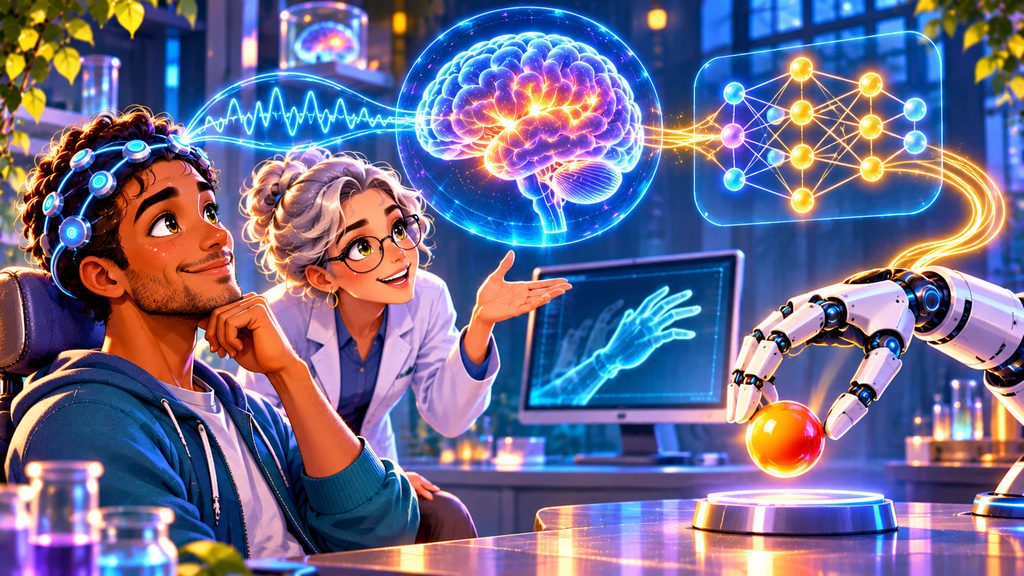
Imagine sitting in front of a computer and moving a cursor without touching a mouse. You simply imagine moving your hand, and the pointer begins to travel across the screen. Although this sounds futuristic, researchers have already demonstrated such abilities using technology that recognizes patterns of electrical activity in the brain.
The secret is not supernatural mind reading but an extraordinary partnership between neuroscience and artificial intelligence. Computers can learn to associate specific brain signals with intended movements, speech, and other measurable activities. Understanding this process reveals how technology is beginning to translate the brain’s complex electrical language into useful digital commands.
How Does the Human Brain Produce Electrical Signals?
The human brain contains approximately 86 billion neurons, specialized cells that communicate through electrical and chemical activity. When you think about moving your hand, groups of neurons in movement-related brain regions change their firing patterns. These signals normally travel through the nervous system to help coordinate muscle activity.
Neural communication involves brief electrical events called action potentials. Individual neurons can generate these rapid pulses, while larger populations produce complex patterns that change over time. The challenge for technology is not simply detecting electrical activity, but discovering which patterns correspond to meaningful actions.
How Do Scientists Capture Brain Signals?
One widely used technique is electroencephalography (EEG), which records changes in electrical potential through electrodes positioned on the scalp. These sensors detect combined activity from large populations of neurons, producing waveforms that scientists can analyze. EEG is particularly useful because it does not require surgery.
More detailed measurements are possible with implanted microelectrode arrays, which record activity close to individual nerve cells or small groups of neurons. Other implants rest on the brain’s surface and measure broader electrical patterns. The choice of sensor affects the amount of information available for analysis.
How Does Artificial Intelligence Learn to Understand These Signals?
A computer initially receives numerical measurements rather than recognizable thoughts or instructions. To interpret them, researchers use machine learning, a collection of techniques that discover relationships in data through repeated examples. The learning process often begins with a carefully designed experiment.
Suppose a participant repeatedly imagines moving their right hand while electrodes record brain activity. Researchers associate those recordings with the known task, creating labeled training data. The computer compares examples, identifies recurring characteristics, and adjusts its model to distinguish right-hand imagery from other recorded conditions.
After sufficient training, the model can analyze new recordings and estimate which learned action they most closely resemble. This process is called neural decoding. Its success depends on the quality of the recordings, the training procedure, and the consistency of the participant’s neural activity.
Why Are Brain Signals So Difficult to Recognize?
Unlike digital messages, brain signals do not arrive as clean sequences of letters or commands. Multiple neural processes occur simultaneously, and electrodes capture mixtures of useful information and unwanted interference. Eye movements, facial muscles, and electrical equipment can introduce additional noise, particularly in scalp recordings.
Researchers therefore use signal processing to filter recordings and identify useful characteristics, such as changes in rhythmic activity or patterns of neural firing. Some algorithms examine how signals vary across different recording locations, while others analyze how they evolve over milliseconds. Recognizing brain activity requires understanding patterns across both space and time.
Can a Computer Recognize an Imagined Movement?
One remarkable application involves motor imagery, the mental rehearsal of movement without actually performing it. Imagining a hand movement can change activity in brain networks associated with physical movement. With appropriate training, software can sometimes distinguish these patterns and convert them into commands.
For example, an experimental interface might associate imagining left-hand movement with moving a cursor left, while another mental task moves it right. More sophisticated implanted systems can estimate intended movement direction continuously. Such technologies have enabled research participants with paralysis to control cursors and robotic devices.
The accuracy varies considerably between systems and individuals. Some tasks require extensive practice, and the computer may occasionally mistake one intended command for another.
How Did Scientists Turn Imagined Handwriting Into Text?
In 2021, researchers demonstrated a brain-computer interface that decoded attempted handwriting in a person whose hand was paralyzed after a spinal cord injury. Instead of physically writing letters, the participant imagined making the familiar pen movements associated with each character. Implanted electrodes recorded movement-related neural activity.
A specially trained artificial neural network converted those patterns into text at approximately 90 characters per minute, achieving 94.1% accuracy before automatic correction. The experiment demonstrated that complex imagined movements can contain useful, distinguishable information. Neuroscientist Krishna Shenoy of Stanford University was among the researchers who helped develop this approach, which built on years of work decoding intended movement.
Can Artificial Intelligence Recognize Speech Signals?
Speaking involves coordinated activity across brain regions responsible for planning and producing speech. Even when paralysis prevents someone from speaking intelligibly, some neural activity associated with attempted speech may remain measurable. Researchers can train algorithms to associate this activity with words or speech sounds.
In a 2023 study, scientists decoded attempted speech from a participant with amyotrophic lateral sclerosis at an average rate of 62 words per minute. With a vocabulary containing 125,000 words, the system had a word error rate of 23.8%. This demonstrated impressive communication speed while also showing that accurate decoding remains a technical challenge.
By 2025, another experimental speech neuroprosthesis could generate synthesized speech continuously from neural activity, processing signals in successive 80-millisecond segments. These developments are particularly valuable for people who have lost the ability to communicate through ordinary speech.
Why Must Brain-Decoding Systems Keep Learning?
Neural recordings can change because of electrode movement, biological variations, attention, fatigue, or differences between recording sessions. This phenomenon is often called signal drift. A model trained under one set of conditions may become less accurate when the signals change.
Researchers address this through recalibration, adaptive algorithms, and more robust training methods. Some systems also provide closed-loop feedback, allowing users to see the results of decoded actions and adjust their neural strategies. Over time, the person and the computer can learn to work together more effectively.
Can Technology Read Someone’s Private Thoughts?
Current brain-decoding systems work best when trained to recognize specific activities under defined conditions. A model that recognizes imagined hand movements cannot automatically decode private memories, beliefs, or arbitrary conversations. Its output depends on the recorded signals and what the algorithm has learned to interpret.
Nevertheless, neural recordings deserve strong privacy protections because they contain sensitive biological information. Secure storage, informed consent, and control over data access are essential as these technologies develop. The purpose of neural decoding is to turn carefully measured brain activity into useful information, not to grant unrestricted access to someone’s mind.
The most promising applications may help people communicate, operate assistive technology, and regain independence after neurological injuries. As algorithms improve, brain-controlled devices could become easier to use and more responsive. If a computer could reliably recognize one kind of brain signal from you, what would you want it to control? Share your ideas in the comments.
Interesting Facts
- The human brain contains approximately 86 billion neurons that participate in complex communication networks.
- EEG allows researchers to measure electrical brain activity without surgery.
- In 2021, an implanted interface decoded imagined handwriting at approximately 90 characters per minute.
- A 2023 brain-interface experiment translated attempted speech at an average of 62 words per minute.
- Some neural decoding algorithms analyze electrical activity in intervals measured in milliseconds.
- Brain-computer interfaces often require both the user and the software to undergo training.
- Algorithms trained to recognize specific brain activities cannot automatically interpret every thought.
Glossary
- Neurons — Specialized nerve cells that communicate through electrical and chemical signals.
- Action Potentials — Brief electrical pulses that transmit information along nerve cells.
- Electroencephalography (EEG) — A noninvasive method of recording electrical brain activity using scalp electrodes.
- Microelectrode Arrays — Collections of tiny electrodes used to measure neural signals near their sources.
- Machine Learning — Computational methods that discover patterns from examples and use them to make predictions.
- Training Data — Recorded examples used to teach an algorithm to recognize particular patterns.
- Neural Decoding — The process of estimating actions, intentions, or other information from recorded nervous system activity.
- Signal Processing — Mathematical techniques used to filter, transform, and analyze recorded signals.
- Motor Imagery — Mentally rehearsing a movement without physically performing it.
- Speech Neuroprosthesis — A technology that converts speech-related neural activity into text or synthesized speech.
- Signal Drift — Changes in recorded neural patterns that can affect a decoding system’s performance.
- Closed-Loop Feedback — A process in which information about a system’s output is used to adjust subsequent actions or responses.