Mathematics

PageRank Algorithm: How Mathematics Helped Make Google Great
Smart Technology News Mathematics

PageRank Algorithm: How Mathematics Helped Make Google Great

In the late 1990s, the internet was growing faster than anyone could organize it. Millions of web pages appeared online, but finding the best information was frustrating. Early search engines often ranked pages mainly by how many times a keyword appeared on a page. That made results easy to manipulate. A low-quality page could repeat a word many times and appear higher than a genuinely useful source. Then came Google, built around a powerful mathematical idea called PageRank. Instead of looking only at words on a page, PageRank analyzed the structure of the web itself. It treated links between pages as signals of importance. If many valuable websites linked to one page, that page was probably important too. This simple but brilliant idea changed online search. Google did not become great only because it indexed more pages. It became great because it ranked information better.


Topology Explained: Why a Coffee Cup and a Donut Are the Same Shape in Mathematics
Science Be Smart Mathematics

Topology Explained: Why a Coffee Cup and a Donut Are the Same Shape in Mathematics

In everyday life, a coffee cup and a donut are clearly different objects. One holds tea or coffee, the other is something you eat. They have different materials, functions, colors, and sizes. But in topology, one of the most fascinating branches of mathematics, they can be considered the same kind of shape. This strange idea comes from the way topology studies objects. Instead of focusing on exact measurements, angles, distances, or rigid geometry, topology asks what remains unchanged when a shape is stretched, bent, twisted, or smoothly deformed. If one object can be transformed into another without cutting, tearing, gluing, or creating new holes, topologists may treat them as equivalent. That is why a cup with one handle and a donut are mathematically similar: both have exactly one hole. This simple example opens the door to a completely different way of thinking about space, form, continuity, and hidden structure.

Random Walks: How a Drunk Person “Finds” the Way Home in Mathematics
Science Be Smart Mathematics

Random Walks: How a Drunk Person “Finds” the Way Home in Mathematics

A random walk is one of the simplest and most powerful ideas in probability theory. It describes a path made of many small steps, where each step is chosen randomly. The classic example is the drunkard’s walk: imagine a person leaving a bar and taking one step left, right, forward, or backward without a clear plan. Where will they end up after many steps? This may sound like a funny mathematical story, but random walks are deeply important in science. They help explain how molecules move, how stock prices fluctuate, how animals search for food, how diseases spread, how algorithms explore data, and how information travels through networks. The key idea is simple: randomness at the small scale can produce patterns at the large scale. Even when each step is unpredictable, the overall behavior can often be described with beautiful mathematical precision.

Fibonacci Numbers: The Mathematical Pattern Hidden Throughout Nature
Science Be Smart Mathematics

Fibonacci Numbers: The Mathematical Pattern Hidden Throughout Nature

At first glance, the Fibonacci sequence appears to be a simple list of numbers. Yet this remarkable mathematical pattern has fascinated scientists, mathematicians, artists, architects, and nature enthusiasts for centuries. From the arrangement of sunflower seeds to the spirals of galaxies, Fibonacci numbers seem to appear in surprising places throughout the natural world. While the sequence itself is mathematically straightforward, its connections to geometry, biology, computer science, and even financial modeling have made it one of the most famous numerical patterns ever discovered. This article explores what Fibonacci numbers are, how they were discovered, where they appear in nature, and why they continue to inspire scientific research today.

Exact Sciences: The Foundation of Modern Civilization
History Science Physics

Exact Sciences: The Foundation of Modern Civilization

From smartphones and satellites to life-saving medicines and space exploration, nearly every technological achievement of modern society is built upon the exact sciences. These disciplines seek to understand the universe through precise measurements, logical reasoning, mathematical models, and repeatable experiments. Unlike fields that often rely on subjective interpretation, the exact sciences strive to produce objective knowledge that can be tested, verified, and refined. The exact sciences have transformed humanity's understanding of nature, enabling breakthroughs that once seemed impossible. They allow engineers to design bridges that withstand earthquakes, astronomers to predict planetary motions, physicists to explore the smallest particles of matter, and mathematicians to solve problems that shape the digital world. This article explores what the exact sciences are, why they matter, how they differ from other scientific disciplines, and why they continue to drive innovation across nearly every aspect of modern life.

The Distribution of Prime Numbers: Understanding the Riemann Hypothesis
Science Be Smart Mathematics

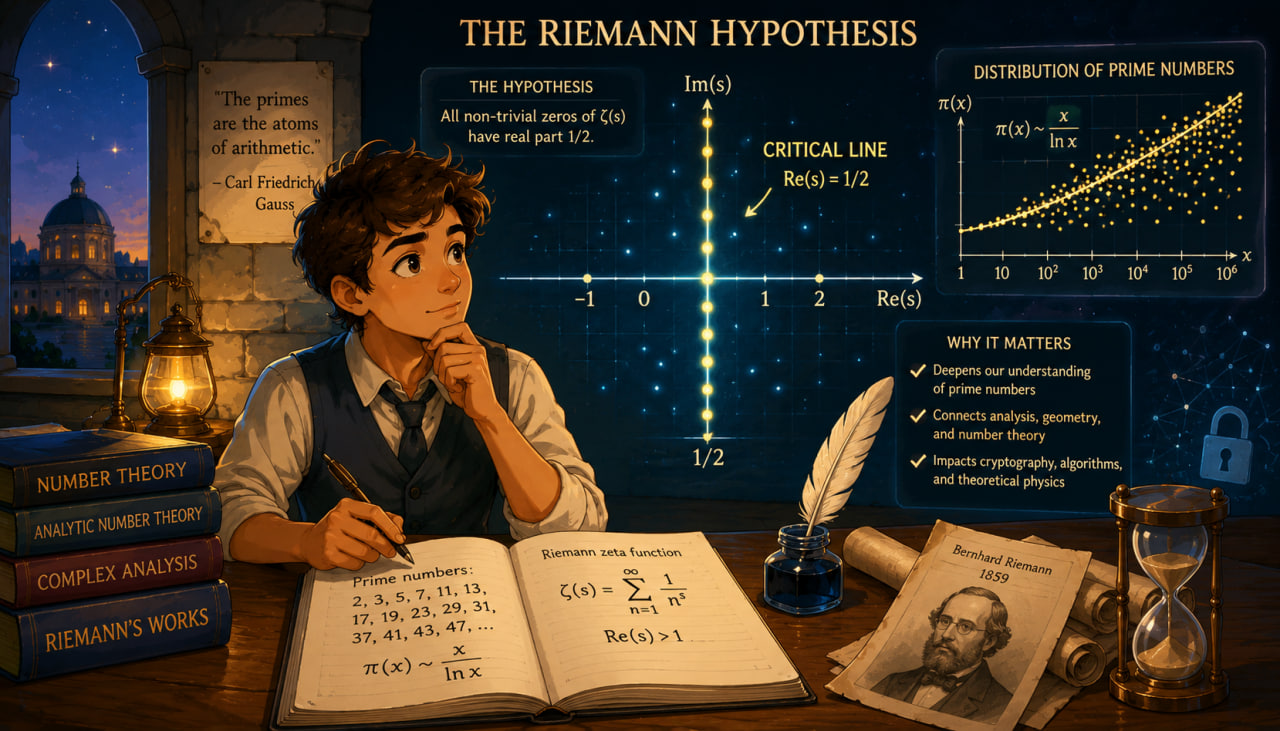
The Distribution of Prime Numbers: Understanding the Riemann Hypothesis

Prime numbers are among the most fundamental objects in mathematics. They are the "building blocks" of whole numbers because every positive integer can be expressed as a unique product of prime numbers. At first glance, primes appear to be scattered randomly along the number line. Sometimes they occur close together, while at other times enormous gaps separate them. For more than 160 years, mathematicians have tried to answer one of the greatest unanswered questions in mathematics: Is there a hidden pattern behind the distribution of prime numbers? This question lies at the heart of the Riemann Hypothesis, a mathematical conjecture that has influenced number theory, cryptography, computer science, and mathematical physics. Although millions of zeros have been tested and found to agree with the hypothesis, no complete proof or counterexample has ever been discovered. Today, the Riemann Hypothesis remains one of the most famous unsolved problems in mathematics and is one of the seven Millennium Prize Problems, carrying a prize of $1 million for a correct proof. This article explains what prime numbers are, what the Riemann Hypothesis states, why it matters, and how it continues to shape modern mathematics.

Gödel's Incompleteness Theorems: Why Every Axiomatic System Contains Truths That Cannot Be Proven
Science Be Smart Mathematics

Gödel's Incompleteness Theorems: Why Every Axiomatic System Contains Truths That Cannot Be Proven

Mathematics is often viewed as the ultimate example of certainty. Starting with a small set of axioms and applying strict logical rules, mathematicians prove theorems that remain true forever. For centuries, many believed it might one day be possible to build a complete mathematical system capable of proving every true statement. That hope changed dramatically in 1931, when Austrian logician Kurt Gödel published one of the most influential papers in the history of mathematics and philosophy. His Incompleteness Theorems demonstrated that any sufficiently powerful formal system contains true mathematical statements that cannot be proven within the system itself. Gödel's discovery did not show that mathematics is flawed. Instead, it revealed something even more fascinating: every powerful logical system has fundamental limits, no matter how carefully it is constructed. This article explains what Gödel's Incompleteness Theorems say, why they transformed mathematics, and how they continue to influence logic, computer science, philosophy, and artificial intelligence.