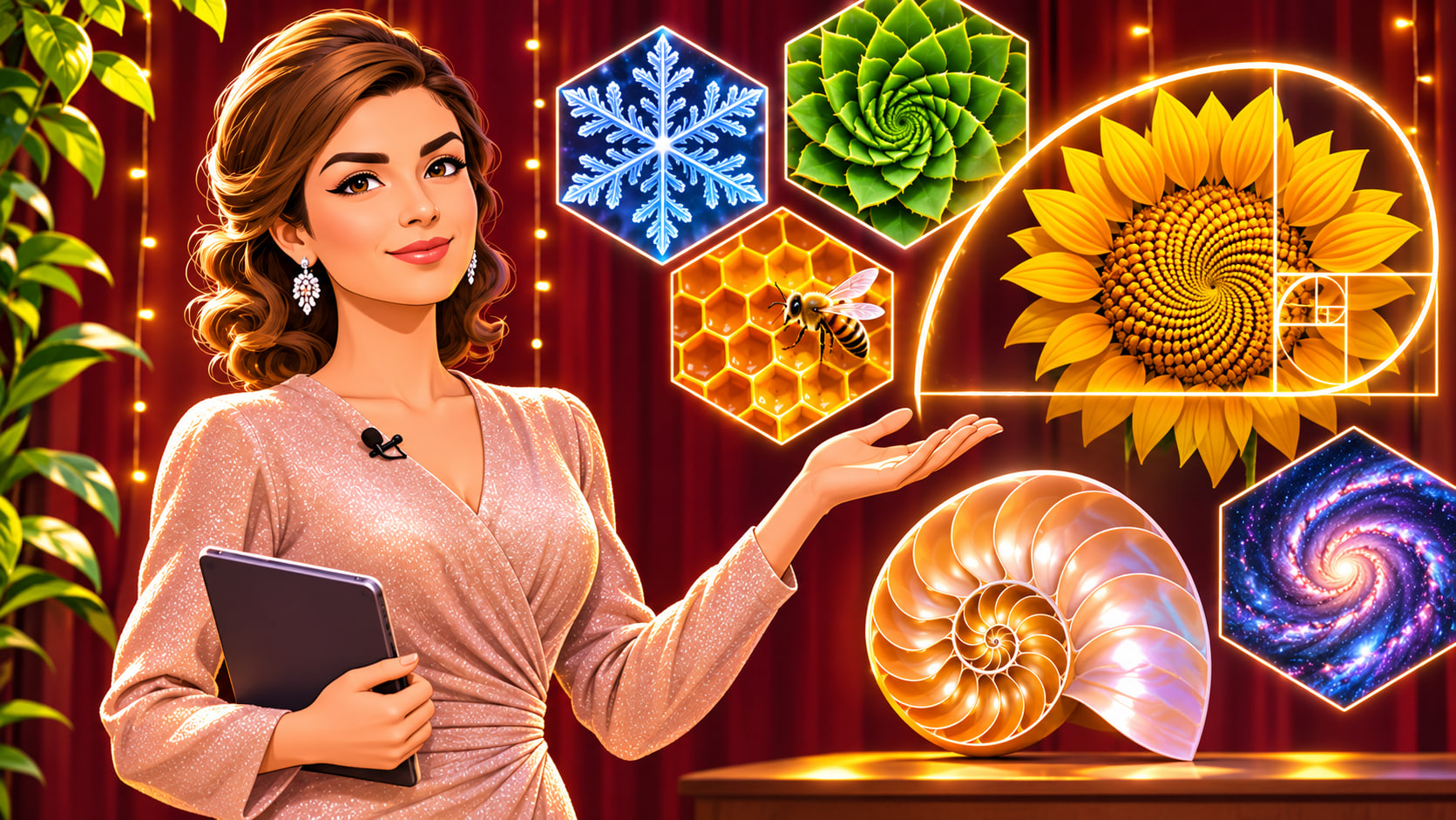
Look closely at a snowflake, a sunflower, or a honeycomb, and something remarkable emerges. Their shapes seem carefully designed, with repeating patterns, precise angles, and surprising numerical relationships. Even the movement of distant planets follows equations that scientists can use to predict their positions years into the future.
A pizza, a spinning wheel, and the orbit of a planet have something obvious in common: circles. But what connects them to random numbers, the familiar bell curve, or the probability that a dropped needle crosses a line? Surprisingly, the same mathematical constant appears in all these situations.
From the dimensions of a doorway to the spacing of columns and the proportions of an entire façade, buildings depend on numerical relationships. Among the most famous of these relationships is the golden ratio, a mathematical proportion often associated with harmony, balance, and visual beauty.
Mathematics is the language in which modern physics is written. From the motion of planets to the behavior of electrons, from black holes to quantum fields, some of the most successful scientific theories are expressed through mathematical structures.
In a zero-sum situation, the total amount of gain and loss is fixed. If one player gains 10 points, another player loses 10 points. The net result is zero.
You pick the shortest line. Then someone ahead needs a price check. Another customer pays with a complicated method. Meanwhile, the line next to you moves twice as fast.
Transcendental numbers are among the most fascinating objects in mathematics. They are real or complex numbers that cannot be produced as solutions to any polynomial equation with integer coefficients. That sounds technical at first, but the idea is surprisingly powerful: some numbers are so mathematically “wild” that no finite algebraic equation can capture them. Famous numbers such as π and e are transcendental. They appear everywhere in mathematics, physics, engineering, geometry, probability, and calculus. Yet they do not behave like ordinary whole numbers, fractions, square roots, or even many irrational numbers. Transcendental numbers reveal that the number system is far richer than everyday arithmetic suggests. They also show that infinity is not just a philosophical idea, but a precise mathematical landscape filled with hidden structure.