
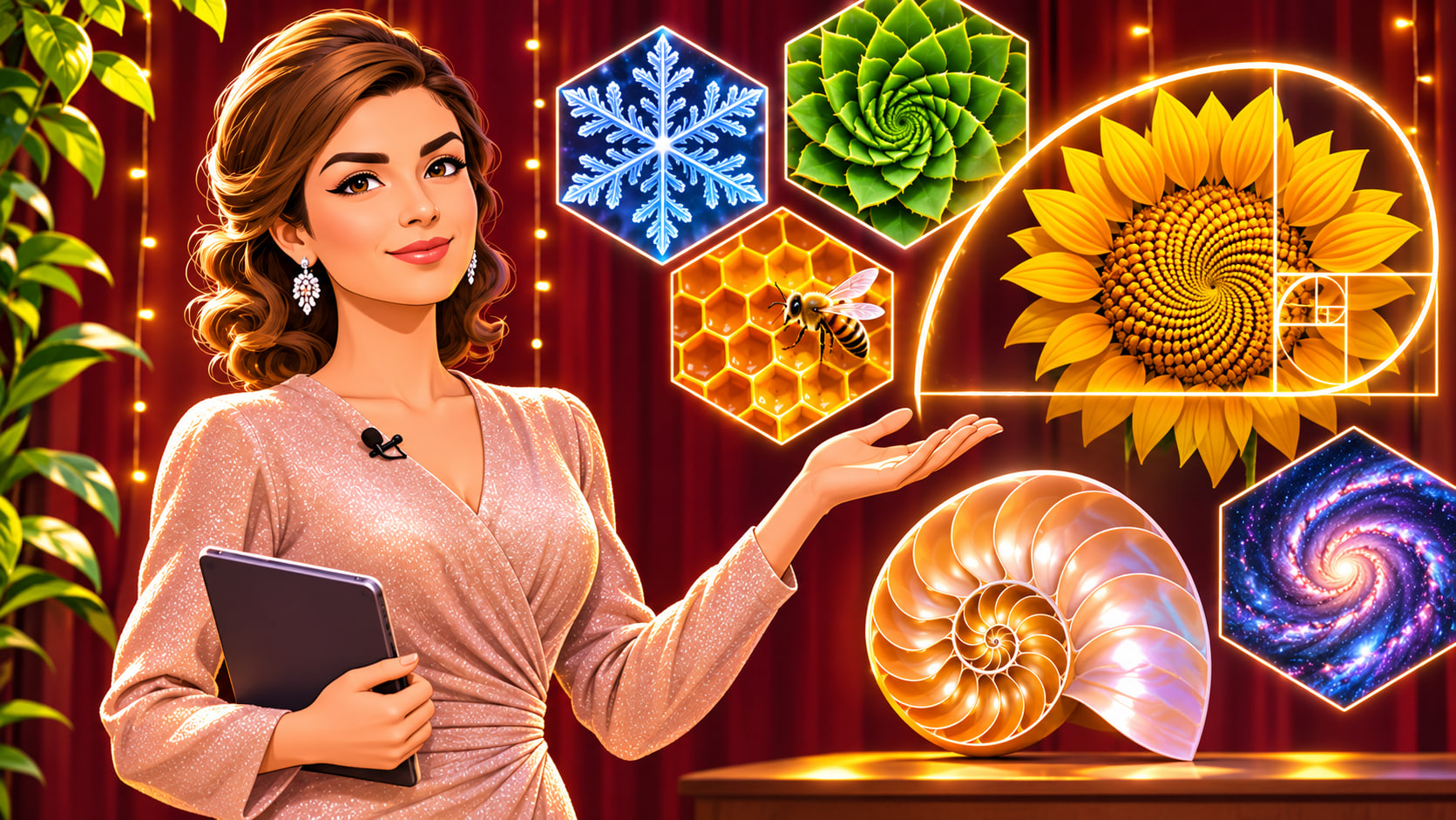
Look closely at a snowflake, a sunflower, or a honeycomb, and something remarkable emerges. Their shapes seem carefully designed, with repeating patterns, precise angles, and surprising numerical relationships. Even the movement of distant planets follows equations that scientists can use to predict their positions years into the future.
Nature does not need a calculator to create these patterns. They arise from physical forces, chemical interactions, and biological processes that obey mathematical relationships. From microscopic crystals to enormous galaxies, mathematics provides a powerful language for explaining how the natural world works.
Why Do Snowflakes Have Six Sides?
Every snowflake begins when water molecules form an ice crystal in cold atmospheric conditions. In ordinary snow-forming ice, the molecules arrange themselves into a hexagonal crystal lattice, creating a structure with sixfold symmetry. This molecular organization explains why snow crystals commonly develop six sides or six branching arms.
The intricate details depend on temperature, humidity, and the crystal's journey through the atmosphere. Its arms grow under similar environmental conditions, producing strikingly symmetrical shapes. However, small differences in growth mean that natural snowflakes are not perfectly identical geometric objects.
A snowflake's geometry emerges from the physical structure of water molecules, rather than from a mysterious preference for beautiful shapes.
Why Do Bees Build Hexagonal Honeycombs?
Honeycombs provide another extraordinary example of mathematical efficiency. Bees construct repeating six-sided cells that fit together without leaving gaps. This arrangement creates a strong, compact structure capable of storing honey and supporting developing bees.
The mathematical explanation involves the honeycomb theorem, which establishes that a regular hexagonal arrangement minimizes total boundary length when dividing a flat plane into regions of equal area. Mathematician Thomas Hales completed a proof of this long-standing problem in 1999.
For a given cell area, shorter walls mean less material is needed. The theorem helps explain why hexagons are so efficient, although real honeycomb construction also involves wax properties, temperature, and bee behavior. Mathematical optimization and biological construction work together to produce the familiar pattern.
Why Do Sunflowers Follow the Fibonacci Sequence?
Examine the center of a sunflower, and you may notice two families of interlocking spirals. Count the spirals in opposite directions, and the results frequently correspond to neighboring numbers in the Fibonacci sequence, such as 34 and 55. Each number in this sequence is the sum of the previous two.
A related pattern involves the golden angle, approximately 137.5 degrees. In many plants, successive leaves or florets develop at angular separations close to this value. Such arrangements distribute growing structures around a central point without repeatedly placing them in the same direction.
This mathematical relationship helps explain efficient packing and exposure to resources. Not every sunflower follows identical Fibonacci counts, however, because biological growth introduces natural variation.
How Do Planets Follow Precise Mathematical Laws?
Planetary motion once appeared almost impossible to predict accurately. In the early seventeenth century, Johannes Kepler discovered three relationships that transformed astronomy. His Kepler's laws describe elliptical planetary orbits, changing orbital speeds, and the relationship between orbital distance and period.
One particularly elegant result states that the square of a planet's orbital period is proportional to the cube of its orbit's semimajor axis when planets orbit the same dominant central mass. This explains why distant planets require much longer to complete a revolution around the Sun.
Isaac Newton later showed how these relationships follow from gravitational physics under idealized conditions. Real planets also influence one another, producing small deviations that astronomers calculate using more detailed models.
Why Does Gravity Follow an Inverse-Square Law?
Imagine moving twice as far from a small light source. Its illumination becomes approximately four times weaker because the same energy spreads across a larger spherical surface. This relationship is called the inverse-square law.
Newtonian gravity follows a similar mathematical pattern: the gravitational force between two point masses decreases with the square of their separation. Double the distance, and the force becomes one-quarter as strong.
The geometry explains the recurring number two. A sphere's surface area increases with the square of its radius, so effects spreading uniformly through three-dimensional space often produce inverse-square relationships. A simple geometric rule connects the brightness of distant stars with the mathematics of gravitational attraction.
Why Do Blood Vessels Branch in Mathematical Patterns?
Inside the human body, arteries repeatedly divide into smaller vessels, creating a vast transportation network. Their branching is not entirely random. Vessel dimensions often reflect a balance between the energy needed to pump blood and the biological cost of maintaining the network.
In 1926, physiologist Cecil Murray developed a mathematical model now known as Murray's law. Under idealized flow conditions, it predicts that the cube of a parent vessel's radius equals the sum of the cubes of its daughter vessels' radii.
This relationship describes efficient branching in many vascular networks. Actual vessels may deviate because blood flow is pulsatile, tissues have different needs, and living structures develop under multiple constraints. Nevertheless, the principle demonstrates how mathematics can explain aspects of biological efficiency.
Can Mathematics Explain Animal Stripes and Spots?
The stripes of a zebra and the spots of a leopard look like artistic decorations, yet biological patterns can emerge through interactions among cells and signaling substances. One influential explanation involves reaction–diffusion systems, in which chemicals interact locally while spreading through developing tissue.
In 1952, mathematician Alan Turing published a groundbreaking theoretical investigation of this process. He demonstrated mathematically how chemical reactions combined with diffusion could transform initially uniform conditions into stable spatial patterns.
Such mechanisms help researchers investigate pigmentation, biological development, and other forms of natural pattern formation. Not every stripe or spot follows a simple Turing model, but his work revealed that intricate organization can arise from surprisingly compact mathematical rules.
Why Do Trees, Rivers, and Lightning Look Similar?
A tree divides into branches, a river gathers tributaries, and lightning forms irregular branching paths. Although these systems operate through different physical processes, their shapes can display related geometric properties.
Mathematicians study such structures using fractal geometry. A fractal exhibits forms of repeating complexity across different scales, often described through self-similarity. Smaller branches of a tree may resemble the broader organization of the entire crown.
Natural objects are not infinitely repeating mathematical fractals. Their patterns exist over limited ranges of scale, shaped by growth, erosion, electrical discharge, and other processes. The similarity arises because branching and repeated local interactions are common solutions to very different natural problems.
Are Mathematical Laws in Nature Truly Exact?
Mathematical equations can be exact, while their application to the real world depends on assumptions and measurement precision. An ideal circle has a precisely defined relationship between circumference and diameter, but a real circular object always contains microscopic imperfections.
Likewise, gravitational equations can predict planetary motion with extraordinary accuracy, while biological relationships are often statistical or approximate. Scientists use mathematical models to identify the most important mechanisms without claiming that every detail is perfectly predictable.
The remarkable discovery is not that nature always creates flawless shapes. It is that complicated natural processes repeatedly produce understandable mathematical relationships. Which pattern fascinates you most: snowflakes, planetary orbits, sunflower spirals, or the branching structures of living organisms? Share your thoughts in the comments.
P.S. I could never have imagined that my research—which began with the scientific facts about the universe presented in A. Novykh’s Sensei of Shambhala book series—would lead me to so many astonishing discoveries about the world we live in. It revealed just how complex everything is; for instance, we go about our lives completely unaware that billions of different processes are taking place within our own bodies at every single moment. If you, like me, are interested in the path of self-discovery, science, and love, I highly recommend reading these books, exploring the facts they contain, and trying out the practices they describe. By doing so—without even leaving your home—you can discover for yourself that God exists, that there is a soul within you, and why all of God’s messengers taught us the most important thing of all: love for God and for one’s neighbor.
Interesting Facts
- Snow crystals commonly display sixfold symmetry because of the molecular arrangement of ordinary ice.
- Mathematician Thomas Hales proved the honeycomb theorem in 1999, solving a problem considered for centuries.
- Sunflower spiral counts frequently include consecutive Fibonacci numbers such as 34 and 55.
- The golden angle measures approximately 137.5 degrees and appears in many botanical growth patterns.
- Under Newtonian gravity, doubling the distance between two point masses reduces their gravitational attraction to one-quarter.
- Alan Turing demonstrated in 1952 how interacting and diffusing chemicals could spontaneously generate spatial patterns.
- Branching patterns in trees, rivers, and blood vessels can exhibit mathematical similarities despite having different physical origins.
Glossary
- Hexagonal Crystal Lattice — A molecular arrangement with sixfold geometric symmetry, characteristic of ordinary ice.
- Honeycomb Theorem — The mathematical result establishing the minimum-perimeter arrangement for partitioning a plane into equal-area regions.
- Fibonacci Sequence — A number sequence in which each term equals the sum of the two preceding terms.
- Golden Angle — An angle of approximately 137.5 degrees associated with the golden ratio and many plant growth patterns.
- Kepler's Laws — Three mathematical relationships describing planetary orbits, orbital speeds, and periods.
- Inverse-Square Law — A relationship in which a physical quantity decreases proportionally to the square of the distance.
- Murray's Law — A mathematical model describing efficient branching relationships in fluid transportation networks.
- Reaction–Diffusion Systems — Models describing substances that undergo chemical reactions while spreading through space.
- Fractal Geometry — The mathematical study of complex structures exhibiting repeating characteristics across different scales.
- Self-Similarity — A property in which smaller parts of a structure resemble its larger overall form.
- Mathematical Model — A representation of a real process using equations, assumptions, and mathematical relationships.