Skip to content
Science Observer Science Observer

Useful articles about our universe and science

  • Home
  • Calculators
    • Artificial intelligence
      • AI Automation ROI Calculator
      • AI Ethics & Governance Risk Checker
      • AI Hallucination Risk Estimator
      • AI Model Training Cost Calculator
      • AI Time Saved Calculator
      • AI Token & Cost Calculator
      • Data Transfer Time Calculator
      • Internet Data Usage Calculator
    • Bioengineering
      • Bacterial Growth Calculator (Doubling Time)
      • DNA Melting Temperature (Tm) Calculator
      • Genetic Trait Probability Calculator
      • Neural Signal Latency Calculator
      • Neural Signal Speed Calculator
      • Punnett Square Calculator
    • Hi-tech
      • GPU Training Time Calculator
      • Screen PPI Calculator
      • Smart Home Energy Savings Calculator
    • Science
      • Capacitor Calculator (C, Q, V, Energy, RC)
      • Coulomb’s Law Calculator
      • Dew Point Calculator
      • Dilution Calculator (C₁V₁ = C₂V₂) !
      • Doppler Effect Calculator (Sound)
      • Electric Power Calculator
      • Exponential Growth Calculator
      • Free Fall Time Calculator
      • Gravitational Force Calculator
      • Heat Capacity Calculator (Q = m·c·ΔT)
      • Heat Conduction Calculator (Fourier’s Law)
      • Historical Time Gap Calculator
      • Ideal Gas Law Calculator (pV = nRT)
      • Kinetic Energy Calculator
      • Magnetic Field Strength Calculator
      • Momentum & Impulse Calculator!
      • Newton’s Second Law Calculator (F = m·a)
      • pH Calculator
      • pH Dilution Calculator
      • Pressure Calculator
      • Projectile Motion Calculator
      • Radioactive Half-Life Calculator
      • Research Impact Projection Calculator
      • Resistors in Series / Parallel Calculator
      • Science Unit Converter
      • Sound Distance Calculator (Thunder)
      • Sound Level (dB) Calculator
      • Time Dilation Calculator
      • Torque Calculator
      • Underwater Pressure Calculator
      • VO₂max Estimate Calculator
      • Wave Calculator
    • Universe
      • Age on Other Planets Calculator
      • Asteroid Impact Energy Calculator
      • Black Hole Radius Calculator
      • Black Hole Survival Distance Calculator
      • Cosmic Lookback Time Calculator
      • Escape Velocity Calculator
      • Horizon Distance Calculator
      • How Many Stars Can You See?
      • Intergalactic Travel Energy Calculator
      • Light Travel Time Calculator
      • Mars vs Earth Day Length Calculator
      • Orbit Speed & Period Calculator
      • Planet Gravity Comparison Calculator
      • Rocket Delta-V Estimator
      • Satellite Signal Delay Calculator
      • Space Travel Time Calculator
      • Telescope Resolution Calculator
      • Tidal Force Comparison Calculator
      • Time to Reach a Planet Calculator
      • Weight on Other Planets Calculator
      • What If Earth Stopped Spinning Calculator
      • What If the Sun Disappeared Timer
      • What If You Fell Into Jupiter Calculator

Be Smart

  • Home
  • Be Smart
  • Page 3
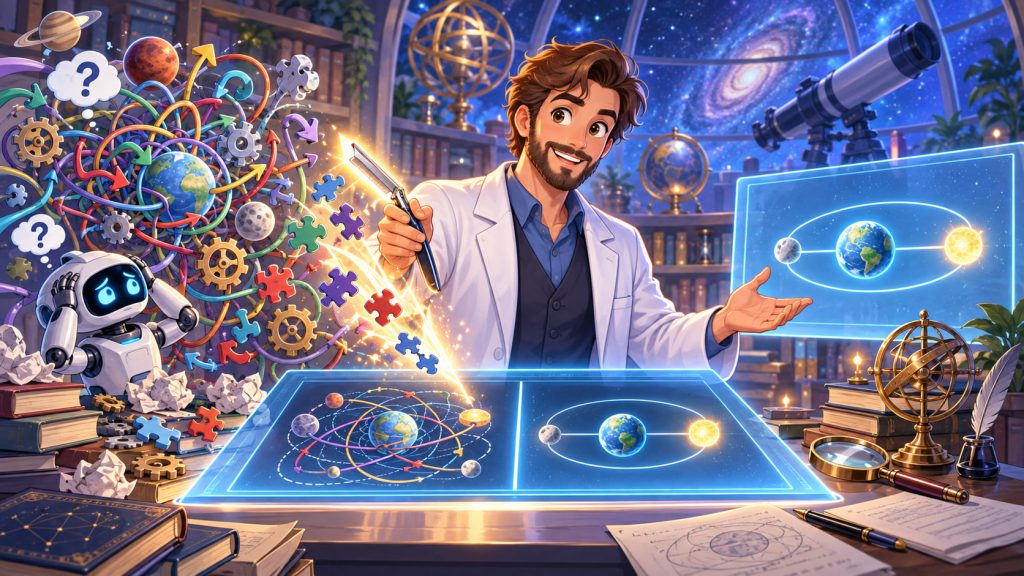
Occam’s Razor: Why the Simpler Explanation Is Often the Better One
Posted inBe Smart Science What if?

Occam’s Razor: Why the Simpler Explanation Is Often the Better One

When several explanations can account for the same facts, people often prefer the simplest one. This idea is commonly called Occam’s Razor. It is usually summarized as: Do not multiply…
Posted by deka September 18, 2026
The Problem of Induction: Why We Cannot Prove the Sun Will Rise Tomorrow
Posted inBe Smart Science What if?

The Problem of Induction: Why We Cannot Prove the Sun Will Rise Tomorrow

Every morning of our lives, the Sun appears in the sky. It has done so for generations, centuries, and far longer than human history. So it feels completely reasonable to…
Posted by deka September 18, 2026
Kuhn’s Paradigm: How Scientific Revolutions Change the Way We See the World
Posted inBe Smart History Science

Kuhn’s Paradigm: How Scientific Revolutions Change the Way We See the World

Science is often described as a steady accumulation of facts. New discoveries are added, old mistakes are corrected, and knowledge gradually becomes more accurate. But philosopher and historian of science…
Posted by deka September 18, 2026
Demarcation: How to Tell Real Science from Pseudoscience
Posted inBe Smart KnowHow Science

Demarcation: How to Tell Real Science from Pseudoscience

Science has enormous cultural authority. Medicines, satellites, computers, vaccines, weather forecasting, genetics, and modern engineering all depend on scientific methods. Because science is trusted, many weak or misleading ideas try…
Posted by deka September 18, 2026
Zero-Sum Games: The Mathematics of Conflict, Competition, and Compromise
Posted inBe Smart Mathematics Science

Zero-Sum Games: The Mathematics of Conflict, Competition, and Compromise

Some conflicts seem simple: if one side wins, the other must lose. That idea lies at the heart of zero-sum games, one of the most important concepts in game theory.…
Posted by deka September 18, 2026
What Can You Trust AI With — and What Should You Never Trust It With?
Posted inAI AI & Ethics Be Smart

What Can You Trust AI With — and What Should You Never Trust It With?

Artificial intelligence has become part of everyday life. People use AI to write emails, summarize documents, generate ideas, translate text, analyze data, plan trips, explain difficult concepts, and even help…
Posted by deka September 18, 2026
Insurance and Actuarial Mathematics: How Mathematicians Calculate the Risks of Life
Posted inBe Smart Mathematics What if?

Insurance and Actuarial Mathematics: How Mathematicians Calculate the Risks of Life

Insurance may look simple from the outside. A customer pays a premium, and the insurer promises financial protection if something goes wrong. Behind that simple exchange is a highly sophisticated…
Posted by deka September 10, 2026
Bayes’ Theorem in Medicine: Why a Positive Test for a Rare Disease Is Not Always a Diagnosis
Posted inBe Smart News Science

Bayes’ Theorem in Medicine: Why a Positive Test for a Rare Disease Is Not Always a Diagnosis

A positive medical test can be frightening. Many people naturally assume that if a test comes back positive, the disease is almost certainly present. But that is not always true.…
Posted by deka September 10, 2026
The Streisand Effect: How Trying to Hide Information Can Make It Spread
Posted inBe Smart News Science

The Streisand Effect: How Trying to Hide Information Can Make It Spread

The internet has created a strange communication paradox: sometimes the fastest way to make information famous is to try to suppress it. This phenomenon is known as the Streisand Effect.…
Posted by deka September 10, 2026
The Monty Hall Paradox: Why Switching Doors Doubles Your Chance of Winning
Posted inBe Smart News Science

The Monty Hall Paradox: Why Switching Doors Doubles Your Chance of Winning

The Monty Hall paradox is one of the most famous probability puzzles ever created. It looks simple, feels obvious, and yet produces an answer that many people initially reject. Imagine…
Posted by deka September 10, 2026

Posts pagination

Previous page 1 2 3 4 5 … 45 Next page
Recent Posts
  • The History of the Flashlight: From Its Invention in 1899 to Cutting-Edge Technology in 2026
  • How Do Flexible and Foldable Displays Work? The Technology Behind Bendable Screens
  • How Quantum Sensors Could Revolutionize Measurement Technology
  • How Augmented Reality Could Transform Everyday Life: The Future of AR Technology
  • The History of the Internet: From Military Research Networks to a Global Communication System
Categories
  • AI
  • AI & Ethics
  • Be Smart
  • Bioengineering
  • Challenges
  • Cosmic Innovations
  • Earth & Moon
  • Hi-Tech
  • History
  • Inventions
  • KnowHow
  • Mathematics
  • Neuro-Tech
  • New Discoveries
  • News
  • Physics
  • Science
  • Smart Home
  • Smart Technology
  • Solar System
  • Space Stories
  • Star Wars
  • Tesla&Co
  • Universe
  • What if?
Copyright 2026 — Science Observer. All rights reserved. Bloghash WordPress Theme
Scroll to Top