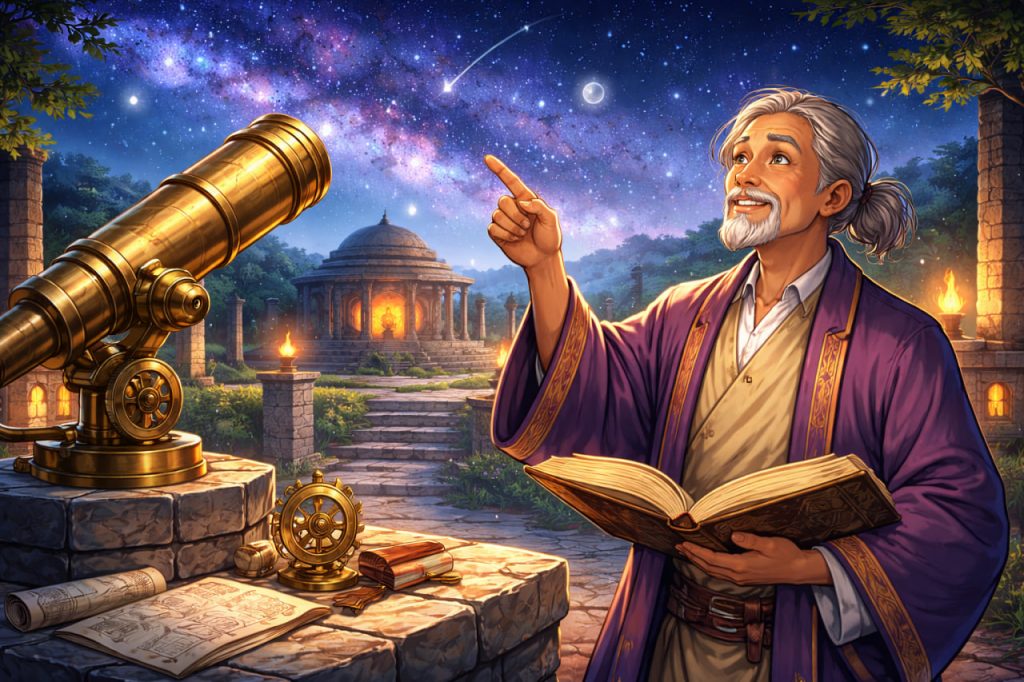
Astronomy is one of the oldest sciences in human history, born from humanity’s natural curiosity about the night sky. For thousands of years, people observed the movements of stars, planets, and the Moon, seeking to understand patterns that governed time, seasons, and navigation. Early civilizations built monuments aligned with celestial events and developed calendars based on astronomical observations. Over centuries, these observations evolved into scientific theories that transformed our understanding of the universe. Today, astronomy combines advanced telescopes, satellites, and space probes to study objects billions of light-years away. The long journey from simple skywatching to modern astrophysics reflects humanity’s enduring desire to explore the cosmos and understand our place within it.
Ancient Observations and Early Sky Knowledge
Long before telescopes existed, ancient cultures carefully studied the sky using only their eyes and simple instruments. Civilizations in Mesopotamia, Egypt, China, and Mesoamerica recorded the positions of stars and tracked the movements of the Sun and Moon. These observations helped predict seasonal changes, agricultural cycles, and eclipses. Ancient astronomers also identified constellations and developed early models of how celestial bodies moved across the sky. According to historian of science Dr. Amelia Rowan:
“Ancient skywatchers were not only observers of the heavens; they were the first scientists who tried to bring order to the patterns they saw above them.”
Their careful records laid the foundations for later astronomical discoveries.
Greek Astronomy and the First Cosmic Models
In ancient Greece, astronomy became closely connected with mathematics and philosophy. Greek scholars attempted to explain the structure of the universe using geometric models. Ptolemy, one of the most influential ancient astronomers, proposed a geocentric system in which Earth sat at the center of the universe while planets and stars revolved around it. Although later proven incorrect, this model dominated scientific thinking for more than a thousand years. Greek astronomers also improved star catalogs, calculated planetary motions, and introduced many concepts that remain part of astronomy today.
The Scientific Revolution and the Telescope
The development of the telescope in the early 17th century transformed astronomy forever. Galileo Galilei used one of the first telescopes to observe mountains on the Moon, moons orbiting Jupiter, and phases of Venus. These discoveries challenged the geocentric view of the universe and supported the revolutionary heliocentric model proposed by Nicolaus Copernicus, which placed the Sun at the center of the solar system. Astronomer Johannes Kepler later refined this model by describing how planets move in elliptical orbits. These breakthroughs marked the beginning of modern scientific astronomy.
From Classical Astronomy to Astrophysics
During the 19th and early 20th centuries, astronomy expanded beyond mapping celestial objects to studying their physical properties. Scientists began using spectroscopy to analyze the light emitted by stars, revealing their chemical composition and temperature. This period marked the birth of astrophysics, a field that combines physics and astronomy to understand how stars, galaxies, and cosmic structures form and evolve. Observatories around the world built increasingly powerful telescopes to explore deeper regions of space.
The Space Age and Modern Astronomy
The launch of the first artificial satellites in the 20th century opened a new era of space exploration. Space telescopes and robotic probes now allow astronomers to observe distant galaxies, black holes, and planetary systems beyond our solar system. Instruments operating above Earth’s atmosphere can capture wavelengths of light that ground-based telescopes cannot detect. Modern astronomy has revealed that the universe is vast, expanding, and filled with billions of galaxies. Researchers continue to explore mysteries such as dark matter, dark energy, and the origins of the cosmos.
Interesting Facts
- The earliest known star catalogs were created more than 4,000 years ago.
- Ancient monuments such as Stonehenge may have been aligned with astronomical events like solstices.
- The first telescopes used in astronomy appeared in the early 1600s.
- Modern space telescopes can observe objects billions of light-years away.
- Our galaxy, the Milky Way, contains hundreds of billions of stars.
Glossary
- Astronomy — the scientific study of celestial objects such as stars, planets, and galaxies.
- Heliocentric Model — the concept that planets orbit the Sun rather than Earth.
- Telescope — an instrument used to observe distant objects by collecting and focusing light.
- Astrophysics — a branch of astronomy that studies the physical properties of celestial bodies.
- Galaxy — a massive system of stars, gas, dust, and dark matter bound together by gravity.