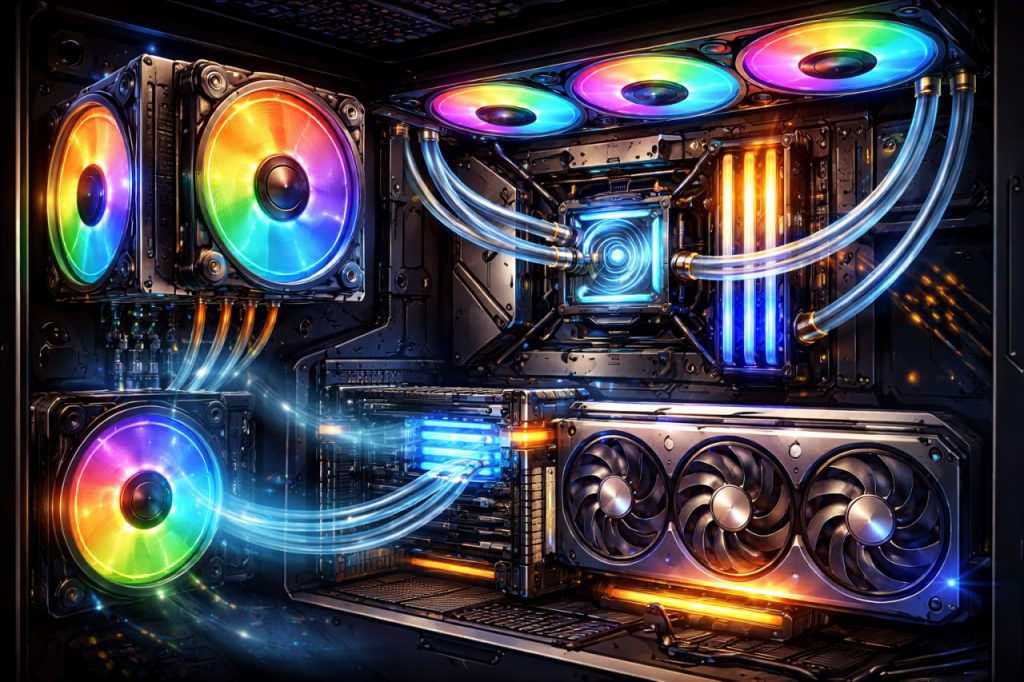
As computer performance continues to grow, so does the need for effective cooling. Modern processors and graphics cards generate significant heat, and without proper temperature management, systems can lose performance or even become unstable. Today, cooling technologies have evolved far beyond simple fans, offering a range of solutions designed to maintain optimal temperatures and system stability.
Why Cooling Is Critical
Every electronic component produces heat during operation. If this heat is not properly dissipated, it can lead to thermal throttling, where the system automatically reduces performance to prevent damage. Experts note:
“Efficient cooling is essential not only for performance but also for the long-term reliability of hardware.”
Maintaining stable temperatures ensures consistent performance and extends the lifespan of components.
Air Cooling: The Classic Solution
Air cooling remains one of the most common methods. It uses fans and heat sinks to transfer heat away from components. Heat sinks absorb heat from the CPU or GPU, while fans push cool air through the case. Modern air coolers are more advanced than ever, featuring larger radiators, improved airflow design, and quieter operation.
Liquid Cooling Systems
Liquid cooling has become increasingly popular, especially in high-performance systems. These systems use a liquid coolant to absorb heat and transfer it to a radiator, where it is dissipated. There are two main types: all-in-one (AIO) systems and custom loops. Liquid cooling is often more efficient than air cooling and can handle higher thermal loads.
Passive Cooling
Passive cooling systems rely on heat sinks without fans, using natural airflow to dissipate heat. While silent and energy-efficient, passive cooling is typically suitable only for low-power devices or specialized builds where noise must be minimized.
Advanced Technologies
Modern cooling solutions include innovations such as vapor chambers, heat pipes, and advanced thermal materials. These technologies improve heat transfer efficiency and allow for more compact designs. Some systems also use intelligent fan control, adjusting speeds dynamically based on temperature.
Cooling for Different Needs
The choice of cooling depends on how the computer is used. Basic systems may function well with air cooling, while gaming or professional workstations often benefit from liquid cooling. Compact systems may use specialized cooling designs to manage heat in limited space.
Balancing Performance and Noise
Modern cooling systems aim to strike a balance between cooling efficiency and noise levels. Improved fan designs and smart control systems allow computers to remain quiet during low workloads while increasing cooling power when needed.
The Future of Cooling
As technology advances, cooling solutions continue to evolve. Researchers are exploring new materials and techniques to improve heat management. Efficient cooling will remain a key factor in enabling faster and more powerful computing systems.
Interesting Facts
- Overheating can cause automatic performance reduction.
- Liquid cooling is often used in high-performance systems.
- Passive cooling systems operate without fans.
- Heat pipes help transfer heat efficiently across components.
- Modern systems can adjust fan speed automatically.
Glossary
- Thermal Throttling — automatic reduction of performance due to high temperature.
- Heat Sink — a component that absorbs and dissipates heat.
- Liquid Cooling — a cooling method using liquid to transfer heat.
- Heat Pipe — a device that transfers heat efficiently using fluid inside a sealed tube.
- Airflow — movement of air used to cool components.