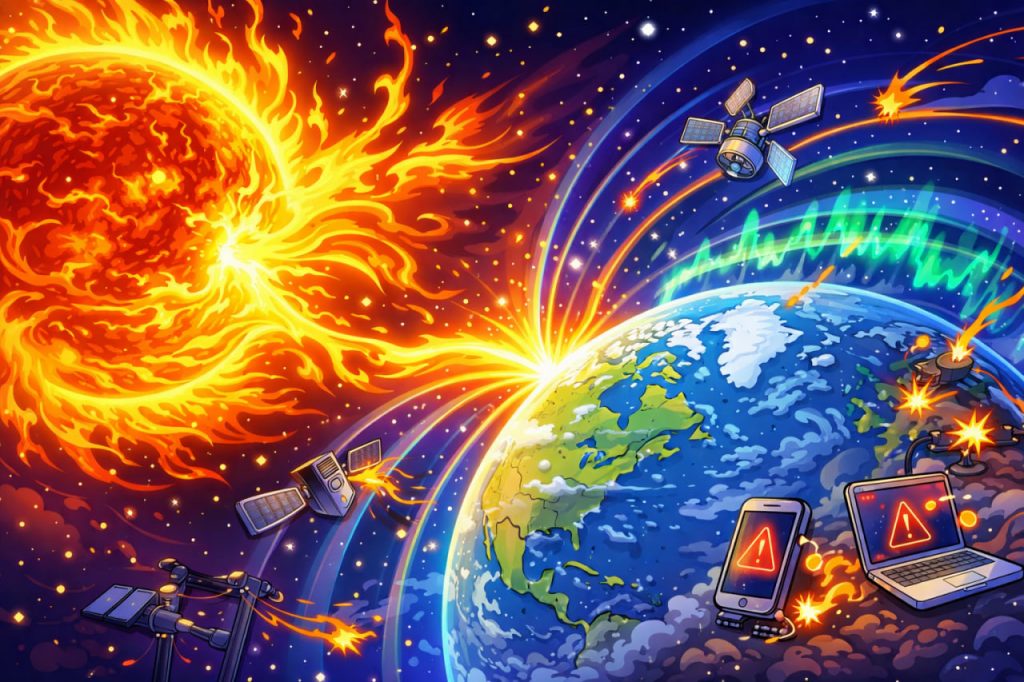
Space weather refers to conditions in space that are influenced by the activity of the Sun, particularly solar flares and coronal mass ejections. Although space may seem distant, solar activity can have direct and powerful effects on Earth. These events release enormous amounts of energy and charged particles that travel through space at high speeds. When they reach Earth, they interact with the planet’s magnetic field and atmosphere. Under certain conditions, this interaction can disrupt modern technological systems. In a world that depends heavily on electricity and digital communication, such disruptions could have serious consequences. Understanding space weather is essential for protecting infrastructure and maintaining global stability.
What Are Solar Storms?
Solar storms are disturbances caused by intense activity on the Sun, including solar flares and coronal mass ejections. These events release bursts of radiation and streams of charged particles into space. When directed toward Earth, they can reach the planet within hours or days. Space physicist Dr. Emily Carter explains:
“Solar storms are powerful releases of energy from the Sun
that can interact strongly with Earth’s magnetic environment.”
The strength of a solar storm depends on the amount of energy released and its direction. Stronger storms have greater potential to disrupt systems on Earth. These events are a natural part of solar activity cycles.
How They Affect Earth
When charged particles from a solar storm reach Earth, they interact with the planet’s magnetic field, creating what is known as a geomagnetic storm. This interaction can induce electric currents in the atmosphere and on the ground. These currents can interfere with power grids, pipelines, and communication systems. Satellites are particularly vulnerable, as they operate outside the protective layers of the atmosphere. Disruptions can include signal loss, navigation errors, and damage to electronic components. Even aviation routes can be affected, especially near polar regions. These effects demonstrate how space weather can directly impact daily life.
Risk to Electricity and the Internet
Modern infrastructure relies heavily on interconnected electrical and communication systems. A strong solar storm could overload power grids, causing widespread blackouts. Transformers, which are critical components of power systems, are especially vulnerable to induced currents. Internet infrastructure, including data centers and undersea cables, could also be affected. While the internet itself is decentralized, its physical components depend on electricity and stable communication links. A severe event could disrupt connectivity on a large scale. This highlights the vulnerability of modern technology to natural cosmic events.
Historical Examples
One of the most famous solar storms is the Carrington Event of 1859, which caused widespread telegraph failures and visible auroras around the world. Although technology at the time was limited, the effects were still significant. If a similar event occurred today, the impact would be far greater due to our reliance on electronics. More recent, smaller events have already caused satellite malfunctions and power disruptions. These examples show that solar storms are not just theoretical risks. They are real events with measurable consequences.
Can We Protect Ourselves?
Scientists and engineers are working to improve monitoring and prediction of space weather. Satellites and observatories track solar activity and provide early warnings of incoming storms. Power grid operators can take preventive measures, such as temporarily shutting down vulnerable systems. Designing more resilient infrastructure is also a key goal. While it is impossible to prevent solar storms, their impact can be reduced with proper preparation. International cooperation is important for sharing data and improving response strategies. Awareness and planning are essential for minimizing risk.
Why Space Weather Matters
Space weather is a reminder that Earth is part of a larger cosmic system. Events on the Sun can influence life and technology on our planet in significant ways. Understanding these processes helps scientists protect critical infrastructure and improve safety. It also highlights the importance of studying space not only for exploration but for practical reasons. As technology continues to advance, dependence on stable systems increases. This makes space weather an increasingly important field of study. Preparing for such events is essential for the future.
Interesting Facts
- Solar storms originate from the Sun’s magnetic activity
- Charged particles can reach Earth in hours to days
- The Carrington Event is the strongest recorded solar storm
- Satellites are especially vulnerable to space weather
- Strong storms can affect power grids and communication systems
Glossary
- Space Weather — conditions in space influenced by solar activity
- Solar Flare — sudden burst of radiation from the Sun
- Coronal Mass Ejection — release of plasma and magnetic field from the Sun
- Geomagnetic Storm — disturbance in Earth’s magnetic field
- Power Grid — network that delivers electricity