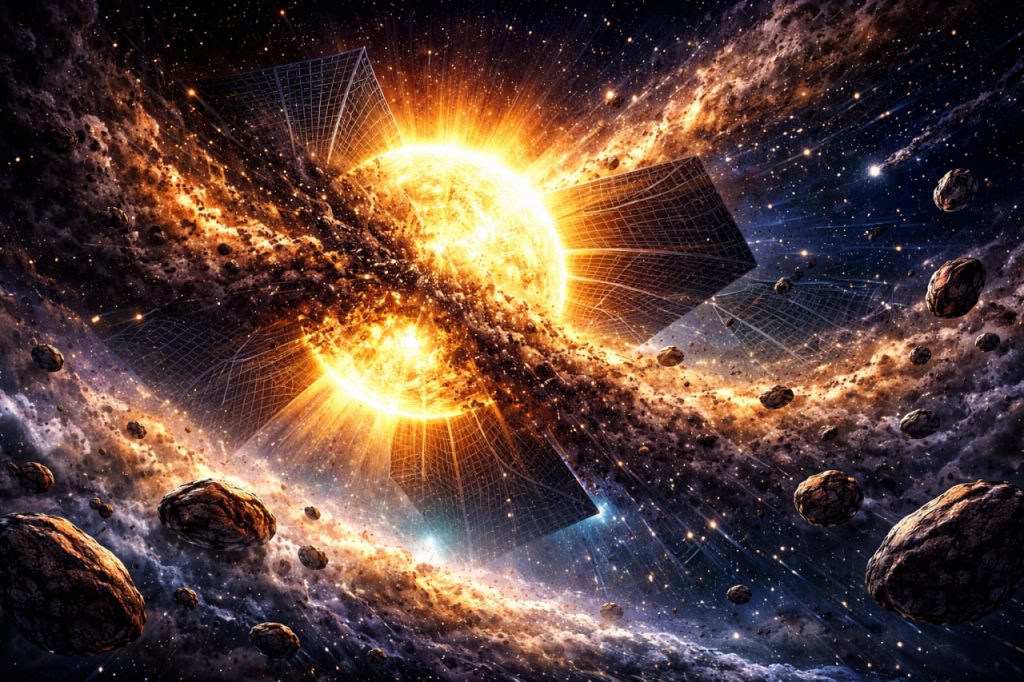
Tabby’s Star, also known as KIC 8462852, is one of the most mysterious objects ever discovered in our galaxy. It attracted global attention because of its unusual and irregular drops in brightness. Unlike typical stars, which dim in predictable ways when planets pass in front of them, this star shows deep and unpredictable fluctuations. Sometimes its brightness drops by more than 20%, which is extremely unusual. These strange patterns have led scientists to explore many possible explanations. Some early ideas even suggested the possibility of alien megastructures, although this remains highly speculative. Today, Tabby’s Star is a key subject in astrophysics research.
Discovery of Tabby’s Star
The star was discovered using data from the Kepler Space Telescope, which searches for planets by observing changes in starlight. Citizen scientists participating in the project noticed something unusual about this star’s light curve. Astronomer Dr. Tabetha Boyajian, after whom the star is nicknamed, led the investigation. She explained:
“The light fluctuations we observed
were unlike anything seen before in stellar observations.”
The irregular dips did not match known patterns of planetary transits. This made the star stand out immediately. It became one of the most puzzling discoveries in modern astronomy.
Why the Star Is So Unusual
Most stars show predictable brightness variations caused by orbiting planets or stellar activity. However, Tabby’s Star behaves differently. Its dimming events are irregular in depth, duration, and timing. This suggests that something complex is blocking its light. The lack of periodicity makes it difficult to identify a single cause. Scientists had to consider multiple hypotheses. This unusual behavior is what makes the star so fascinating.
Possible Explanations
Several theories have been proposed to explain the strange dimming. One leading idea is that clouds of dust or debris orbit the star, occasionally blocking its light. Another possibility is that fragments from comets or planetary collisions create irregular shadows. The idea of alien megastructures gained attention but is not supported by scientific evidence. Most researchers favor natural explanations involving dust and debris. Observations in different wavelengths suggest that fine particles are likely involved. However, no single explanation fully accounts for all observations.
Recent Findings
More recent studies have provided additional clues about Tabby’s Star. Observations show that the dimming is stronger at certain wavelengths, which supports the dust hypothesis. This means that tiny particles are scattering and absorbing light. Scientists continue to monitor the star using advanced telescopes. Each new observation helps refine existing models. Although progress has been made, the mystery is not completely solved. Tabby’s Star remains an active area of research.
Why This Star Matters
Tabby’s Star is important because it challenges our understanding of stellar behavior. It shows that there are still unknown processes in the universe. Studying such anomalies helps scientists improve models of star systems. It also demonstrates the value of collaborative research, including contributions from citizen scientists. Unusual discoveries often lead to new scientific breakthroughs. This star reminds us that the universe still holds many mysteries.
Conclusion
Tabby’s Star is one of the most intriguing astronomical objects ever discovered. Its strange dimming behavior has sparked debate and research worldwide. While natural explanations are currently the most likely, the mystery is not fully resolved. Continued observation and analysis are essential for understanding it. The star represents the frontier of modern astrophysics. It shows how much there is still to learn about the cosmos.
Interesting Facts
- Tabby’s Star can dim by more than 20%
- It was discovered using the Kepler Space Telescope
- Its dimming is irregular and unpredictable
- Dust clouds are the leading explanation
- It is about 1,500 light-years away
Glossary
- Light Curve — graph of a star’s brightness over time
- Exoplanet — planet outside our solar system
- Dust Cloud — particles that can block light
- Wavelength — property of light related to color
- Astronomy — study of space and celestial objects