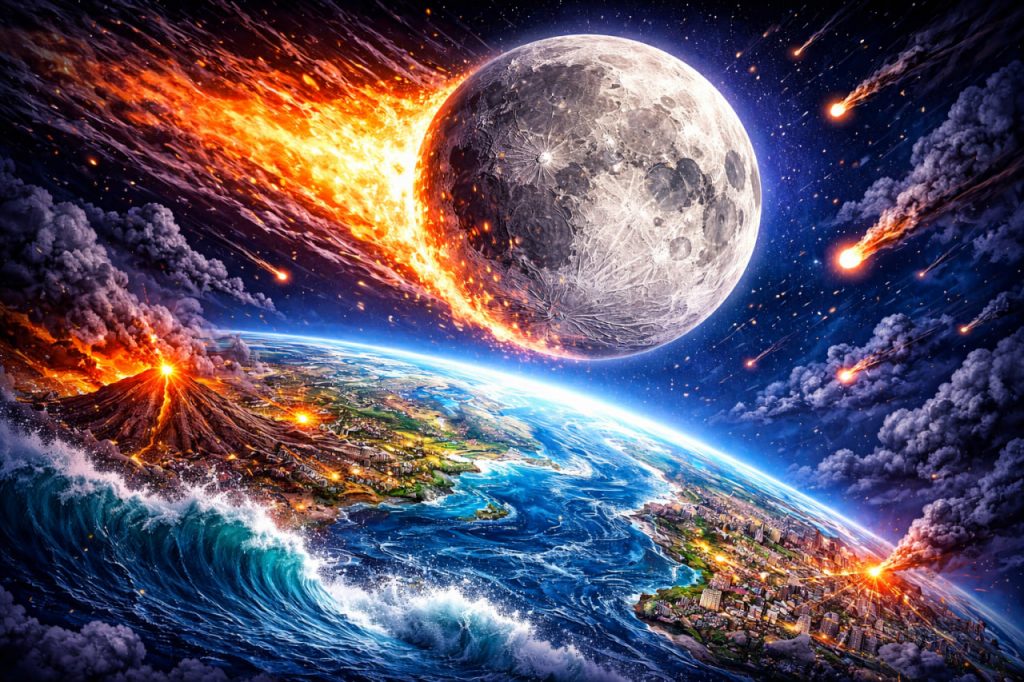
The idea that the Moon could suddenly fall to Earth is a dramatic and often frightening thought. However, according to modern science, such a scenario is extremely unlikely under natural conditions. The Moon is not simply “hanging” above Earth—it is in a stable orbit governed by gravity and motion. This balance between gravitational attraction and orbital velocity keeps the Moon moving around Earth rather than falling into it. For billions of years, this system has remained stable. In fact, the Moon is slowly moving away from Earth over time, not getting closer. Understanding orbital mechanics helps explain why a collision is not expected.
How the Moon Stays in Orbit
The Moon remains in orbit because of the balance between Earth’s gravity and its own forward motion. Gravity pulls the Moon toward Earth, but its velocity causes it to keep moving sideways, creating a continuous orbit. Astrophysicist Dr. Daniel Reed explains:
“An orbit is essentially a constant state of falling,
where motion prevents collision.”
This means the Moon is technically always “falling” toward Earth, but never reaches it. Instead, it follows a curved path around the planet. This delicate balance is stable and predictable. It is the same principle that keeps satellites in orbit.
Is the Moon Getting Closer?
Surprisingly, the Moon is actually moving away from Earth at a rate of about 3–4 centimeters per year. This happens because of tidal interactions between Earth and the Moon. Over long periods, this gradual increase in distance changes the dynamics of the system. However, the change is very slow and does not pose any danger. Scientists have measured this movement using laser experiments. The results confirm that the Moon is drifting away, not approaching Earth. This makes the idea of it falling even less likely.
What Would It Take for the Moon to Fall?
For the Moon to fall to Earth, something would have to drastically change its motion. This could involve a massive external force or a disruption of its orbital velocity. Such events might include a collision with a large object or extreme gravitational disturbances. However, there are no known forces in our solar system capable of causing this. The Moon’s orbit is well understood and highly stable. Any significant change would likely take millions or billions of years. Sudden collapse of the orbit is not supported by scientific evidence.
What If It Did Happen?
If the Moon somehow began to fall toward Earth, the consequences would be catastrophic. Tidal forces would increase dramatically, causing massive ocean disturbances and geological stress. Earth’s rotation could be affected, and global conditions would change rapidly. Eventually, the collision would release enormous energy, far beyond any known natural disaster. However, this scenario is purely hypothetical. It serves more as a thought experiment than a realistic possibility. The physics required for this event are extremely unlikely.
Why This Scenario Is Important to Understand
Exploring such questions helps people understand how stable our planetary system is. It also highlights the importance of gravity and motion in maintaining cosmic order. The Moon plays a crucial role in stabilizing Earth’s rotation and influencing tides. Its presence has likely contributed to the development of life on Earth. Understanding its behavior helps scientists study planetary systems across the universe. Even unlikely scenarios can provide valuable insights into physics and astronomy.
Interesting Facts
- The Moon moves away from Earth by 3–4 cm per year
- It takes about 27 days to orbit Earth
- The Moon stabilizes Earth’s axial tilt
- Tides are caused by the Moon’s gravity
- The Earth-Moon system is billions of years old
Glossary
- Orbit — path of an object around another object
- Gravity — force of attraction between masses
- Tidal Forces — effects caused by gravitational differences
- Velocity — speed in a specific direction
- Axial Tilt — angle of Earth’s rotation axis