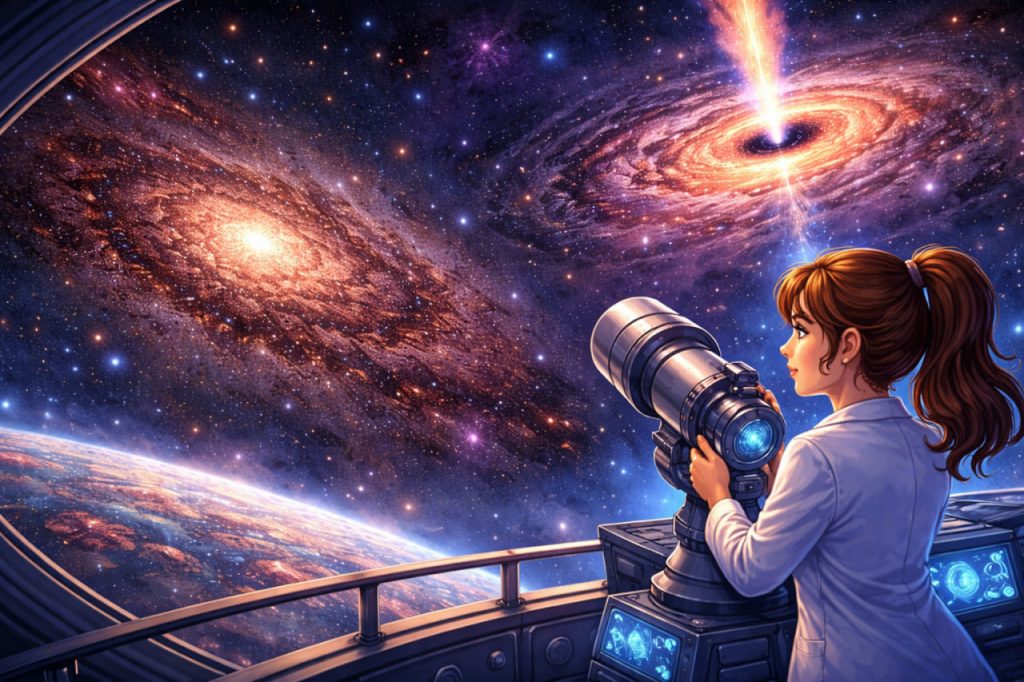
Galaxies are vast systems of stars, gas, dust, and dark matter, but not all of them shine with the same intensity. Some galaxies, known as “quenched” or “dead galaxies,” have stopped forming new stars, leaving them dim, red, and slowly fading over time. Unlike active galaxies filled with bright, young stars, these systems are dominated by older, cooler stars that emit less energetic light. Scientists have long tried to understand what causes galaxies to “turn off,” since star formation is the key process that keeps galaxies alive and luminous. The mystery is not just about what stops star birth, but also about what prevents it from restarting. Exploring this phenomenon helps astronomers understand how galaxies evolve and how the universe itself changes over billions of years.
What Does It Mean for a Galaxy to “Die”?
A “dead” galaxy is not truly inactive, but it has largely stopped producing new stars. Star formation requires cold gas, which collapses under gravity to form new stellar objects. When this gas is no longer available or cannot cool properly, star formation slows down or stops entirely. Over time, existing stars age and fade, shifting the galaxy’s color toward red. According to astrophysicist Dr. Elena Morozova:
“A galaxy doesn’t die suddenly — it slowly runs out of the raw material needed to create new stars, like a fire that has exhausted its fuel.”
This gradual fading process is why dead galaxies still exist but appear much less vibrant than their active counterparts.
Supermassive Black Holes and Energy Feedback
One of the leading explanations for galaxy quenching involves supermassive black holes located at the centers of galaxies. When matter falls into these black holes, enormous amounts of energy are released in the form of radiation and high-speed jets. This process, known as active galactic nucleus (AGN) feedback, can heat surrounding gas or even push it out of the galaxy entirely. When gas becomes too hot, it cannot collapse to form new stars. This effectively shuts down star formation on a galactic scale. Researchers believe that this mechanism plays a major role in turning once-active galaxies into quiet, fading systems.
Loss of Gas and Galactic Starvation
Another important factor is the loss of star-forming gas. Galaxies can lose gas through interactions with other galaxies, powerful stellar winds, or environmental effects in dense galaxy clusters. In some cases, galaxies are stripped of their gas as they move through hot intergalactic plasma, a process known as ram-pressure stripping. Without a steady supply of cold gas, the galaxy becomes “starved,” unable to sustain the formation of new stars. This gradual depletion leads to the slow transition from a bright, blue galaxy to a dim, red one.
Collisions and Structural Changes
Galaxy mergers and collisions can also influence whether a galaxy remains active or becomes quenched. While some collisions trigger bursts of star formation, others disrupt gas distribution and feed central black holes, accelerating quenching processes. The outcome depends on factors such as mass, velocity, and the amount of available gas. Over time, these interactions can transform spiral galaxies into elliptical galaxies, which are more likely to be “dead” due to their lack of cold gas and stable structure.
The Role of Cosmic Environment
The environment in which a galaxy exists plays a crucial role in its evolution. Galaxies located in dense clusters are more likely to become quenched due to gravitational interactions and exposure to hot intergalactic gas. In contrast, isolated galaxies may continue forming stars for much longer periods. This suggests that galaxy “death” is not caused by a single factor, but by a combination of internal processes and external influences acting over billions of years.
Interesting Facts
- Some “dead” galaxies stopped forming stars more than 10 billion years ago.
- Massive galaxies tend to “die” faster than smaller ones, a phenomenon called “galactic downsizing.”
- The color of a galaxy can reveal its age—blue means active, while red means aging.
- Even “dead” galaxies can contain trillions of stars, despite forming no new ones.
- Astronomers use powerful telescopes to observe galaxies at different stages, effectively looking back in time.
Glossary
- Quenched Galaxy — a galaxy in which star formation has significantly slowed or stopped.
- Cold Gas — the material required for forming new stars within galaxies.
- Supermassive Black Hole — a massive black hole at the center of most galaxies.
- AGN Feedback — energy released by a black hole that affects surrounding gas and star formation.
- Elliptical Galaxy — a type of galaxy with little gas and low star formation activity.