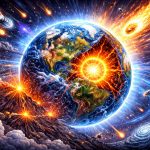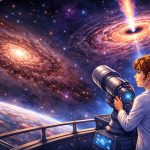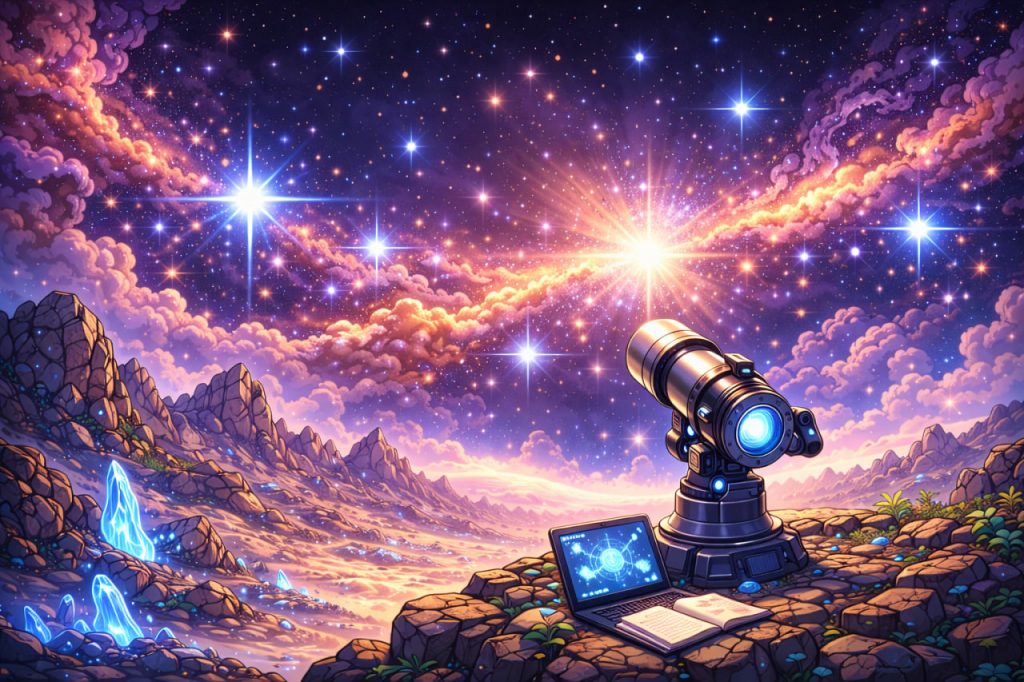
The first stars in the universe marked a turning point known as the cosmic dawn, when darkness gave way to light for the very first time. After the Big Bang, the universe spent hundreds of millions of years in a period often called the cosmic dark ages, where no stars or galaxies yet existed. During this time, matter slowly gathered under gravity, forming dense regions of gas that would eventually ignite the first stars. These early stars were fundamentally different from those we see today, as they were composed almost entirely of hydrogen and helium. Their formation not only illuminated the universe but also began the process of creating heavier elements necessary for planets and life. Understanding these first stars helps scientists uncover how structure, light, and complexity emerged in the early universe.
What Were the First Stars Like?
The earliest stars, often referred to as Population III stars, were massive, extremely hot, and short-lived. Without heavier elements to cool the gas clouds, these stars grew much larger than typical stars today, sometimes reaching hundreds of times the mass of the Sun. Their immense size meant they burned their fuel rapidly and exploded as powerful supernovae. According to astrophysicist Dr. Marcus Levin:
“The first stars were cosmic giants, burning bright and fast,
shaping the chemical foundation of everything that followed.”
These explosions released the first heavy elements into space, enabling the formation of later generations of stars, planets, and eventually life.
From Darkness to Light
Before the first stars formed, the universe was filled with neutral hydrogen that absorbed light, making it opaque. When the first stars ignited, they emitted intense radiation that began to ionize this hydrogen in a process known as reionization. This gradually made the universe transparent, allowing light to travel freely across vast distances. The transition from darkness to light was not instantaneous but occurred over hundreds of millions of years. This period fundamentally changed the structure of the universe and set the stage for galaxy formation.
The Role of Gravity and Gas Clouds
Gravity played a crucial role in the formation of the first stars by pulling together clouds of gas into dense regions. As these clouds collapsed, temperatures and pressures increased until nuclear fusion began. Unlike modern star formation, which is influenced by complex chemistry and dust, early star formation was simpler but more extreme. The lack of cooling mechanisms led to the creation of massive stars rather than smaller, stable ones. These early processes established the patterns that would later govern galaxy formation and evolution.
Why the First Stars No Longer Exist
None of the original Population III stars are believed to exist today because of their short lifespans. Their enormous mass caused them to burn out quickly, often within just a few million years. However, their legacy remains in the form of heavier elements scattered throughout the universe. Every planet, including Earth, contains elements forged in the cores of ancient stars. This means that, in a very real sense, modern cosmic structures are built from the remnants of these first luminous objects.
Observing the Cosmic Dawn Today
Studying the first stars is challenging because they are so distant in both space and time. Astronomers rely on powerful telescopes, such as space-based observatories, to detect faint signals from the early universe. They also study ancient galaxies and chemical signatures that hint at the presence of early stars. Advances in technology continue to push the boundaries of observation, bringing us closer to directly understanding the cosmic dawn. These discoveries not only reveal the origins of stars but also help answer fundamental questions about the universe itself.
Interesting Facts
- The first stars formed about 100–200 million years after the Big Bang.
- Population III stars contained no heavy elements, only hydrogen and helium.
- Some early stars were hundreds of times more massive than the Sun.
- The first supernovae created the universe’s first heavy elements.
- Light from the cosmic dawn is only now reaching Earth after traveling for billions of years.
Glossary
- Cosmic Dawn — the period when the first stars formed and began illuminating the universe.
- Population III Stars — the first generation of stars, composed of primordial elements.
- Reionization — the process where early radiation ionized hydrogen, making the universe transparent.
- Supernova — a powerful explosion marking the end of a massive star’s life.
- Nuclear Fusion — the process by which stars generate energy by fusing atomic nuclei.