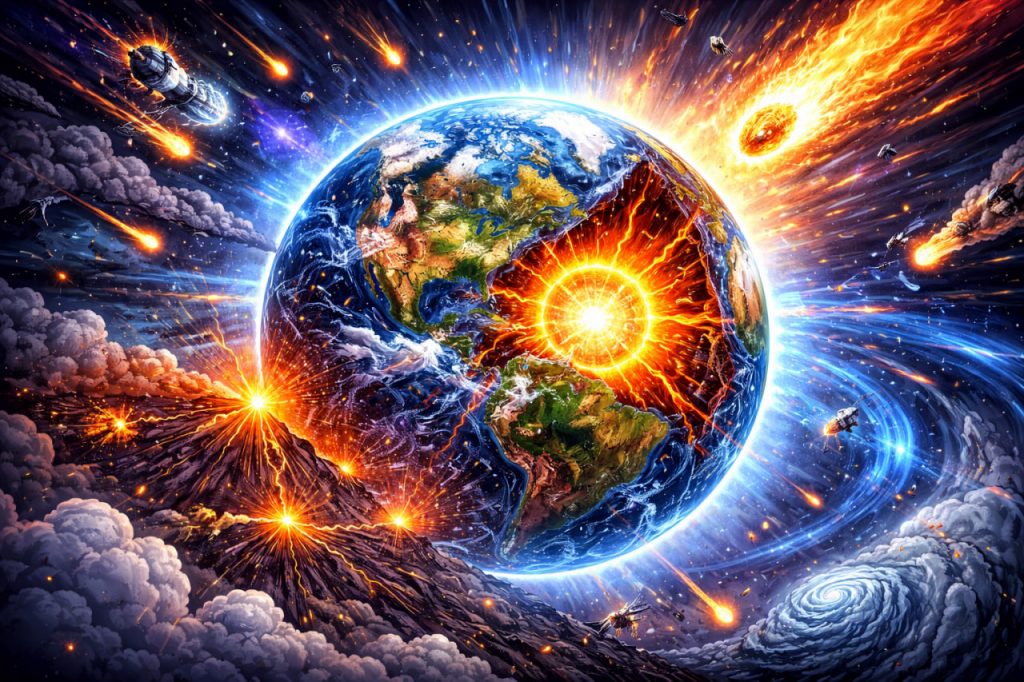
The idea of Earth’s core suddenly stopping is a dramatic scenario that helps us understand how important the planet’s internal dynamics are. The core of Earth, especially its liquid outer layer, is constantly moving. This movement generates the planet’s magnetic field and contributes to geological processes. If the core were to stop, the consequences would be profound and global. Although such an event is extremely unlikely, exploring it reveals how interconnected Earth’s systems are. The core plays a central role in maintaining conditions suitable for life. Without it functioning properly, many processes we take for granted would begin to change. This hypothetical situation highlights the importance of Earth’s internal structure.
The Role of Earth’s Core
Earth’s core consists of a solid inner core and a liquid outer core made mostly of iron and nickel. The motion of the liquid outer core creates electric currents that generate the magnetic field. Geophysicist Dr. Laura Bennett explains:
“The movement of molten metal in the outer core
is what powers Earth’s magnetic field.”
This magnetic field protects the planet from harmful solar radiation. It also plays a role in navigation systems and atmospheric stability. The core’s heat drives convection in the mantle, which leads to plate tectonics. These processes shape continents and influence volcanic activity. Without the core’s motion, these systems would be affected.
Loss of the Magnetic Field
One of the most immediate consequences of the core stopping would be the weakening or loss of Earth’s magnetic field. Without this protective shield, the planet would be exposed to solar wind and cosmic radiation. This could damage satellites, disrupt communication systems, and increase radiation levels at the surface. Over time, the atmosphere could begin to erode due to solar wind exposure. This process has been observed on planets like Mars, which lacks a strong magnetic field. Increased radiation could also affect living organisms. The loss of protection would have serious long-term consequences.
Geological Changes
The core’s heat is a driving force behind mantle convection and plate tectonics. If the core stopped moving, heat transfer within Earth would change. This could slow down or alter tectonic activity. Over long periods, this might reduce volcanic activity and the formation of new crust. Earth’s surface would become less dynamic. However, these changes would likely occur over millions of years rather than instantly. Geological systems respond slowly to changes in deep internal processes.
Impact on Life and Technology
The effects on life would be gradual but significant. Increased radiation could affect ecosystems and human health. Technology would also be impacted, especially satellites and power systems that rely on stable magnetic conditions. Navigation systems that depend on Earth’s magnetic field would need adjustment. Power grids could become more vulnerable to solar activity. While life would not disappear immediately, conditions would become more challenging over time. Adaptation would be necessary.
Why This Scenario Is Unlikely
In reality, the core cannot simply “stop” under normal physical conditions. The processes driving its motion are powered by heat from Earth’s formation and radioactive decay. These energy sources are extremely long-lasting. Scientists have no evidence suggesting that the core could suddenly stop. This makes the scenario purely hypothetical. However, studying it helps scientists understand how essential the core is. It also highlights the stability of Earth’s internal systems.
Why It Matters
Understanding the role of Earth’s core helps explain why our planet is suitable for life. It connects deep geological processes with surface conditions and technology. Even hypothetical scenarios provide valuable insight into planetary science. They show how different systems depend on each other. The core may be hidden deep beneath our feet, but its influence is global. Studying it helps us better understand Earth as a complex and dynamic system.
Interesting Facts
- Earth’s core temperature is similar to the surface of the Sun
- The magnetic field protects Earth from solar radiation
- Plate tectonics are driven by internal heat
- Mars lost much of its atmosphere due to weak magnetic field
- The core is about 3,500 km in radius
Glossary
- Core — central part of the Earth
- Magnetic Field — protective field around Earth
- Mantle — layer between crust and core
- Tectonics — movement of Earth’s plates