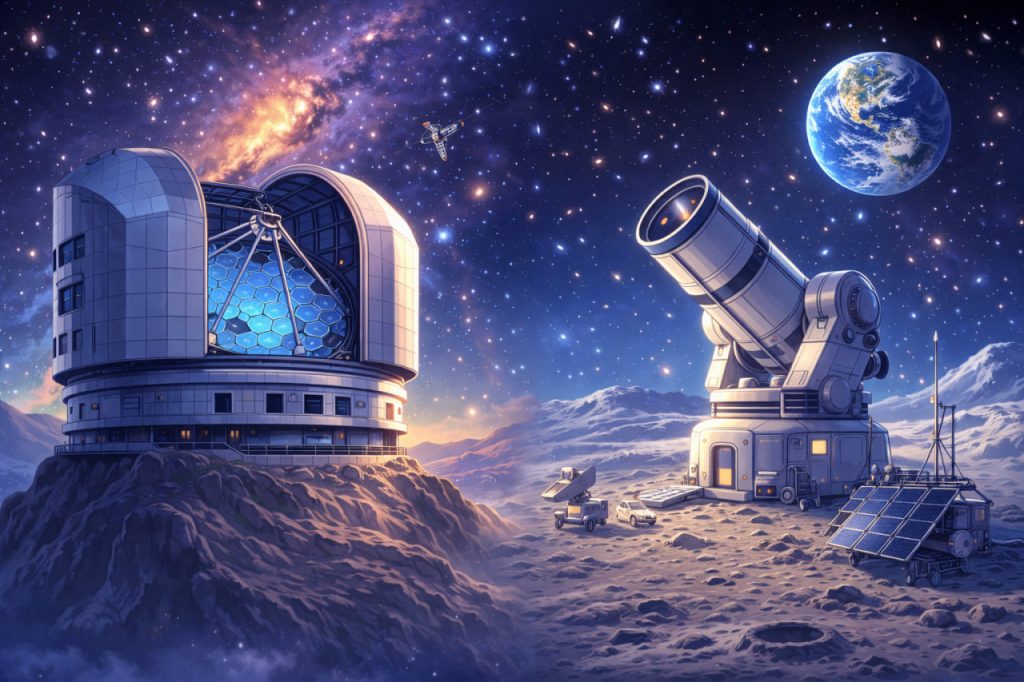
Humanity has always sought to explore the universe, and telescopes have been the primary tools enabling us to look deeper into space. Today, a new generation of instruments is being developed that promises to revolutionize our understanding of the cosmos. Among them are Extremely Large Telescopes (ELTs) on Earth and the concept of observatories on the Moon, both designed to overcome the limitations of current technology. These advanced systems aim to capture more light, produce sharper images, and observe distant objects that were previously beyond reach. As astronomy enters a new era, these innovations may help answer some of the biggest questions about the origin of the universe, dark matter, and the possibility of life beyond Earth. Understanding how these technologies work reveals why they are considered the future of astronomical discovery.
What Are Extremely Large Telescopes
Extremely Large Telescopes are ground-based observatories equipped with mirrors far larger than any previously built. Some designs include primary mirrors over 30 meters in diameter, allowing them to collect significantly more light than current telescopes. This increased sensitivity enables astronomers to observe faint and distant galaxies, study the atmospheres of exoplanets, and detect subtle cosmic phenomena. One of the key technologies used in ELTs is adaptive optics, which corrects distortions caused by Earth’s atmosphere in real time. According to astrophysicist Dr. Martin Keller:
“Extremely Large Telescopes will allow us to see the universe with unprecedented clarity,
bringing distant worlds and early galaxies into sharp focus.”
These telescopes represent a major step forward in observational power, pushing the boundaries of what can be seen from Earth.
Challenges of Earth-Based Observations
Despite their size and advanced design, ground-based telescopes still face limitations. Earth’s atmosphere causes turbulence that distorts incoming light, reducing image quality. Weather conditions, light pollution, and atmospheric absorption can also interfere with observations. Although adaptive optics significantly improves clarity, it cannot completely eliminate all distortions. Additionally, certain wavelengths of light—such as parts of the infrared spectrum—are partially blocked by the atmosphere. These challenges motivate scientists to consider alternative locations for telescopes, where such limitations are minimized.
Why the Moon Is an Ideal Observatory Location
The Moon offers a unique environment for astronomical observations. Without an atmosphere, there is no distortion from air turbulence, allowing telescopes to capture extremely sharp images. The lunar surface also experiences long periods of darkness, especially on the far side, which is shielded from Earth’s radio signals. This makes it an ideal location for radio astronomy and deep-space observation. Furthermore, the Moon’s low gravity simplifies the construction of large structures compared to Earth. According to space engineer Dr. Elena Varga:
“A lunar observatory could open a completely new window into the universe,
free from many of the limitations we face on Earth.”
These advantages make the Moon one of the most promising locations for future astronomical facilities.
Technological and Logistical Challenges
Building observatories on the Moon is far from simple. Transporting materials, ensuring power supply, and protecting equipment from extreme temperatures and radiation are major challenges. Lunar dust, which is fine and abrasive, can also damage sensitive instruments. Engineers must develop new technologies for remote construction, possibly using robots or autonomous systems. Communication delays between Earth and the Moon require systems that can operate with a high degree of independence. Despite these obstacles, ongoing advancements in space exploration make lunar observatories increasingly feasible in the coming decades.
The Future of Astronomy
The combination of Extremely Large Telescopes on Earth and potential observatories on the Moon represents a powerful future for astronomy. Together, these technologies could provide complementary data, offering a more complete view of the universe. While ELTs push the limits of ground-based observation, lunar observatories may unlock entirely new possibilities by eliminating atmospheric interference. Scientists believe that these tools will play a key role in discovering new exoplanets, understanding cosmic evolution, and exploring fundamental physics. As these projects develop, they will shape the next chapter of human exploration and deepen our connection to the universe.
Interesting Facts
- The largest planned ELTs will have mirrors up to 39 meters in diameter.
- Adaptive optics systems can adjust mirrors thousands of times per second to correct distortions.
- The far side of the Moon is one of the quietest radio environments in the Solar System.
- Some lunar telescope concepts involve building mirrors directly from local lunar materials.
- Future telescopes may be powerful enough to detect signs of life in exoplanet atmospheres.
Glossary
- Extremely Large Telescope (ELT) — a next-generation ground-based telescope with a very large primary mirror for deep-space observation.
- Adaptive Optics — a technology that corrects atmospheric distortions in real time.
- Exoplanet — a planet located outside our Solar System.
- Radio Astronomy — the study of space using radio frequency signals.
- Lunar Observatory — a telescope facility located on the Moon for advanced astronomical observations.