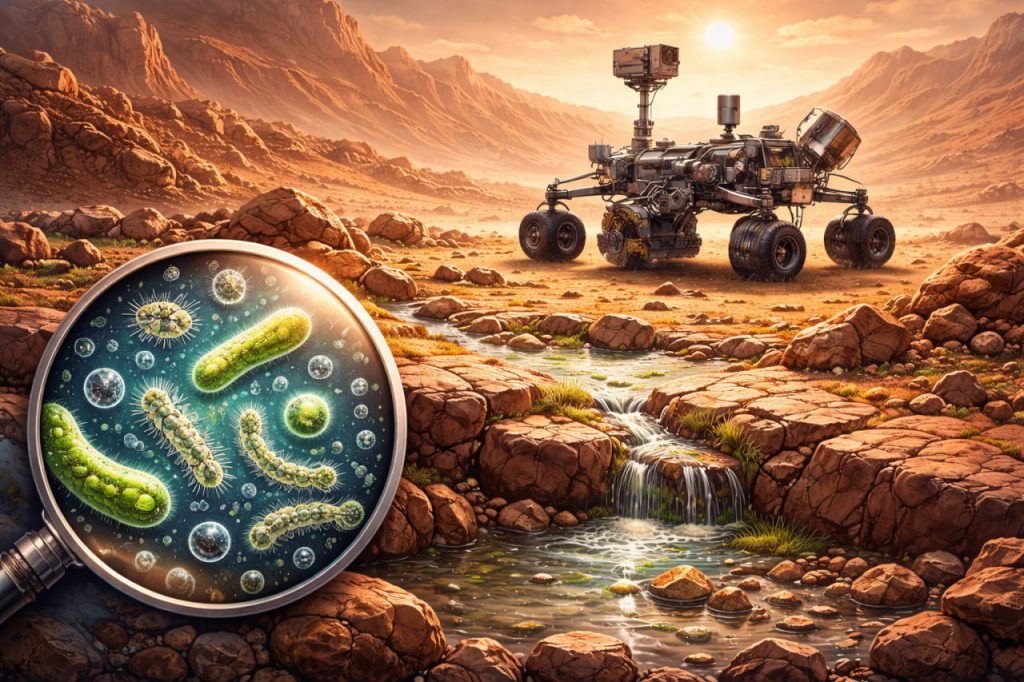
The question of whether life exists on Mars has fascinated scientists and the public for generations. As one of Earth’s closest planetary neighbors, Mars shares several similarities with our planet, including seasons, polar ice caps, and evidence of ancient water. These features make it one of the most promising places in the Solar System to search for signs of past or present life. Over the past decades, robotic missions, orbiters, and rovers have collected vast amounts of data, revealing a complex history that suggests Mars was once much more hospitable than it is today. While no direct evidence of life has been confirmed, the discoveries made so far continue to raise important questions about the potential for microbial organisms beneath the planet’s surface. Understanding Mars helps scientists better understand how life might arise elsewhere in the universe.
Evidence of Water on Mars
One of the most important factors in the search for life is the presence of liquid water, and Mars shows strong evidence that water once existed in large quantities. Ancient river valleys, lakebeds, and mineral deposits indicate that billions of years ago, Mars had flowing water on its surface. Today, most of that water is frozen in polar ice caps or trapped beneath the surface. Some studies also suggest that salty liquid water may occasionally exist in subsurface environments. According to planetary scientist Dr. Elena Ramirez:
“Where there is water, there is potential for life.
Mars shows us clear signs that it once had the right conditions.”
This makes Mars a key target in the search for past microbial life.
The Harsh Environment of Modern Mars
Despite its promising past, present-day Mars is a challenging environment for life as we know it. The planet has a thin atmosphere composed mostly of carbon dioxide, offering little protection from harmful radiation. Surface temperatures are extremely low, and liquid water is unstable under current conditions. Strong dust storms can cover the entire planet, further complicating the environment. These factors make it unlikely that complex life forms exist on the surface today. However, scientists believe that microbial life could still survive underground, where conditions are more stable and protected.
Search Missions and Scientific Discoveries
Numerous missions have been sent to Mars to investigate its geology and potential for life. Rovers such as Curiosity and Perseverance have analyzed soil samples, detected organic molecules, and studied ancient environments that may have supported life. While these findings are not proof of life, they provide important clues about Mars’s habitability. Future missions aim to bring samples back to Earth for detailed analysis, which could provide more definitive answers. Each new discovery brings scientists closer to understanding whether life ever existed on the Red Planet.
Possibility of Subsurface Life
One of the most exciting possibilities is that life may exist beneath the Martian surface. Underground environments could contain liquid water, geothermal heat, and protection from radiation. On Earth, similar extreme environments host resilient microorganisms, suggesting that life could adapt to harsh conditions. Scientists are developing new technologies to explore deeper beneath Mars’s surface, where evidence of life may still be preserved or even active.
Why the Search Matters
The search for life on Mars is not just about one planet—it has broader implications for understanding life in the universe. Discovering even simple microbial life would demonstrate that life can arise in different environments, increasing the likelihood that it exists elsewhere. It would also provide insight into the origins of life on Earth and how it evolves under extreme conditions. As exploration continues, Mars remains one of the most important destinations in the quest to answer one of humanity’s oldest questions.
Interesting Facts
- Mars is often called the “Red Planet” due to iron oxide (rust) on its surface.
- A day on Mars is very similar to Earth, lasting about 24.6 hours.
- Evidence suggests Mars once had oceans covering large areas of its surface.
- Some Martian rocks contain organic molecules, which are building blocks of life.
- Future missions aim to return samples from Mars to Earth for deeper analysis.
Glossary
- Microbial Life — microscopic organisms such as bacteria that can survive in extreme environments.
- Organic Molecules — chemical compounds that are often associated with life processes.
- Subsurface — located beneath the surface of a planet.
- Habitability — the ability of an environment to support life.
- Radiation — high-energy particles that can damage living cells.