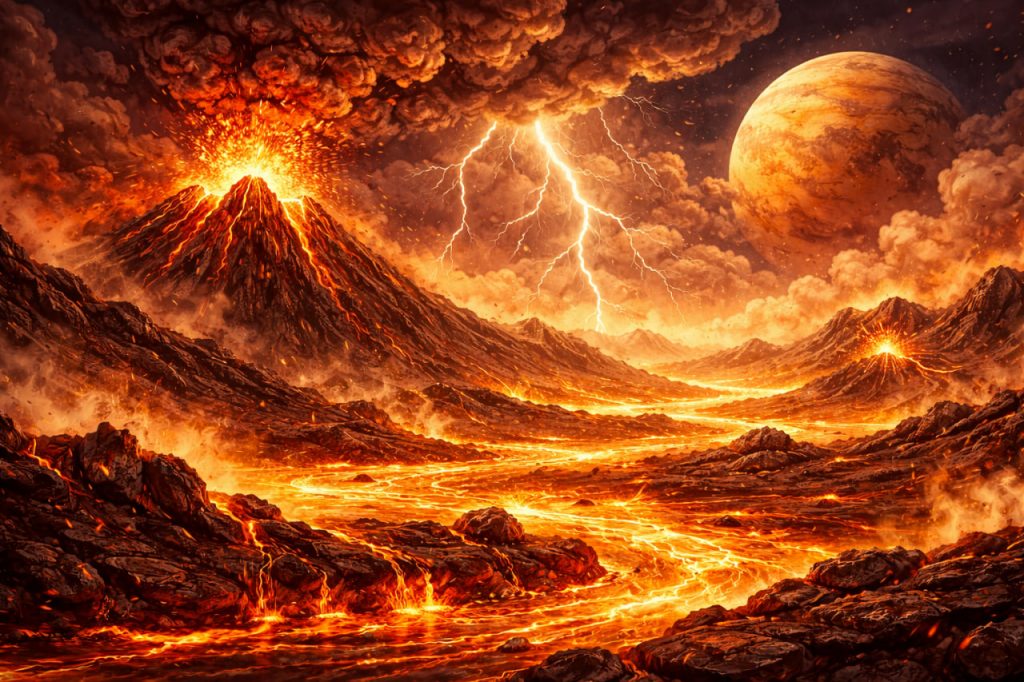
Venus is often called Earth’s “twin” because of its similar size, composition, and location in the inner Solar System. However, despite these similarities, Venus evolved into one of the most extreme and hostile environments known, with surface temperatures hot enough to melt lead and atmospheric pressure crushing enough to destroy most spacecraft. Scientists believe that billions of years ago, Venus may have had conditions more similar to Earth, including the potential for liquid water. Over time, however, a series of runaway processes transformed the planet into a hellish world dominated by extreme heat and a toxic atmosphere. Understanding how Venus changed so dramatically provides valuable insight into planetary evolution and the delicate balance required to sustain life.
The Runaway Greenhouse Effect
The primary reason Venus became so hot is the runaway greenhouse effect, a process in which heat becomes trapped in a planet’s atmosphere, causing temperatures to rise uncontrollably. Venus’s atmosphere is composed mostly of carbon dioxide, a powerful greenhouse gas that traps heat very efficiently. As the planet warmed, any existing water likely evaporated into the atmosphere as vapor, which further intensified the greenhouse effect. According to planetary scientist Dr. Maria Velasquez:
“Once the greenhouse effect on Venus reached a critical point,
the planet lost its ability to cool itself, locking it into a permanent state of extreme heat.”
This feedback loop caused temperatures to rise to the extreme levels observed today.
Loss of Water and Atmospheric Transformation
Water plays a crucial role in regulating planetary temperature, but Venus lost nearly all of its water early in its history. As temperatures increased, water vapor rose into the upper atmosphere, where it was broken apart by solar radiation. Hydrogen escaped into space, while oxygen either reacted with surface materials or was lost over time. Without oceans to absorb carbon dioxide, the gas accumulated in the atmosphere, further strengthening the greenhouse effect. This transformation turned Venus from a potentially habitable world into a dry and overheated planet.
Thick Clouds and Toxic Atmosphere
Today, Venus is covered by a dense layer of clouds composed mainly of sulfuric acid, making the atmosphere both reflective and highly corrosive. These clouds trap heat while also reflecting sunlight, creating a complex energy balance that keeps the planet extremely hot. The surface pressure on Venus is about 90 times greater than Earth’s, equivalent to the pressure deep in Earth’s oceans. The thick atmosphere prevents heat from escaping, maintaining surface temperatures around 460°C. These conditions make Venus one of the most inhospitable places in the Solar System.
Volcanic Activity and Surface Changes
Volcanic activity has also played a significant role in shaping Venus’s environment. The planet’s surface is covered with vast lava plains, suggesting extensive volcanic eruptions in the past. These eruptions likely released large amounts of carbon dioxide and other gases into the atmosphere, contributing to the runaway greenhouse effect. Some scientists believe that Venus may still be volcanically active today, which would mean the planet continues to evolve. The lack of plate tectonics, unlike on Earth, prevents the recycling of carbon and contributes to the buildup of greenhouse gases.
Lessons for Earth and Planetary Science
Studying Venus provides important lessons about climate systems and planetary stability. It shows how small changes in atmospheric composition can lead to dramatic and irreversible outcomes. Scientists use Venus as a model to understand extreme climate change and to study the limits of habitability. While Earth and Venus started with similar conditions, their paths diverged due to differences in atmosphere, distance from the Sun, and geological activity. These insights are crucial not only for understanding our own planet but also for studying exoplanets beyond our Solar System.
Interesting Facts
- Venus is the hottest planet in the Solar System, even hotter than Mercury.
- A day on Venus is longer than a year, lasting about 243 Earth days.
- The planet rotates in the opposite direction compared to most planets.
- Surface pressure on Venus is equivalent to being 900 meters underwater on Earth.
- Spacecraft that land on Venus survive only a few hours due to extreme conditions.
Glossary
- Runaway Greenhouse Effect — a process where heat trapping becomes uncontrollable, causing extreme temperature rise.
- Carbon Dioxide — a gas that traps heat in a planet’s atmosphere.
- Atmospheric Pressure — the force exerted by the weight of a planet’s atmosphere.
- Sulfuric Acid Clouds — dense, corrosive clouds found in Venus’s atmosphere.
- Volcanic Activity — the release of molten rock and gases from a planet’s interior.