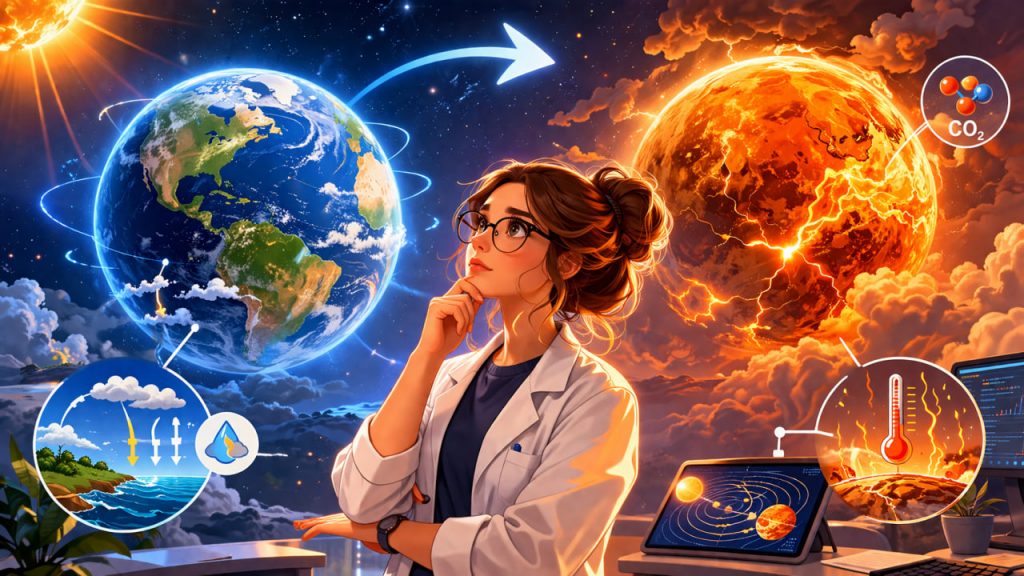
The idea that Earth could one day become like Venus—a hot, hostile planet with crushing pressure and toxic clouds—may sound alarming, but it raises important scientific questions about climate and planetary evolution. Venus is often called Earth’s “twin” because of its similar size and composition, yet the two planets developed in dramatically different ways. While Earth supports life, Venus became an extreme world dominated by a powerful greenhouse effect. Understanding whether Earth could follow a similar path helps scientists study climate stability and the limits of habitability. The short answer is that while some processes are similar, a full transformation like Venus is extremely unlikely under current conditions.
What Happened to Venus
Venus likely started with conditions closer to Earth’s, possibly including liquid water and a more balanced climate. However, its closer distance to the Sun caused higher temperatures, leading to the evaporation of water. This triggered a runaway greenhouse effect, where heat became trapped in the atmosphere, raising temperatures further. Eventually, oceans disappeared, and carbon dioxide built up in massive amounts, creating the extreme environment we see today.
Could Earth Experience a Runaway Greenhouse Effect
Earth does experience a greenhouse effect, which is essential for maintaining a livable temperature. However, a runaway version like Venus requires extreme conditions. Scientists believe that triggering such a process on Earth would require a massive and rapid increase in greenhouse gases far beyond current levels. While climate change is a serious issue, it is not expected to turn Earth into Venus. The processes involved are far more intense and depend on factors such as solar radiation and atmospheric composition.
Key Differences Between Earth and Venus
Several important differences make Earth more stable. Earth has liquid oceans, which help regulate temperature by absorbing heat and carbon dioxide. It also has a magnetic field that protects the atmosphere from solar wind, and active geological processes that recycle carbon through the planet. Venus, in contrast, lacks these stabilizing systems, making it more vulnerable to extreme climate changes.
The Role of the Sun
Over very long timescales, the Sun itself will become brighter. In billions of years, increased solar radiation could gradually heat Earth enough to evaporate oceans and change the atmosphere. In that distant future, Earth could become more Venus-like. However, this process would take hundreds of millions to billions of years, not something that could happen in the near future.
What This Means for Us
Although Earth is not in danger of becoming Venus anytime soon, studying Venus highlights how delicate planetary climates can be. It shows that once certain thresholds are crossed, changes can become irreversible. This makes it important to maintain Earth’s climate balance and avoid large-scale disruptions. Venus serves as a natural example of what can happen when a planet loses its ability to regulate temperature.
Interesting Facts
- Venus is the hottest planet in the Solar System.
- Its surface temperature is about 460°C.
- Earth’s oceans play a key role in stabilizing climate.
- A full Venus-like transformation of Earth would take billions of years.
- Venus’s atmosphere is made of about 96% carbon dioxide.
Glossary
- Greenhouse Effect — the trapping of heat by gases in a planet’s atmosphere.
- Runaway Greenhouse Effect — an uncontrollable increase in temperature due to heat trapping.
- Atmosphere — the layer of gases surrounding a planet.
- Solar Radiation — energy emitted by the Sun.
- Habitability — the ability of a planet to support life.