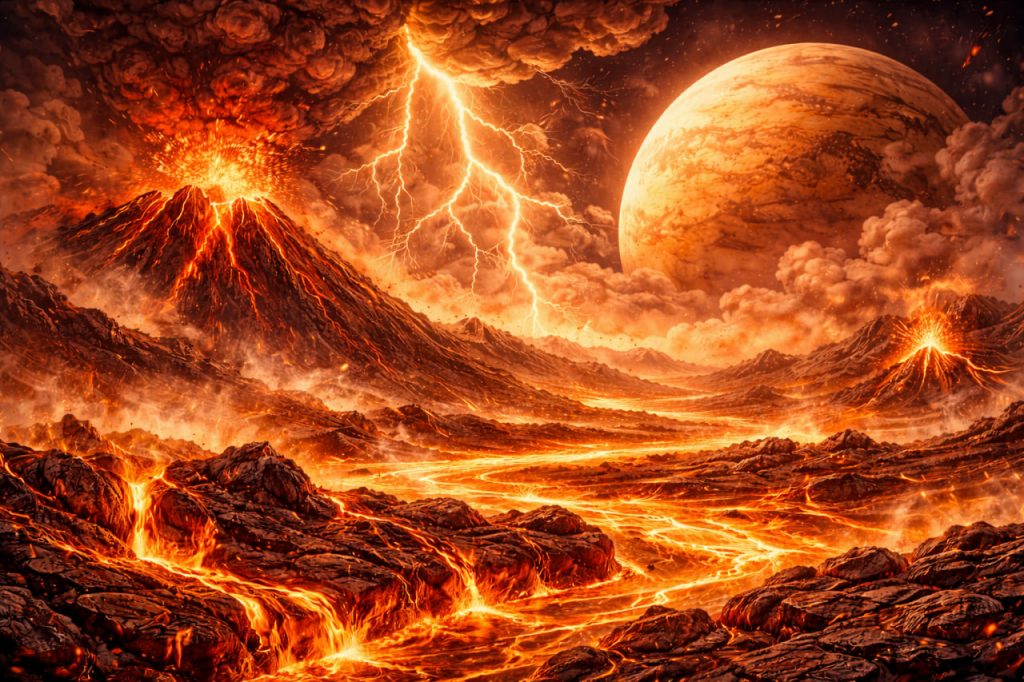
Venus is often described as a “dead” or “lost” world—not because the planet itself disappeared, but because it likely lost the conditions that could have supported life. Billions of years ago, Venus may have had a much more Earth-like environment, with moderate temperatures and possibly even liquid water on its surface. However, over time, a series of powerful climatic and atmospheric changes transformed it into the extremely hot and hostile planet we see today. This transformation is one of the most dramatic examples of planetary evolution in the Solar System. Studying how Venus “died” helps scientists understand the fragile balance required for a planet to remain habitable. It also provides important warnings about how climate systems can change beyond recovery.
A Potentially Habitable Past
Early in its history, Venus may have had conditions suitable for life, including oceans and a thicker atmosphere capable of regulating temperature. Because Venus is similar in size and composition to Earth, scientists believe it could have followed a similar evolutionary path. Models suggest that for millions or even billions of years, Venus may have maintained stable conditions. However, its closer proximity to the Sun meant it received more solar energy, which eventually triggered long-term changes in its climate. This increased energy input played a crucial role in pushing the planet toward instability.
The Runaway Greenhouse Collapse
The turning point in Venus’s history was the onset of a runaway greenhouse effect. As temperatures increased, any existing water began to evaporate, adding water vapor—a strong greenhouse gas—to the atmosphere. This caused even more heat to be trapped, creating a feedback loop. Eventually, the oceans completely evaporated, and the planet lost its ability to regulate temperature. Without liquid water to absorb carbon dioxide, the gas accumulated in the atmosphere, making the greenhouse effect even stronger. This process effectively ended Venus’s potential to support life.
Destruction of Water and Atmosphere
Once water vapor reached the upper atmosphere, it was exposed to intense solar radiation. This radiation broke water molecules into hydrogen and oxygen. The lightweight hydrogen escaped into space, while the oxygen either reacted with surface rocks or was lost over time. This irreversible loss of water was a critical step in Venus’s transformation. Without water, the planet could no longer support any Earth-like climate system, marking a point of no return in its evolution.
Extreme Conditions Today
Today, Venus is one of the most extreme environments in the Solar System. Surface temperatures reach around 460°C, and the atmospheric pressure is about 90 times higher than on Earth. The thick atmosphere, composed mostly of carbon dioxide, traps heat efficiently, while clouds of sulfuric acid create a toxic and corrosive environment. These conditions make it impossible for life as we know it to survive on the surface. Venus did not physically “die,” but it became completely inhospitable, losing all potential for life.
Lessons from Venus
The story of Venus provides valuable insights into planetary climates and the risks of extreme environmental change. It demonstrates how small differences—such as distance from the Sun—can lead to dramatically different outcomes over time. Scientists study Venus to better understand climate stability, greenhouse effects, and planetary habitability. These lessons are important not only for understanding other planets but also for recognizing how delicate Earth’s balance truly is.
Interesting Facts
- Venus may have had oceans for hundreds of millions of years before losing them.
- It is the hottest planet in the Solar System despite not being closest to the Sun.
- The atmosphere of Venus is made of about 96% carbon dioxide.
- A spacecraft can survive on Venus’s surface for only a few hours.
- Venus likely lost its water irreversibly billions of years ago.
Glossary
- Runaway Greenhouse Effect — a process where heat trapping becomes uncontrollable, leading to extreme temperature rise.
- Water Vapor — a gaseous form of water that acts as a strong greenhouse gas.
- Atmospheric Pressure — the force exerted by a planet’s atmosphere.
- Carbon Dioxide — a gas that traps heat and contributes to planetary warming.
- Habitability — the ability of a planet to support life.