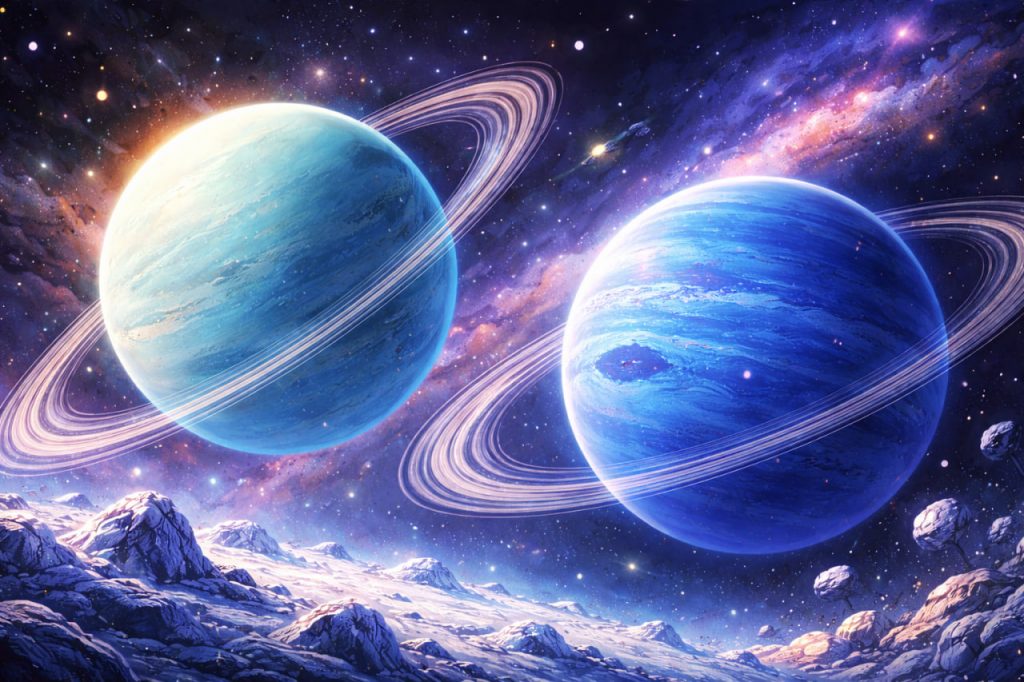
Uranus and Neptune are often referred to as the ice giants of the Solar System, yet they remain some of the least explored and most mysterious planets. Unlike the more famous gas giants like Jupiter and Saturn, these distant worlds receive far less attention, largely due to their extreme distance from Earth. However, they hold crucial clues about planetary formation, atmospheric physics, and the diversity of worlds beyond our Solar System. Composed largely of water, ammonia, and methane ices, these planets differ significantly from gas giants, offering a unique class of planetary environments. Despite their beauty and scientific importance, Uranus and Neptune are often called “forgotten” because only one spacecraft—Voyager 2—has ever visited them. Studying these planets helps scientists better understand not only our Solar System but also the many similar planets discovered around other stars.
What Makes Ice Giants Different
The term ice giant refers to planets whose composition is dominated by heavier volatile substances rather than hydrogen and helium. Uranus and Neptune contain large amounts of icy compounds, including water, methane, and ammonia, which exist under extreme pressure and temperature conditions. These materials form deep, hot, and dense layers beneath their atmospheres. Unlike Jupiter and Saturn, which are mostly gas, ice giants have more complex internal structures with possible superheated “icy oceans.” Their unique composition makes them an important link between rocky planets and gas giants in planetary science.
Uranus: The Tilted Planet
Uranus is one of the most unusual planets in the Solar System due to its extreme axial tilt of about 98 degrees. This means the planet essentially rotates on its side, causing extreme seasonal variations that can last for decades. One pole can face the Sun continuously for years, while the other remains in darkness. Scientists believe this tilt may have been caused by a massive collision early in the planet’s history. Uranus also has a faint ring system and a set of moons, but its relatively featureless atmosphere makes it appear calm compared to other giant planets.
Neptune: The Windy World
Neptune, the farthest known planet from the Sun, is known for its extreme weather conditions. It has the fastest winds in the Solar System, reaching speeds of over 2,000 km/h. Despite receiving very little sunlight, Neptune radiates internal heat, which drives its dynamic atmosphere. Massive storms, including the famous Great Dark Spot, appear and disappear over time. The deep blue color of Neptune is caused by methane in its atmosphere, which absorbs red light and reflects blue wavelengths.
Why They Are Considered Forgotten
Uranus and Neptune are often overlooked because of their distance and the lack of missions dedicated to studying them. Since the flyby of Voyager 2 in the 1980s, no spacecraft has returned to these planets. This means that much of what we know comes from limited data and distant observations. Scientists consider them a priority for future missions because they represent a common type of planet found in other star systems. Understanding ice giants could help explain how planetary systems form and evolve across the universe.
The Future of Exploration
Interest in Uranus and Neptune is growing as space agencies plan potential missions to study them more closely. Future probes could analyze their atmospheres, magnetic fields, and internal structures in detail. These missions may also explore their moons, some of which could have subsurface oceans. As technology advances, the “forgotten planets” may soon become key targets in planetary science, offering new insights into the nature of distant worlds.
Interesting Facts
- Uranus rotates on its side with an axial tilt of about 98 degrees.
- Neptune has the strongest winds in the Solar System.
- Both planets appear blue due to methane in their atmospheres.
- Voyager 2 is the only spacecraft to have visited both planets.
- A year on Neptune lasts about 165 Earth years.
Glossary
- Ice Giant — a type of planet composed mainly of heavier volatile substances like water, ammonia, and methane.
- Axial Tilt — the angle at which a planet rotates relative to its orbit.
- Methane — a gas that absorbs red light and gives planets a blue appearance.
- Atmosphere — the layer of gases surrounding a planet.
- Voyager 2 — a spacecraft that provided the only close-up observations of Uranus and Neptune.