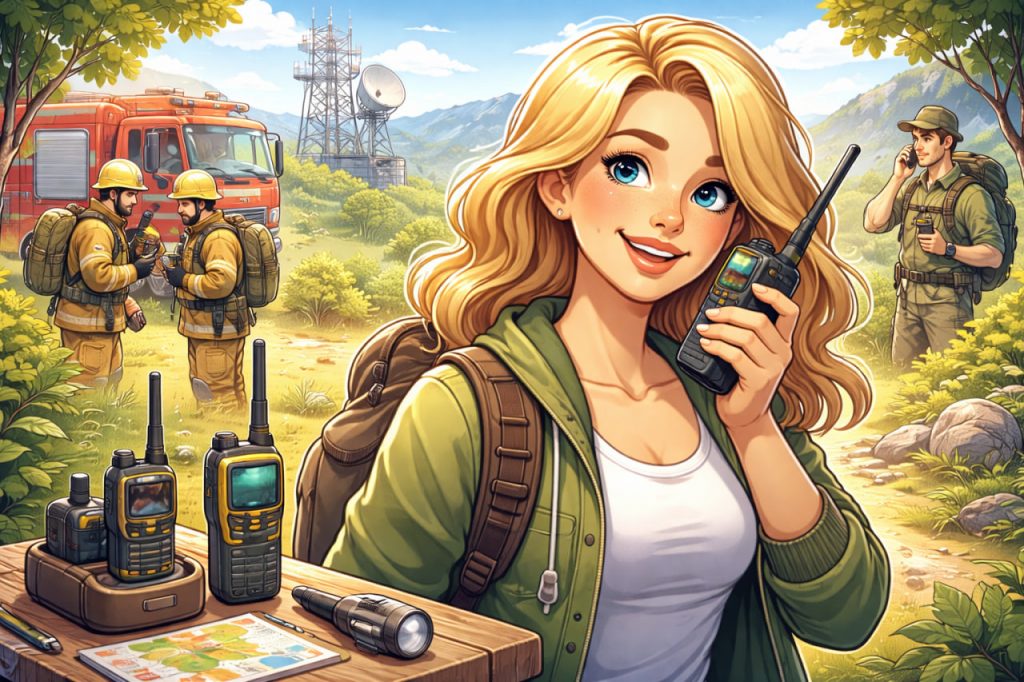
Radio communication devices, commonly known as walkie-talkies, are portable tools that allow people to communicate over distance without the need for cellular networks or the internet. These devices use radio waves to transmit voice signals instantly between users. Despite the development of smartphones and modern communication systems, radios remain essential in many fields due to their reliability, simplicity, and independence from infrastructure. From emergency services to outdoor activities, radios provide a fast and effective way to stay connected. Understanding how they work and where they are used helps explain why they are still widely relevant today.
How Radio Communication Works
A walkie-talkie operates by converting sound into radio signals. When a user speaks into the device, the microphone transforms the voice into an electrical signal. This signal is then transmitted as radio waves through an antenna. Another radio tuned to the same frequency receives the signal and converts it back into sound through a speaker. Most walkie-talkies use a push-to-talk (PTT) system, meaning only one person can speak at a time on a given channel. This simple mechanism ensures clear communication without overlapping signals.
Frequencies and Channels
Radios operate on specific frequencies, which are divided into channels. To communicate, users must be on the same channel. Different frequency ranges are used depending on the purpose, such as public use, professional communication, or emergency services. Some radios allow switching between multiple channels to avoid interference or crowded frequencies. The ability to choose channels makes radio communication flexible and adaptable to different environments.
Range and Limitations
The communication range of a radio depends on several factors, including power output, terrain, and obstacles. In open areas, radios can transmit signals over several kilometers. However, buildings, mountains, and dense forests can reduce range by blocking or weakening signals. More advanced radios use repeaters—devices that receive and retransmit signals—to extend communication distance. While radios are highly reliable, they are still affected by physical conditions and environmental factors.
Types of Radios
There are several types of radio communication devices designed for different uses. Consumer walkie-talkies are simple and easy to use, often used for recreational purposes such as hiking or events. Professional radios are more powerful and durable, used by security teams, construction workers, and event staff. Emergency and military radios are designed for extreme reliability and may include encryption and advanced features. Each type is adapted to specific needs, balancing simplicity, power, and functionality.
Practical Applications
Radios are widely used in many areas of modern life. Emergency services such as police, firefighters, and rescue teams rely on them for instant communication in critical situations. In construction and logistics, radios help coordinate teams efficiently. Outdoor enthusiasts use them in areas without mobile coverage, such as mountains or forests. Radios are also essential in aviation and maritime communication, where reliable contact is crucial for safety. Their ability to function independently of networks makes them especially valuable in remote or emergency conditions.
Advantages Over Modern Devices
Despite the popularity of smartphones, radios offer several advantages. They provide instant communication without dialing, work without internet or cellular signals, and often have longer battery life. They are also more durable and can operate in harsh conditions where other devices might fail. These features make radios a dependable choice in situations where reliability is more important than convenience.
Why Radios Still Matter
Radio communication remains a vital technology because of its simplicity, reliability, and independence. While modern devices offer more features, they also depend on infrastructure that may not always be available. Radios continue to serve as a backup communication system and, in many cases, the primary one. Their continued use across industries shows that even older technologies can remain essential when they perform their function effectively.
Interesting Facts
- Walkie-talkies were widely used during World War II for military communication.
- Radio signals travel at the speed of light.
- Some professional radios can operate over dozens of kilometers with repeaters.
- Radios can work without any internet or mobile network.
- The push-to-talk system prevents people from speaking at the same time.
Glossary
- Radio Waves — electromagnetic waves used to transmit information through the air.
- Frequency — the specific range at which a radio signal is transmitted.
- Channel — a designated frequency used for communication.
- Antenna — a component that sends and receives radio signals.
- Push-to-Talk (PTT) — a system where the user presses a button to speak.