Biomimicry is an approach in science and engineering where ideas are drawn from natural systems, organisms, and processes to solve human problems. Instead of inventing solutions from scratch, researchers study how nature has already optimized structures and mechanisms over millions of years of evolution. This method has led to innovations in materials, architecture, medicine, and technology. Nature operates efficiently, using minimal energy and resources, which makes it an ideal model for sustainable design. Biomimicry is not about copying nature directly, but about understanding the principles behind natural solutions and applying them in new contexts.
What Is Biomimicry
The term biomimicry comes from the combination of “bio” (life) and “mimicry” (imitation). It refers to studying biological systems to develop technologies that are efficient, adaptive, and sustainable. For example, engineers might analyze how plants capture sunlight or how animals move through air and water. These observations are then translated into practical designs. Biomimicry bridges disciplines such as biology, engineering, and design, creating solutions that align more closely with natural processes.
Famous Examples
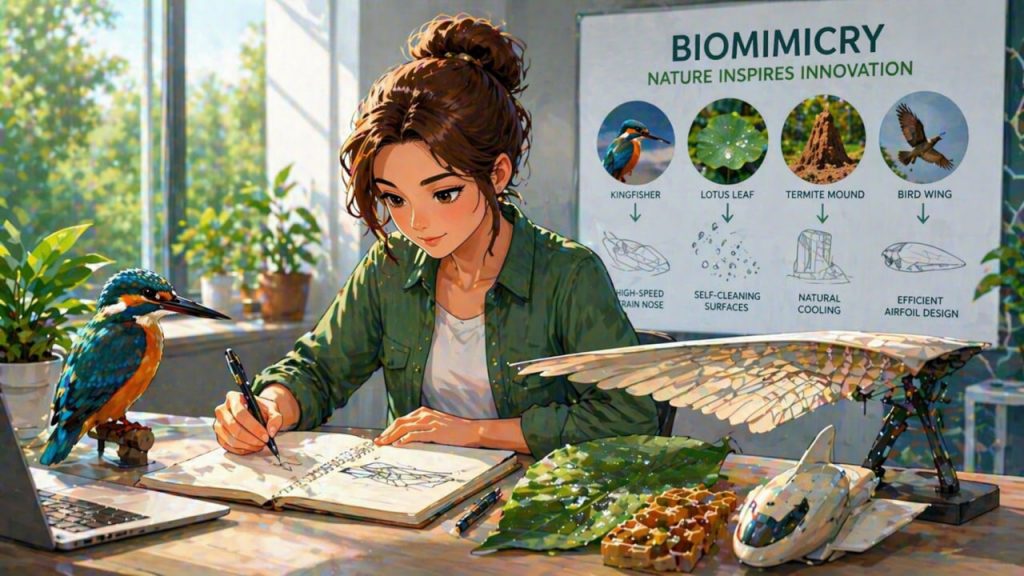
One well-known example of biomimicry is the development of Velcro, inspired by the way burr seeds attach to animal fur using tiny hooks. Another example is the design of high-speed trains, where the shape of the front was influenced by the beak of a kingfisher bird to reduce noise and improve efficiency. In architecture, buildings have been designed to mimic termite mounds, which regulate temperature naturally through airflow. These examples show how observing nature can lead to practical and effective innovations.
Materials and Structures
Nature provides inspiration for advanced materials with unique properties. For instance, spider silk is incredibly strong and flexible, inspiring research into new types of fibers. The structure of bones, which are both lightweight and strong, has influenced engineering design in construction and manufacturing. Surfaces inspired by lotus leaves have led to self-cleaning materials that repel water and dirt. These natural designs often outperform synthetic ones in efficiency and sustainability.
Energy and Efficiency
Biomimicry also plays a role in improving energy use. Solar panels can be designed based on the arrangement of leaves to maximize sunlight absorption. Wind turbine blades have been influenced by the shape of whale fins, improving efficiency and reducing noise. These designs show how nature can guide the development of technologies that use less energy while achieving better performance. By studying ecosystems, engineers can also design systems that recycle resources more effectively.
Medicine and Technology
In medicine, biomimicry has inspired innovations such as adhesives based on the way geckos climb surfaces and needles modeled after mosquito proboscises to reduce pain. Robotics has also benefited from biomimicry, with machines designed to move like animals for better mobility and adaptability. These applications demonstrate how biological systems can inform solutions in complex and sensitive fields.
Why Biomimicry Matters
Biomimicry offers a path toward sustainable innovation. Natural systems operate in balance with their environment, minimizing waste and maximizing efficiency. By applying these principles, engineers can create technologies that are not only effective but also environmentally responsible. This approach is increasingly important as global challenges such as resource scarcity and climate change require smarter solutions.
A Future Inspired by Nature
As research continues, biomimicry is likely to play an even greater role in shaping technology and design. Advances in biology and materials science allow for deeper understanding of natural systems, opening new possibilities for innovation. By learning from nature rather than working against it, humanity can develop solutions that are both practical and sustainable. Biomimicry represents a shift in thinking—one where nature is seen not just as a resource, but as a teacher and guide.
Interesting Facts
- Velcro was inspired by plant burrs sticking to fur.
- Termite mounds influenced energy-efficient building design.
- Whale fin shapes improved wind turbine efficiency.
- Lotus leaves inspired self-cleaning surfaces.
- Spider silk is one of the strongest natural fibers known.
Glossary
- Biomimicry — using nature-inspired solutions in engineering and design.
- Adaptation — a feature that helps an organism survive in its environment.
- Sustainability — using resources in a way that does not harm future generations.
- Ecosystem — a system of living organisms interacting with their environment.
- Innovation — the creation of new ideas or technologies.