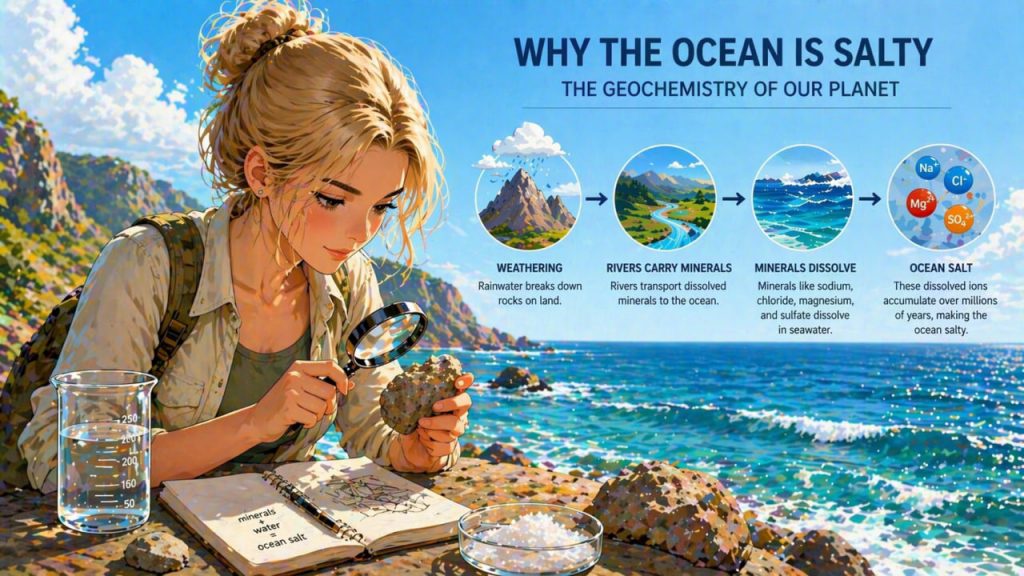
The salty taste of ocean water is one of the most familiar features of Earth, yet its origin is the result of long-term geological and chemical processes acting over billions of years. The oceans did not start out as salty as they are today. Instead, their composition gradually changed as minerals were transported, dissolved, and recycled through Earth’s systems. The saltiness of the ocean reflects a balance between inputs from land and the seafloor and processes that remove or store dissolved elements. Understanding this balance reveals how deeply connected the ocean is to the planet’s geology.
The Role of Weathering on Land
One of the main sources of ocean salts is the weathering of rocks on land. Rainwater absorbs carbon dioxide from the atmosphere, forming a weak acid that slowly breaks down rocks. This process releases minerals such as sodium, calcium, and potassium. Rivers then carry these dissolved ions into the ocean. Over millions of years, this continuous input has added vast amounts of dissolved material to seawater. Among these elements, sodium and chloride become the dominant components, forming common salt.
Volcanic and Hydrothermal Contributions
Another important source of ocean salts comes from volcanic activity and hydrothermal vents on the ocean floor. Seawater seeps into cracks in the Earth’s crust, where it is heated and reacts with surrounding rocks. These reactions release minerals into the water and alter its chemical composition. When the water returns to the ocean, it carries dissolved elements that contribute to overall salinity. This process shows that the ocean is not only influenced by surface processes but also by deep Earth interactions.
Why the Ocean Doesn’t Keep Getting Saltier
A natural question arises: if rivers constantly bring minerals into the ocean, why doesn’t it become endlessly saltier? The answer lies in removal processes that balance the input. Some dissolved ions are used by marine organisms to build shells and skeletons, which eventually settle to the seafloor. Others become trapped in sediments or chemically react to form new minerals. These processes remove certain elements from seawater, maintaining a relatively stable level of salinity over long periods.
Why Sodium and Chloride Dominate
Not all elements remain in seawater equally. Sodium and chloride dominate because they are highly soluble and less reactive compared to other ions. This means they are not easily removed by biological or chemical processes. As a result, they accumulate over time, making up the majority of ocean salinity. This selective accumulation is a key part of the ocean’s chemical balance.
The Average Salinity of the Ocean
The average salinity of seawater is about 3.5%, meaning that for every liter of seawater, approximately 35 grams are dissolved salts. This value can vary depending on location. Areas with high evaporation, such as subtropical regions, tend to have higher salinity, while regions with heavy rainfall or freshwater input have lower salinity. Despite these variations, the global average remains relatively stable due to the balance of geological processes.
A Dynamic and Connected System
The salinity of the ocean is not a static feature but part of a dynamic Earth system involving the atmosphere, land, and interior of the planet. Processes such as plate tectonics, erosion, and ocean circulation all contribute to maintaining chemical balance. This interconnected system operates over vast timescales, shaping the composition of seawater we observe today.
Why It Matters
Ocean salinity affects marine life, ocean circulation, and climate. Differences in salinity influence water density, which drives currents that distribute heat around the planet. These currents play a crucial role in regulating global climate. In addition, the chemical composition of seawater determines the conditions in which marine organisms live. Studying ocean salinity helps scientists understand both Earth’s past and its future.
Interesting Facts
- The ocean contains billions of tons of dissolved salt.
- If all ocean salt were removed, it could cover land in a thick layer.
- Rivers continuously supply minerals, but salinity remains stable due to natural balance.
- Sodium and chloride make up about 85% of dissolved salts in seawater.
- Ocean salinity plays a role in global climate regulation.
Glossary
- Salinity — the concentration of dissolved salts in water.
- Weathering — the breakdown of rocks into smaller particles and dissolved ions.
- Hydrothermal Vents — openings on the seafloor where heated water releases minerals.
- Ions — charged particles dissolved in water.
- Geochemistry — the study of chemical processes within Earth systems.