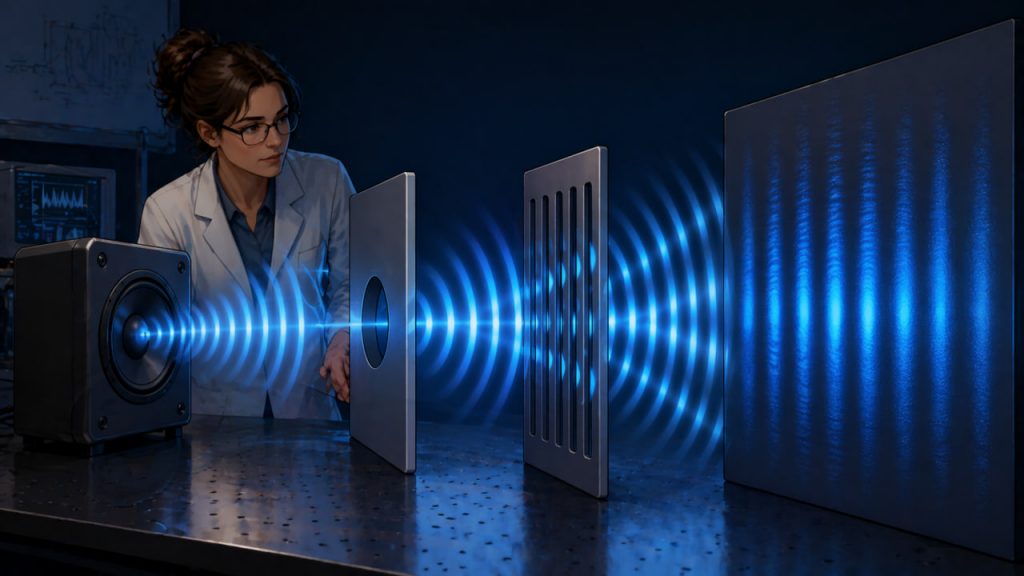
The term “laser” usually brings to mind beams of light used in medicine, communication, and technology. But scientists have discovered a fascinating counterpart: acoustic lasers, devices that amplify and control sound waves in ways similar to how traditional lasers manipulate light. These systems open new possibilities in physics, engineering, and medicine, challenging our understanding of waves and energy.
What Is an Acoustic Laser?
An acoustic laser, often called a “saser” (Sound Amplification by Stimulated Emission of Radiation), is a device that produces highly controlled and coherent sound waves. Just like optical lasers emit focused light, acoustic lasers generate concentrated vibrations in materials.
Key characteristics of acoustic lasers:
- Coherent sound waves (waves in phase)
- High intensity and precision
- Controlled frequency and direction
- Ability to focus energy in very small areas
Instead of photons (light particles), acoustic lasers deal with phonons, which are quantum units of sound or vibration in a material.
How Acoustic Lasers Work
Acoustic lasers rely on principles similar to traditional lasers, particularly stimulated emission. In a laser, excited atoms release photons that trigger other atoms to emit identical photons, creating a coherent beam of light.
In an acoustic laser:
- Vibrational energy is introduced into a material
- Phonons are generated and amplified
- These phonons stimulate further emissions
- A coherent sound wave builds up
This process often occurs in specially engineered structures such as semiconductors or nanomaterials.
Physicist Dr. Anthony Kent, a researcher in acoustic wave technologies, explains:
“Acoustic lasers allow us to control sound at the nanoscale with a precision that was previously impossible, opening new frontiers in both fundamental physics and practical applications.”
What Are Phonons?
To understand acoustic lasers, it is important to grasp the concept of phonons.
Phonons are:
- Quantized vibrations in a solid
- Carriers of sound and heat energy
- Analogous to photons in light
They are not particles in the traditional sense but represent energy moving through a material’s structure.
By controlling phonons, scientists can manipulate how sound and heat travel at extremely small scales.
Where Are Acoustic Lasers Used?
Although still an emerging technology, acoustic lasers have several promising applications.
Nanotechnology and Materials Science
Acoustic lasers can control vibrations in nanostructures, allowing scientists to:
- Study material properties
- Improve semiconductor performance
- Design new materials with unique behaviors
Medical Applications
High-precision sound waves can be used for:
- Targeted drug delivery
- Non-invasive surgery
- Imaging techniques
Communication and Signal Processing
Acoustic waves can carry information, especially in environments where light or radio waves are less effective.
Quantum Technologies
Phonons may play a role in:
- Quantum computing
- Information storage
- Advanced sensing systems
Differences Between Optical and Acoustic Lasers
While both systems rely on similar physical principles, there are key differences:
| Optical Laser | Acoustic Laser |
|---|---|
| Uses photons | Uses phonons |
| Travels through space or media | Travels through materials |
| Operates at extremely high speeds | Moves slower than light |
| Common in everyday technology | Still largely experimental |
Despite these differences, both systems demonstrate how wave behavior can be controlled and amplified.
Why Acoustic Lasers Are Important
Acoustic lasers represent a new way to control energy at very small scales. This has implications for both science and technology.
They allow researchers to:
- Explore quantum behavior in solids
- Manipulate heat and sound precisely
- Develop new types of sensors and devices
In the future, they could lead to breakthroughs in computing, medicine, and materials engineering.
Challenges and Limitations
Despite their potential, acoustic lasers face several challenges:
- Complex fabrication at nanoscale
- Energy loss due to material imperfections
- Difficulty maintaining coherence
- Limited practical applications so far
Research is ongoing to overcome these obstacles and make the technology more accessible.
Interesting Facts
- The first experimental acoustic lasers were developed using semiconductor structures.
- Phonons can interact with electrons, influencing electrical conductivity.
- Acoustic lasers can operate at extremely high frequencies, even in the gigahertz range.
- They may help improve thermal management in electronics.
- Some systems use crystals to guide and amplify sound waves precisely.
Glossary
- Phonon — a quantum unit of vibrational energy in a material.
- Coherence — a property where waves maintain a constant phase relationship.
- Stimulated Emission — a process where one wave triggers the emission of another identical wave.
- Nanotechnology — the manipulation of matter at extremely small scales.
- Semiconductor — a material used in electronic devices that can conduct electricity under certain conditions.