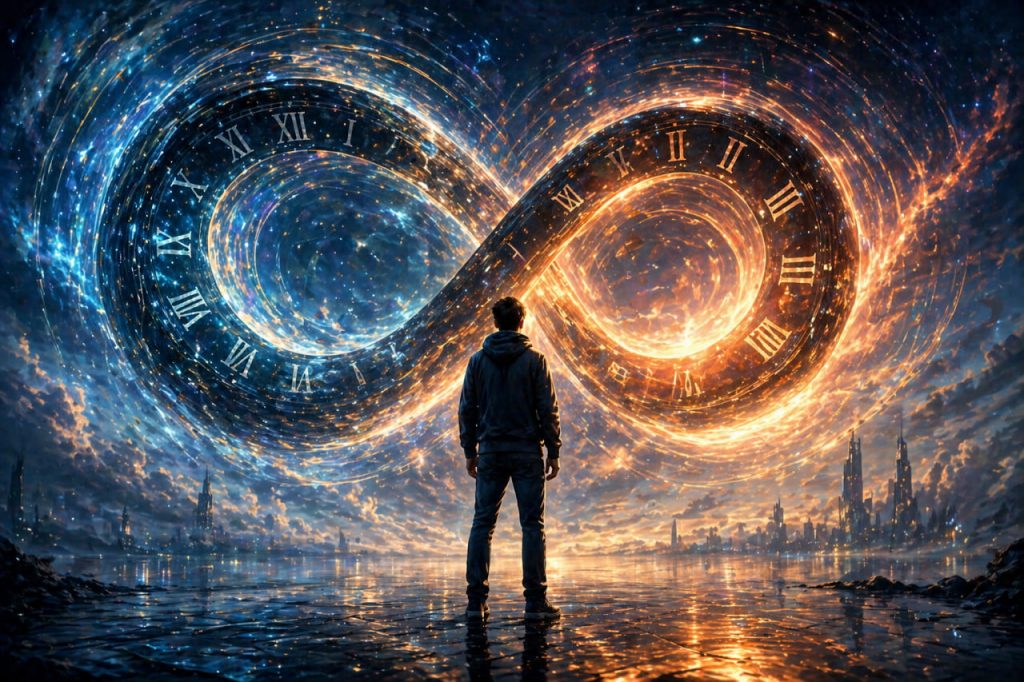
Time is usually perceived as a straight line—flowing from the past, through the present, and into the future. However, modern physics suggests that time may be far more complex. Under certain theoretical conditions, it might even behave like a loop, allowing events to influence themselves. This leads to one of the most intriguing questions in science: are time paradoxes physically possible, or are they just logical puzzles?
What Does It Mean for Time to Be a Loop?
In everyday experience, time moves forward in one direction. But in theoretical physics, spacetime—the combined structure of space and time—can bend and curve under extreme conditions.
A “time loop” refers to a situation where an object or event returns to its own past. This idea appears in solutions to Einstein’s equations of general relativity, where gravity can warp spacetime so strongly that paths through time can curve back on themselves.
These paths are known as closed timelike curves, meaning a traveler could theoretically return to an earlier point in their own timeline.
The Role of General Relativity
Einstein’s theory of general relativity describes how massive objects distort spacetime. Under extreme conditions, such as near black holes or in hypothetical cosmic structures, spacetime could become so warped that time behaves non-linearly.
Physicist Kurt Gödel demonstrated a solution to Einstein’s equations in which the universe rotates in a way that allows time loops to exist. While this model does not describe our actual universe, it proves that the laws of physics do not completely forbid such structures.
Famous Time Paradoxes Explained
If time loops were possible, they would create paradoxes—situations where cause and effect become inconsistent.
The Grandfather Paradox
This is the most well-known example. Imagine traveling back in time and preventing your grandfather from meeting your grandmother. This would mean you were never born—so how could you travel back in time in the first place?
This paradox highlights a contradiction in cause and effect.
The Bootstrap Paradox
In this scenario, an object or piece of information exists without a clear origin. For example, a scientist receives a future version of a book, publishes it, and that same book is later sent back in time.
The question becomes: who actually created the information?
Do Physics Laws Allow Paradoxes?
Interestingly, many physicists believe that while time loops may be mathematically possible, true paradoxes are not.
Stephen Hawking proposed the chronology protection conjecture, which suggests that the laws of physics prevent time travel scenarios that would create paradoxes.
He famously stated:
“The laws of physics conspire to prevent time travel on a macroscopic scale.”
This idea implies that even if time loops could exist, something would always stop paradoxical situations from occurring.
Quantum Mechanics and Time Consistency
At the quantum level, some theories suggest that time travel could be self-consistent. This means events would adjust in such a way that contradictions never arise.
For example, if you traveled back in time, your actions would already be part of history. You could not change the past in a way that creates a contradiction—you would only fulfill it.
This concept is known as the self-consistency principle, proposed by physicist Igor Novikov.
Wormholes: A Possible Gateway to Time Loops
One of the most discussed mechanisms for time travel involves wormholes, theoretical tunnels connecting distant points in spacetime.
If one end of a wormhole experienced time differently—due to high speed or strong gravity—it could create a situation where traveling through it leads to the past.
However, maintaining a stable wormhole would require exotic matter, a hypothetical substance with unusual properties that has not been observed in reality.
Why Time Paradoxes Remain Unproven
Despite fascinating theories, there is no experimental evidence that time loops or paradoxes actually exist.
Challenges include:
- Extreme conditions required to bend spacetime
- Lack of observed wormholes
- Limits of current technology
As a result, time paradoxes remain theoretical concepts rather than physical realities.
What This Means for Our Understanding of Time
The study of time loops and paradoxes pushes the boundaries of physics and philosophy. It forces scientists to rethink:
- The nature of causality
- The structure of spacetime
- The limits of physical laws
Even if time travel is never possible, exploring these ideas helps deepen our understanding of the universe.
Interesting Facts
- Some solutions to Einstein’s equations allow time loops mathematically.
- Black holes can slow down time relative to distant observers.
- Quantum theories suggest that paradoxes may resolve themselves naturally.
- Wormholes are a common concept in theoretical physics but remain unproven.
- The idea of time loops appears frequently in science fiction but is rooted in real equations.
Glossary
- Spacetime — The combined framework of space and time in physics.
- Closed Timelike Curve — A path through spacetime that returns to its starting point in time.
- Paradox — A logical contradiction arising from conflicting conditions.
- Wormhole — A hypothetical tunnel connecting different points in spacetime.
- Self-Consistency Principle — The idea that time travel cannot create contradictions.