Static electricity is one of the simplest yet most fascinating phenomena in physics. Almost everyone has experienced it—whether through a small shock after touching a metal object or hair standing on end when rubbed with a balloon. Despite its simplicity, static electricity reveals fundamental principles about how electric charges behave.
Understanding static electricity not only explains everyday effects but also provides insight into the broader world of electromagnetism.
What Is Static Electricity?
Static electricity refers to the build-up of electric charge on the surface of an object. Unlike current electricity, where charges flow continuously, static electricity involves charges that remain in place until they are discharged.
These charges are typically electrons, which can move from one material to another. When electrons accumulate or are removed, objects become electrically charged.
How Static Charges Are Created
Static electricity is usually generated through a process called friction, where two materials are rubbed together.
During this process:
- Electrons transfer from one object to another
- One object becomes negatively charged (gains electrons)
- The other becomes positively charged (loses electrons)
This imbalance of charge creates an electric field around the objects.
Everyday Examples of Static Electricity
Static electricity appears in many common situations:
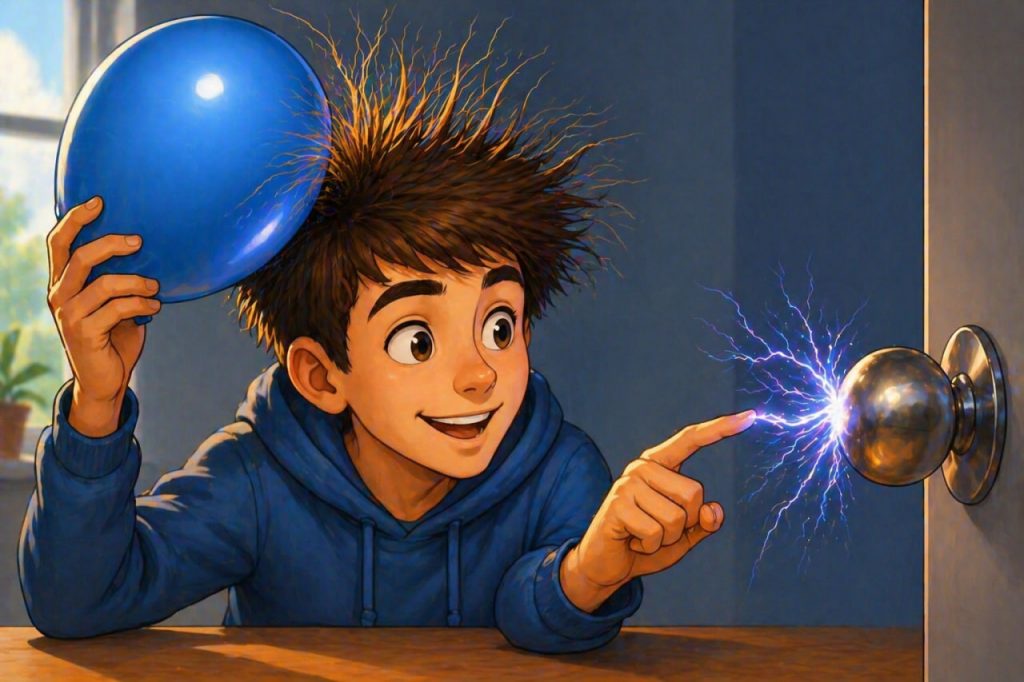
- A small shock when touching a doorknob
- Clothes sticking together after drying
- Hair standing up when rubbed with a balloon
- Dust particles being attracted to surfaces
These effects are usually harmless but demonstrate how powerful electric forces can be even at small scales.
Why You Feel a Shock
When a charged object comes close to a conductor (like a metal surface), the difference in charge can become strong enough to cause a sudden discharge.
This discharge:
- Happens extremely quickly
- Produces a tiny spark
- Creates the sensation of a shock
The energy involved is small, but the rapid movement of charge makes it noticeable.
The Role of Electric Fields
Static electricity creates an electric field, an invisible region where forces act on other charges.
This is why:
- Charged objects can attract or repel each other without touching
- Lightweight materials like paper or dust move toward charged surfaces
Electric fields are a fundamental concept in physics and play a key role in many technologies.
Static Electricity in Nature
Static electricity is not limited to small-scale effects. It also appears in powerful natural phenomena.
Lightning
Lightning is a large-scale example of static electricity. It occurs when:
- Charge builds up in clouds
- The electric field becomes extremely strong
- A massive discharge occurs between cloud and ground
This process releases enormous energy in a fraction of a second.
Useful Applications of Static Electricity
Static electricity is not just a curiosity—it has practical uses in technology.
Air Purifiers
Charged particles are used to attract dust and pollutants from the air.
Photocopiers and Printers
Electrostatic charges help transfer toner onto paper.
Industrial Coating
Electrostatic spraying ensures even distribution of paint or powder coatings.
Factors That Affect Static Electricity
Several conditions influence how easily static charge builds up.
- Humidity — Moist air reduces static buildup
- Material type — Some materials gain or lose electrons more easily
- Surface contact — More friction increases charge transfer
This is why static shocks are more common in dry environments.
Why Static Electricity Matters
Static electricity is a simple yet powerful demonstration of how electric forces work. It connects everyday experiences with deeper scientific principles and helps explain a wide range of natural and technological processes.
By studying static electricity, scientists have developed a better understanding of charge, fields, and energy—concepts that are essential to modern physics.
Interesting Facts
- Static electricity can reach thousands of volts, even in small everyday situations.
- Lightning can carry millions of volts and enormous energy.
- Dry air increases static buildup significantly.
- The human body can store electric charge temporarily.
- Static electricity played a key role in early discoveries about electricity.
Glossary
- Electric Charge — A property of matter that causes electrical forces.
- Electron — A negatively charged particle in atoms.
- Electric Field — A region where electric forces act.
- Discharge — The release of built-up electric charge.
- Friction — The force created when two surfaces rub together.