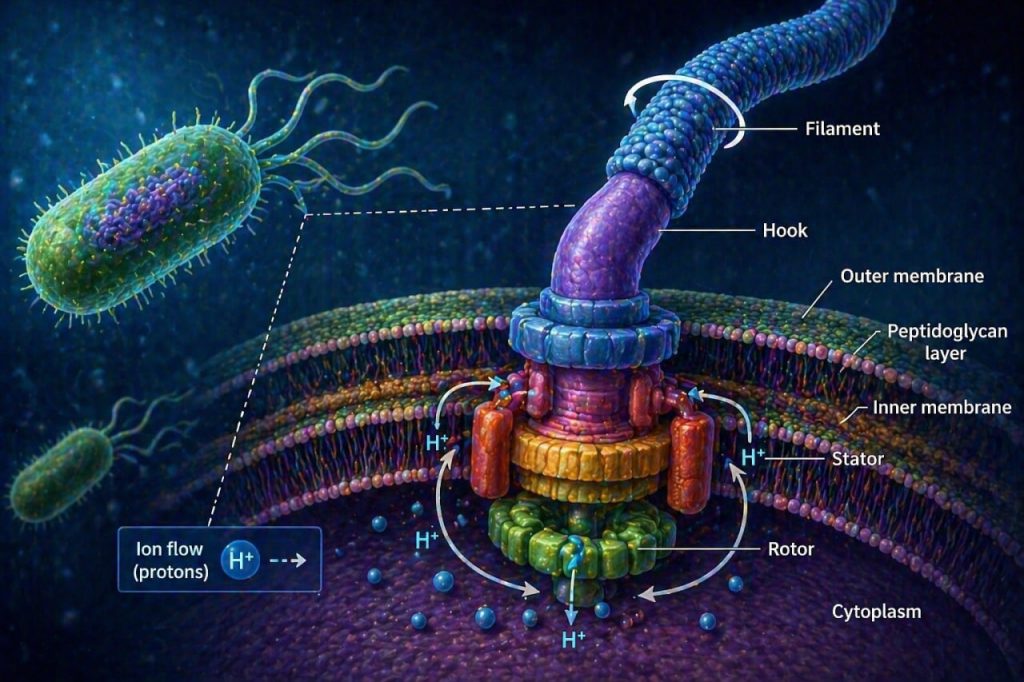
Among the most remarkable structures in biology is the flagellar motor of bacteria—a microscopic machine that allows single-celled organisms to move with incredible efficiency. These natural “engines” rotate like propellers, enabling bacteria to swim through liquids in search of nutrients or better environments.
Despite their tiny size, flagellar motors are among the most sophisticated biological systems ever discovered.
What Is a Flagellum?
A flagellum is a long, thin, whip-like structure that extends from the surface of certain bacteria. Its main function is movement.
Unlike simple tail-like appendages, bacterial flagella are powered by a rotary motor embedded in the cell membrane. This makes them fundamentally different from most biological motion systems, which rely on linear movement.
The Structure of the Flagellar Motor
The bacterial flagellar motor consists of several key parts:
- Filament — the long external “propeller” that pushes the bacterium forward
- Hook — a flexible connector that links the filament to the motor
- Basal body — the core motor embedded in the cell membrane
The basal body acts as the engine, converting energy into rotational motion.
How the Motor Works
The flagellar motor rotates using energy from an ion gradient—a difference in charged particles across the cell membrane.
Most commonly, this involves protons (hydrogen ions).
Here’s how it works:
- Protons flow through the motor structure
- This flow generates torque (rotational force)
- The motor spins the filament at high speed
This process is similar in concept to how turbines generate motion from flowing fluid.
Speed and Efficiency
Bacterial flagellar motors are incredibly fast and efficient.
- They can rotate up to tens of thousands of revolutions per minute
- They can switch direction in milliseconds
- They operate with high energy efficiency
This allows bacteria to respond quickly to changes in their environment.
Movement and Navigation
Bacteria use their flagella to perform a movement pattern known as “run and tumble.”
- Run — the bacterium swims in a straight line
- Tumble — it changes direction randomly
By adjusting the frequency of tumbling, bacteria can move toward favorable conditions, such as areas with more nutrients.
This behavior is known as chemotaxis—movement in response to chemical signals.
A Biological Nanomachine
The flagellar motor is often described as a nanomachine, meaning a machine operating at the molecular scale.
It has features similar to human-made devices:
- Rotating parts
- Energy conversion system
- Structural components
However, it is self-assembled and operates within a living cell.
Biophysicist Howard Berg, a leading researcher in this field, once said:
“The bacterial flagellar motor is the most efficient rotary engine known.”
Why It Matters in Science
Studying bacterial flagella helps scientists understand:
- How molecular machines work
- How energy is converted at small scales
- How life adapts to environments
It also inspires new technologies in nanotechnology and engineering.
Applications and Inspiration
The design of flagellar motors has influenced:
- Nanorobotics
- Microfluidic systems
- Artificial propulsion at microscopic scales
By learning from nature, engineers hope to create devices that mimic these efficient biological systems.
Limitations and Vulnerabilities
Despite their efficiency, flagella are sensitive to environmental conditions.
Factors that affect their function include:
- Changes in ion gradients
- Temperature
- Chemical environment
If the energy source is disrupted, the motor stops.
Why These Motors Are Extraordinary
The bacterial flagellar motor shows how complex and efficient biological systems can be, even at microscopic scales. It combines physics, chemistry, and biology into a single functioning unit.
It is a powerful example of how life has evolved highly optimized solutions to fundamental challenges like movement.
Interesting Facts
- Flagellar motors can rotate both clockwise and counterclockwise.
- Some bacteria have multiple flagella for increased mobility.
- The motor is powered by ion flow, not ATP directly.
- It assembles itself from proteins inside the cell.
- It is one of the smallest known rotary engines in nature.
Glossary
- Flagellum — A tail-like structure used for movement in some cells.
- Ion Gradient — A difference in ion concentration across a membrane.
- Torque — A force that causes rotation.
- Chemotaxis — Movement toward or away from chemical signals.
- Nanomachine — A machine operating at a molecular or atomic scale.