A nuclear explosion is one of the most powerful events humans can create. It releases an enormous amount of energy in a fraction of a second, far exceeding that of conventional explosives. To understand it properly, it is important to look at the physics behind nuclear reactions and how that energy is released.
The Source of Nuclear Energy
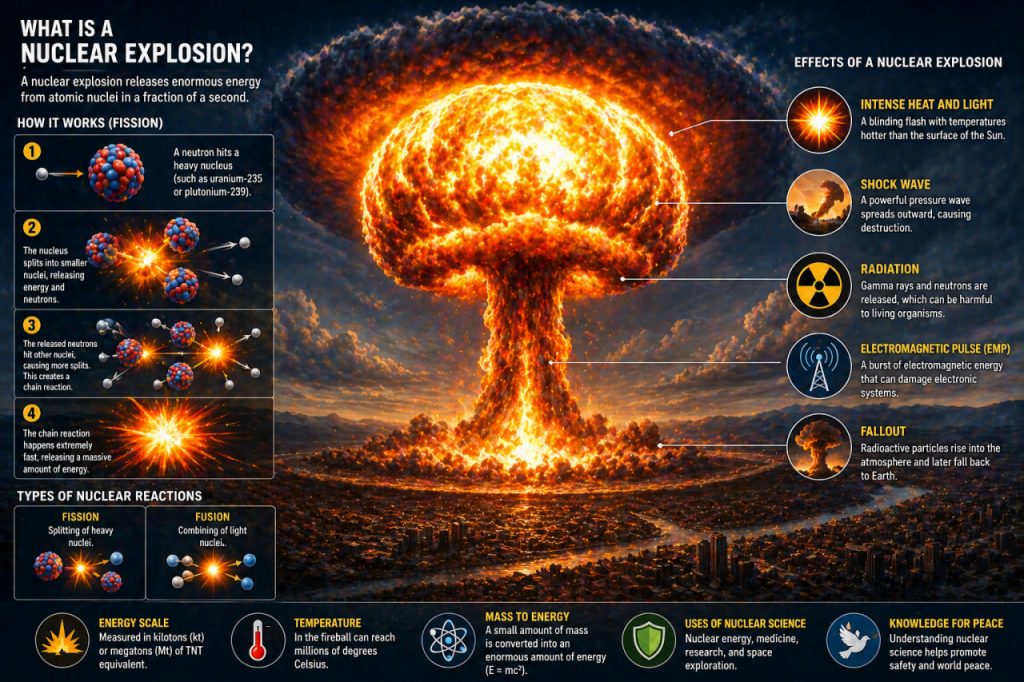
At the core of a nuclear explosion is the energy stored inside atomic nuclei. Atoms consist of a nucleus made of protons and neutrons, surrounded by electrons.
In nuclear physics, energy can be released in two main ways:
- Fission — splitting a heavy nucleus into smaller ones
- Fusion — combining light nuclei into a heavier one
Both processes convert a small amount of mass into a huge amount of energy, according to Einstein’s famous principle:
E=mc2E = mc^2E=mc2
This means even a tiny amount of mass can produce an enormous energy release.
Nuclear Fission: The Chain Reaction
Most nuclear explosions are based on fission reactions.
In fission:
- A heavy atom (such as uranium or plutonium) absorbs a neutron
- The nucleus becomes unstable and splits
- This releases energy and more neutrons
Those neutrons then trigger more fission events, creating a chain reaction.
If this reaction happens extremely fast and uncontrollably, it results in an explosion.
Nuclear Fusion: Even Greater Energy
Fusion reactions occur when light nuclei, such as hydrogen isotopes, combine under extreme conditions.
Fusion:
- Produces even more energy than fission
- Requires very high temperatures and pressure
- Occurs naturally in stars
Some nuclear weapons use fusion to greatly increase their energy output, but the physics behind it is also important for understanding stars and astrophysics.
What Happens During a Nuclear Explosion
A nuclear explosion releases energy in several forms almost instantly:
Intense Heat and Light
A bright flash forms, producing temperatures hotter than the surface of the Sun.
Shock Wave
A powerful pressure wave expands outward, capable of destroying structures.
Radiation
Various forms of radiation are emitted, including gamma rays and neutrons.
Electromagnetic Pulse (EMP)
A burst of electromagnetic energy can disrupt electronic systems.
The Fireball and Mushroom Cloud
The initial explosion creates a fireball, a rapidly expanding sphere of extremely hot gas.
As it rises:
- Hot air moves upward
- Cooler air is drawn in below
- This forms the characteristic mushroom cloud
This cloud is a visible result of intense heat and atmospheric movement.
Energy Scale of Nuclear Explosions
The energy released is often measured in kilotons or megatons of TNT equivalent.
- 1 kiloton = energy of 1,000 tons of TNT
- Nuclear explosions can reach millions of tons equivalent
This scale shows how much more powerful nuclear reactions are compared to chemical explosions.
Differences from Conventional Explosions
Unlike chemical explosions:
- Nuclear explosions release energy from the atomic nucleus
- The energy density is vastly higher
- The effects are more complex and long-lasting
This makes them fundamentally different in both physics and impact.
Why Understanding Matters
Studying nuclear explosions is important for several reasons:
- Understanding fundamental physics
- Improving safety in nuclear technology
- Developing peaceful uses of nuclear energy
- Preventing misuse through knowledge and control
Modern science focuses heavily on controlling nuclear reactions safely, such as in power plants.
P.S. Unfortunately, we have turned the technologies that could provide the entire planet with clean energy into the deadliest weapon on the planet. Why? Because instead of self-knowledge, self-development, and the development of the best inner qualities, many choose to live under the dictation of negative thoughts in their heads – but once they understand this, they can change their lives for the better. To begin with, at least, helping those in need and society…
Interesting Facts
- Nuclear reactions release millions of times more energy than chemical reactions.
- The temperature in a nuclear fireball can exceed millions of degrees.
- Fusion reactions power stars like the Sun.
- The mushroom cloud forms due to rising hot air and pressure differences.
- Nuclear physics is also used in medicine and energy production.
Glossary
- Fission — Splitting of a heavy atomic nucleus.
- Fusion — Combining of light nuclei into a heavier one.
- Chain Reaction — A self-sustaining series of reactions.
- Radiation — Energy emitted in the form of particles or waves.
- Fireball — The initial hot sphere formed in an explosion.