Stars are among the most fundamental objects in the universe. They light up galaxies, create the elements necessary for life, and shape cosmic evolution. Yet, like all things, stars are not eternal. They are born, evolve, and eventually die—sometimes quietly, sometimes in spectacular explosions.
Understanding the life cycle of stars reveals how the universe itself changes over time.
The Birth of a Star
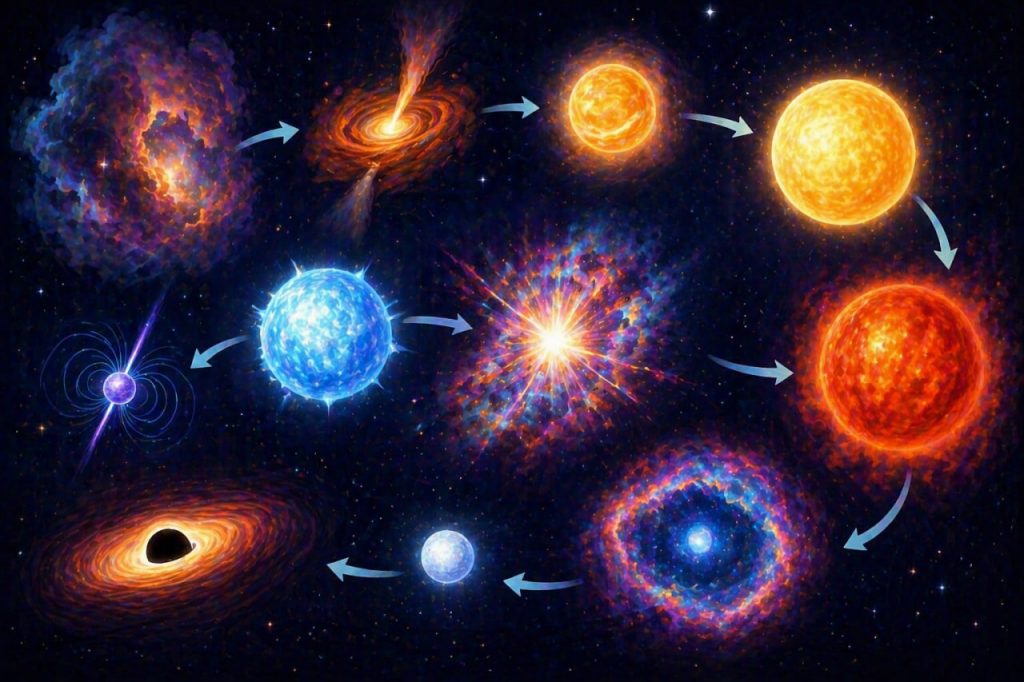
Stars are born inside vast clouds of gas and dust called nebulae. These regions are mostly composed of hydrogen, the simplest and most abundant element in the universe.
Gravitational Collapse
A star begins to form when a region within a nebula starts to collapse under its own gravity. This can be triggered by:
- Shock waves from nearby supernovae
- Collisions between gas clouds
- Instabilities within the nebula
As the cloud collapses:
- It becomes denser and hotter
- A core begins to form
- Matter continues to fall inward
This early stage is called a protostar.
The Birth of Nuclear Fusion
As the protostar grows, its core temperature rises dramatically. When it reaches about 10 million degrees Celsius, a critical process begins: nuclear fusion.
In this process:
- Hydrogen atoms fuse into helium
- Enormous amounts of energy are released
This energy creates outward pressure that balances gravity. At this point, a stable star is born.
The Main Sequence: A Star’s Stable Life
Most of a star’s life is spent in the main sequence phase, where it steadily fuses hydrogen into helium.
During this stage:
- The star remains stable
- Energy output is relatively constant
- Size and brightness depend on mass
Our Sun is currently in this phase.
Larger stars:
- Burn fuel faster
- Live shorter lives
Smaller stars:
- Burn slowly
- Can live billions or even trillions of years
What Happens When Fuel Runs Out?
Eventually, hydrogen in the core becomes depleted. Without fusion, the balance between pressure and gravity is disrupted.
This leads to dramatic changes.
The Death of Sun-Like Stars
Stars similar in size to the Sun follow a relatively gentle path.
Red Giant Phase
The star expands as fusion moves to outer layers. It becomes much larger and cooler on the surface.
Planetary Nebula
The outer layers are expelled into space, forming a glowing shell of gas.
White Dwarf
The remaining core becomes a white dwarf, a small, dense object that slowly cools over time.
The Death of Massive Stars
Massive stars have far more dramatic endings.
Red Supergiant
The star expands enormously and begins fusing heavier elements.
Supernova Explosion
When the core collapses, it triggers a supernova, one of the most powerful explosions in the universe.
This explosion:
- Releases enormous energy
- Spreads heavy elements into space
- Can outshine entire galaxies briefly
Neutron Stars and Black Holes
After a supernova, the core may become one of two extreme objects:
- Neutron Star — incredibly dense, with matter packed tightly together
- Black Hole — gravity becomes so strong that not even light can escape
These objects represent the final stages of stellar evolution for massive stars.
Why Stars Matter
Stars are not just sources of light—they are the factories of elements.
Inside stars:
- Hydrogen becomes helium
- Heavier elements like carbon, oxygen, and iron are formed
When stars die, they release these elements into space, allowing new stars, planets, and even life to form.
The Cosmic Cycle
The life and death of stars form a continuous cycle:
- Gas clouds form stars
- Stars produce elements
- Stars die and release material
- New stars form from that material
This cycle has been repeating for billions of years, shaping the universe we see today.
Interesting Facts
- The Sun is about halfway through its life cycle.
- Massive stars can live only a few million years.
- Supernova explosions create many of the elements found on Earth.
- Some neutron stars spin hundreds of times per second.
- Black holes can form from the collapse of massive stars.
Glossary
- Nebula — A cloud of gas and dust where stars form.
- Protostar — An early stage of star formation.
- Nuclear Fusion — The process of combining atoms to release energy.
- Red Giant — A late stage where a star expands.
- Supernova — A powerful stellar explosion.