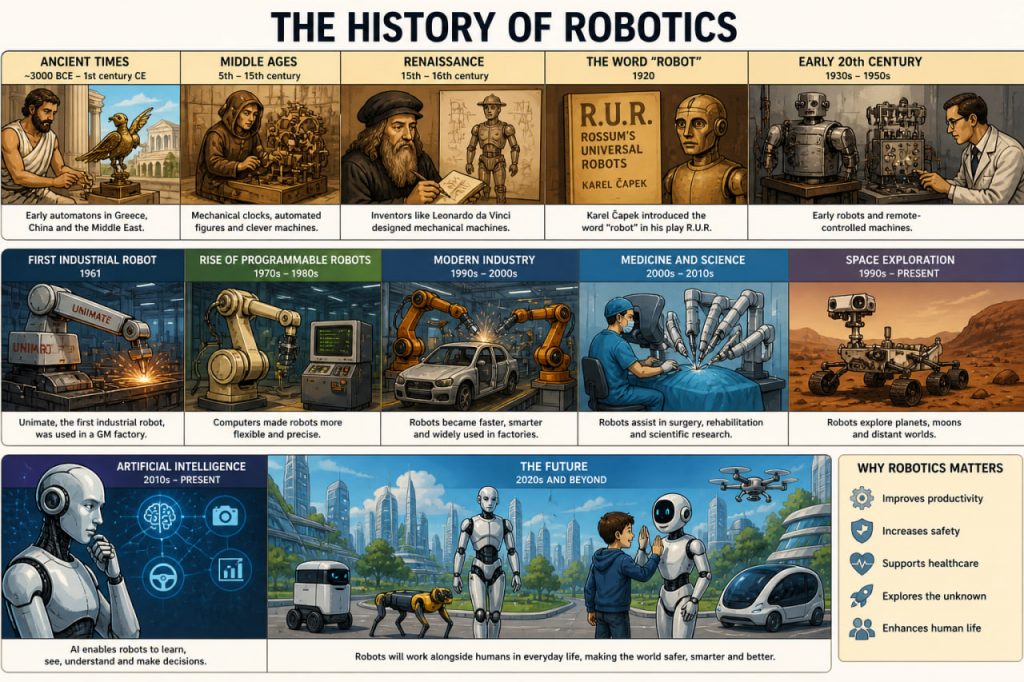
Robotics is one of the most exciting fields of modern technology, but its roots go back thousands of years. The idea of creating machines that can move and act like humans has fascinated people across different cultures and eras. Today, robots are used in industry, medicine, space exploration, and everyday life. Understanding the history of robotics helps us see how human imagination and engineering have evolved together over time.
Early Ideas and Ancient Automatons
The concept of robots began long before modern technology existed. Ancient civilizations imagined mechanical beings capable of movement.
In ancient Greece:
- Engineers designed simple mechanical devices powered by water and steam
- Inventor Hero of Alexandria created early automatons that could perform basic actions
In ancient China and the Middle East:
- Craftsmen built mechanical figures that could move using gears and hydraulics
These early machines were not true robots, but they showed the first attempts to imitate life using technology.
The Birth of Mechanical Automation
During the Middle Ages and the Renaissance, mechanical engineering advanced significantly.
Inventors created:
- Mechanical clocks with moving figures
- Automated musical instruments
- Complex gear-based machines
Leonardo da Vinci even designed a mechanical knight that could move its arms and head. These inventions demonstrated a growing understanding of mechanics and motion.
The Origin of the Word “Robot”
The term “robot” was first introduced in 1920 by Czech writer Karel Čapek in his play R.U.R. (Rossum’s Universal Robots).
In the play:
- Robots were artificial workers
- They were created to serve humans
- The story explored themes of control and independence
The word “robot” comes from a term meaning “forced labor,” reflecting early concerns about automation.
Early 20th Century Developments
In the early 1900s, engineers began creating more advanced machines.
These included:
- Remote-controlled devices
- Early electromechanical systems
- Experimental humanoid machines
Although limited by technology, these developments laid the foundation for modern robotics.
The First Industrial Robots
The real breakthrough came in the mid-20th century.
In 1961:
- The first industrial robot, Unimate, was introduced
- It was used in a factory to handle hot metal parts
- It improved safety and efficiency
This marked the beginning of robotics in industry.
The Rise of Computer-Controlled Robots
With the development of computers, robots became much more capable.
Advancements included:
- Programmable systems
- Sensors for detecting the environment
- Improved precision and control
Robots could now perform complex tasks and adapt to different conditions.
Robotics in Modern Industry
Today, robots are widely used in manufacturing.
They perform tasks such as:
- Assembly
- Welding
- Packaging
- Quality control
Industrial robots work faster and more accurately than humans in repetitive tasks, increasing productivity.
Robotics in Medicine and Science
Robots are also transforming healthcare and research.
Applications include:
- Surgical robots that assist doctors
- Robots used in rehabilitation
- Laboratory automation
In space exploration:
- Robots explore planets and moons
- They operate in environments too dangerous for humans
Artificial Intelligence and Smart Robots
Modern robotics is closely linked to artificial intelligence (AI).
AI allows robots to:
- Learn from data
- Recognize objects
- Make decisions
This has led to the development of autonomous robots, including self-driving vehicles and service robots.
The Future of Robotics
The future of robotics is rapidly evolving.
Potential developments include:
- More human-like robots
- Integration with everyday life
- Advanced collaboration between humans and machines
Robots may become more adaptable, intelligent, and widely used in many fields.
Why Robotics Matters
Robotics reflects human creativity and the desire to improve life through technology. It combines engineering, science, and imagination to solve real-world problems.
From simple mechanical devices to intelligent systems, robotics shows how far technology has come—and how much further it can go.
Interesting Facts
- The first industrial robot was used in a car factory.
- The word “robot” originated in a science fiction play.
- Some robots can perform delicate surgeries.
- Space robots operate millions of kilometers away from Earth.
- Modern robots can learn using artificial intelligence.
Glossary
- Robot — A machine capable of carrying out tasks automatically.
- Automation — Use of machines to perform tasks without human intervention.
- Artificial Intelligence — Technology that allows machines to simulate human thinking.
- Sensor — A device that detects changes in the environment.
- Autonomous — Able to operate independently.