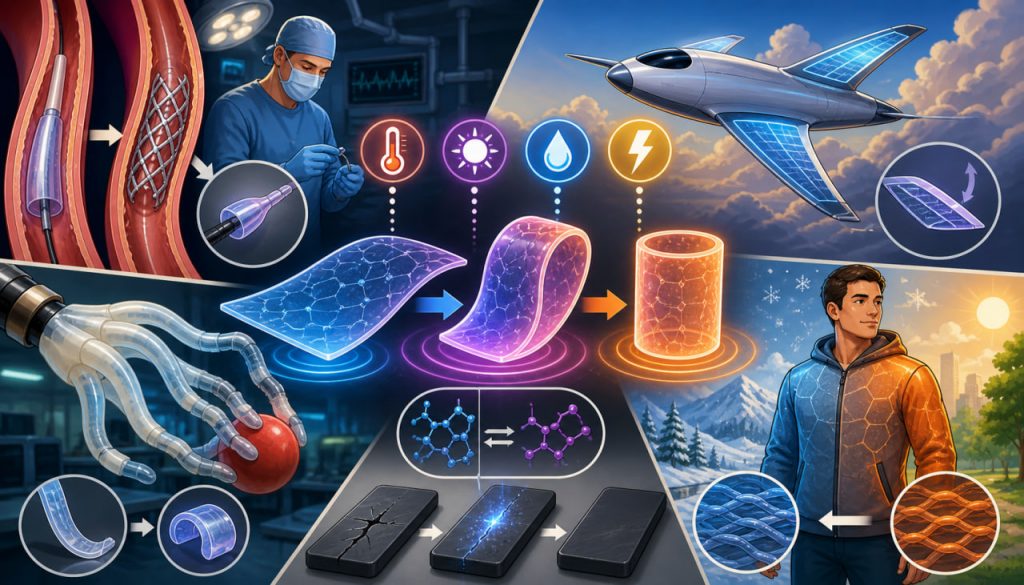
Materials that can change shape on their own sound like science fiction, but they are already becoming a reality. Known as shape-changing polymers or smart polymers, these advanced materials respond to external stimuli such as heat, light, moisture, or electric fields. They have the potential to transform industries ranging from medicine to aerospace.
Understanding how these materials work reveals a new generation of adaptive technologies that can respond to the environment in real time.
What Are Smart Polymers?
Polymers are long chains of molecules that form materials like plastics, rubber, and fibers. Smart polymers are specially designed so that their structure reacts to external conditions.
They can:
- Change shape
- Expand or contract
- Become rigid or flexible
- Respond to environmental changes
This ability comes from how their molecular chains are arranged and interact.
Shape Memory Polymers
One of the most important types is shape memory polymers (SMPs).
These materials can:
- Be deformed into a temporary shape
- Stay stable in that shape
- Return to their original form when triggered
Triggers can include:
- Heat
- Light
- Electrical signals
This “memory” is stored in the molecular structure.
How They Work
The behavior of these polymers depends on their internal structure.
At the molecular level:
- Chains are connected by cross-links
- Some segments are flexible, others are fixed
- External energy activates movement
When triggered, the polymer reorganizes itself and returns to its original configuration.
Types of Stimuli
Different smart polymers respond to different conditions.
Common triggers include:
- Temperature — heating activates movement
- Light — certain wavelengths cause structural changes
- pH levels — used in chemical and biological environments
- Electric fields — used in advanced devices
This makes them highly versatile.
Applications in Medicine
Smart polymers are especially promising in healthcare.
They are used in:
- Minimally invasive implants that expand inside the body
- Drug delivery systems that release medicine at the right location
- Surgical tools that adapt to body temperature
Dr. Andreas Lendlein, a leading researcher in this field, has emphasized:
“Shape-memory polymers enable medical devices that can change their function directly inside the human body.”
This ability can improve precision and reduce the need for complex procedures.
Applications in Engineering
In engineering, these materials can create adaptive structures.
Examples include:
- Aircraft components that adjust shape for efficiency
- Self-repairing materials
- Flexible electronics
Such systems can improve performance and durability.
Soft Robotics
Smart polymers are also key to soft robotics.
Unlike traditional robots made of rigid parts, soft robots:
- Move more naturally
- Adapt to their surroundings
- Can safely interact with humans
Shape-changing materials allow these robots to bend, stretch, and move in complex ways.
Advantages of Shape-Changing Polymers
These materials offer several important benefits:
- Lightweight and flexible
- Energy-efficient (require little power to change shape)
- Highly adaptable
- Can operate in difficult environments
This makes them ideal for future technologies.
Challenges and Limitations
Despite their potential, there are still challenges:
- Limited durability over repeated cycles
- Sensitivity to environmental conditions
- Cost of production
- Need for precise control mechanisms
Researchers are actively working to improve these aspects.
The Future of Smart Materials
Shape-changing polymers represent a shift toward materials that are no longer passive but active participants in technology.
In the future, we may see:
- Clothes that adjust to temperature
- Buildings that adapt to weather
- Medical devices that respond to the body automatically
These innovations could redefine how we interact with materials.
Interesting Facts
- Some smart polymers can “remember” multiple shapes.
- They can be triggered remotely using light or electricity.
- They are used in experimental space technologies.
- Certain polymers can repair small damages on their own.
- They are inspired by biological systems like muscles and skin.
Glossary
- Polymer — A material made of long chains of molecules.
- Shape Memory — Ability to return to an original form.
- Stimulus — An external factor that triggers change.
- Cross-links — Connections between polymer chains.
- Soft Robotics — Robots made from flexible materials.