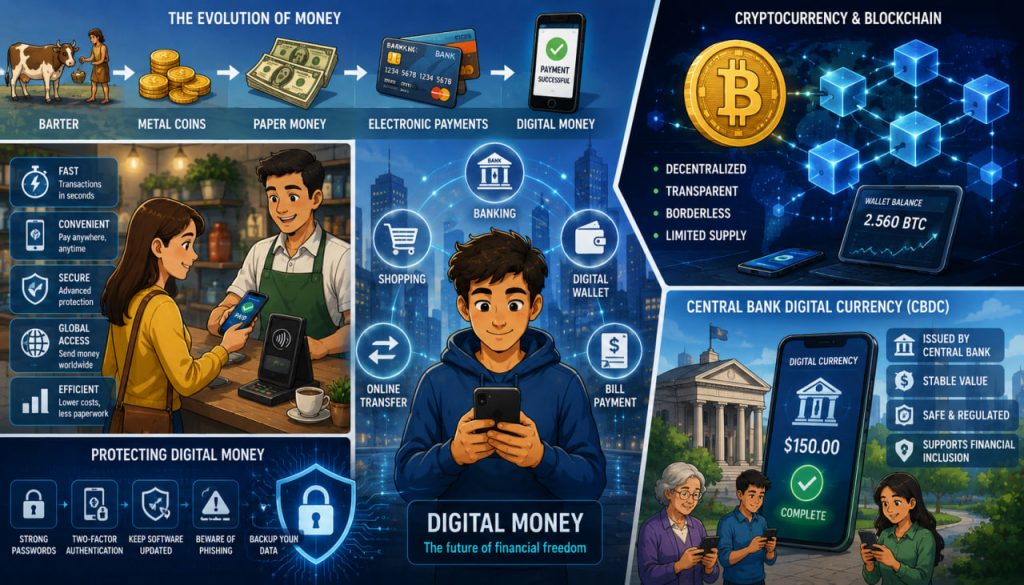
Money has evolved dramatically throughout human history. Ancient civilizations once relied on barter systems, then moved to metal coins, paper banknotes, and eventually electronic banking. Today, humanity is entering another major financial transformation — the era of digital money.
Digital money is rapidly becoming a central part of modern economies. People increasingly pay using smartphones, bank apps, online transfers, cryptocurrencies, and contactless systems rather than physical cash. Governments, banks, and technology companies are investing billions into digital financial infrastructure, while economists debate how these technologies may reshape society.
But what exactly is digital money, how did it emerge, and why do many experts believe it may become dominant in the future?
What Is Digital Money?
Digital money refers to any form of money that exists primarily in electronic form rather than as physical cash.
Examples include:
- Online bank balances
- Mobile payment systems
- Electronic transfers
- Digital wallets
- Cryptocurrencies
- Central bank digital currencies (CBDCs)
Unlike physical coins or paper bills, digital money is stored and transferred electronically through computer networks.
The Origins of Digital Payments
The foundations of digital money appeared long before cryptocurrencies existed.
In the second half of the 20th century, banks began using:
- Electronic databases
- Credit cards
- Automated payment systems
As the internet expanded in the 1990s and 2000s, online banking and digital transactions became increasingly common.
This shift gradually reduced dependence on physical cash in many countries.
Today, millions of transactions occur every second through global digital financial systems.
The Rise of Mobile Payments
Smartphones accelerated the growth of digital money dramatically.
Modern mobile payment systems allow users to:
- Pay in stores
- Send money instantly
- Shop online
- Transfer funds internationally
Countries such as China and Sweden became leaders in cashless payments, where many people rarely use physical money anymore.
Convenience is one of the biggest reasons for this transition.
Cryptocurrencies and Blockchain Technology
The launch of Bitcoin in 2009 introduced a new type of digital money called cryptocurrency.
Unlike traditional electronic banking systems controlled by banks, cryptocurrencies use decentralized networks based on blockchain technology.
A blockchain is a distributed digital ledger that records transactions across many computers.
Supporters argue that cryptocurrencies offer:
- Greater decentralization
- Reduced dependence on banks
- Borderless transactions
Critics point to:
- Price volatility
- Regulatory uncertainty
- Energy consumption concerns
Despite controversy, cryptocurrencies significantly influenced the global discussion about digital finance.
Why Digital Money Is Popular
Digital money offers several major advantages.
Speed
Transfers can happen almost instantly, even internationally.
Convenience
People can pay using phones, watches, or computers.
Accessibility
Digital systems allow online shopping and remote financial services.
Reduced Physical Handling
Digital payments reduce the need to carry cash.
Automation
Businesses can automate accounting and payment processes efficiently.
These advantages make digital finance highly attractive for modern economies.
Are Digital Payments More Secure?
Digital money can improve security in some ways.
For example:
- Stolen physical cash is usually unrecoverable
- Digital transactions may include fraud protection
- Banks monitor suspicious activity automatically
However, digital systems also introduce new risks:
- Cybercrime
- Hacking
- Data theft
- Online fraud
Cybersecurity has therefore become one of the most important aspects of modern finance.
Economist Eswar Prasad explained:
“Digital currencies could fundamentally reshape the nature of money and financial systems.”
This transformation creates both opportunities and challenges.
Central Bank Digital Currencies (CBDCs)
Many governments are now exploring official digital currencies issued directly by central banks.
These are called CBDCs.
Unlike cryptocurrencies:
- CBDCs are state-controlled
- Their value is linked to national currencies
- Governments regulate their operation
Countries are researching CBDCs to:
- Modernize payment systems
- Reduce transaction costs
- Improve financial inclusion
Some experts believe CBDCs may become a major future form of money.
Concerns About Privacy
One major debate surrounding digital money involves privacy.
Critics worry that fully digital financial systems could allow:
- Extensive transaction tracking
- Reduced anonymity
- Greater financial surveillance
Cash transactions are relatively private, while digital payments leave electronic records.
Balancing convenience and privacy remains a major political and ethical challenge.
The Decline of Physical Cash
In some countries, cash use has already declined sharply.
Many businesses increasingly prefer:
- Card payments
- Mobile payments
- Online banking
However, physical cash still remains important for:
- Emergency situations
- Rural areas
- Elderly populations
- Privacy concerns
Experts generally believe physical money will coexist with digital systems for many years.
Digital Money and the Global Economy
Digital finance is transforming:
- International trade
- Banking
- Consumer behavior
- Investment systems
Financial technology companies now compete directly with traditional banks in many areas.
This technological competition is accelerating innovation throughout the financial sector.
The Future of Money
Future financial systems may include:
- AI-powered banking
- Fully digital national currencies
- Faster global payment networks
- Biometric payment systems
Some experts believe cashless societies could eventually become normal in many regions.
However, debates about privacy, security, and government control will likely remain central issues.
Interesting Facts
- Most money in modern economies already exists digitally rather than as physical cash.
- Sweden is among the world’s most cashless societies.
- Bitcoin was introduced in 2009 by the mysterious figure known as Satoshi Nakamoto.
- Contactless payments expanded rapidly worldwide during the 2020s.
- Some countries are actively testing official digital currencies.
Glossary
- Digital Money — Money stored and transferred electronically.
- Blockchain — A distributed digital ledger recording transactions across multiple systems.
- Cryptocurrency — A decentralized digital currency using cryptographic technology.
- CBDC (Central Bank Digital Currency) — A government-issued digital national currency.
- Cybercrime — Criminal activity involving computers or digital networks.