Few astronomical events capture human attention as powerfully as eclipses. For thousands of years, people viewed eclipses with fear, wonder, and curiosity. Ancient civilizations often considered them supernatural signs, while modern science explains them as predictable alignments between celestial bodies.
Despite their scientific explanation, eclipses remain among the most breathtaking natural phenomena visible from Earth. Whether it is the dramatic darkening of the sky during a solar eclipse or the mysterious reddish glow of a lunar eclipse, these events remind humanity of the immense cosmic mechanics governing our Solar System.
Today, eclipses continue to fascinate astronomers, photographers, travelers, and millions of ordinary observers around the world.
What Is an Eclipse?
An eclipse occurs when one celestial body moves into the shadow of another or blocks its light.
In the Earth-Moon-Sun system, there are two main types:
- Solar eclipses
- Lunar eclipses
These events happen because the Moon orbits Earth while Earth orbits the Sun.
When the alignment becomes nearly perfect, shadows create dramatic visual effects visible from Earth.
Solar Eclipses: When Day Turns Into Night
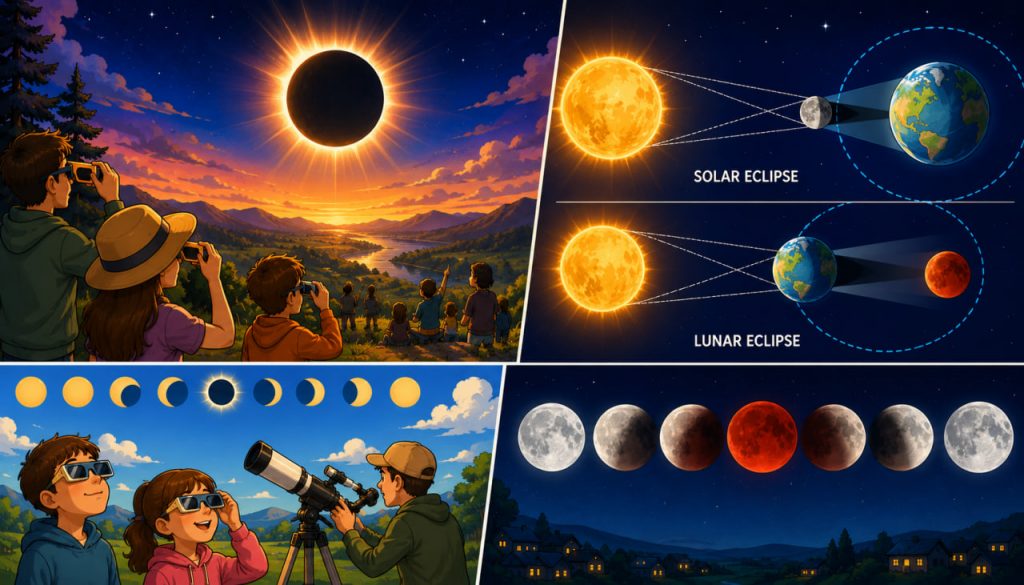
A solar eclipse happens when the Moon moves between Earth and the Sun, temporarily blocking sunlight.
During a total solar eclipse, the sky darkens dramatically even during daytime.
Observers may see:
- The Sun’s corona glowing around the Moon
- Stars appearing in the sky
- Sudden temperature drops
- Unusual animal behavior
Astronomer Fred Espenak, one of the world’s leading eclipse experts, described total solar eclipses as:
“Nature’s grandest spectacle.”
For many people, witnessing a total solar eclipse becomes a life-changing experience.
Types of Solar Eclipses
There are several kinds of solar eclipses.
Total Solar Eclipse
The Moon completely covers the Sun.
This is the rarest and most dramatic type.
Partial Solar Eclipse
Only part of the Sun is blocked.
The sky becomes dimmer but not completely dark.
Annular Eclipse
The Moon appears slightly smaller than the Sun, leaving a bright “ring of fire” visible around it.
This happens because the Moon’s orbit is not perfectly circular.
Lunar Eclipses: Earth’s Shadow on the Moon
A lunar eclipse occurs when Earth moves between the Sun and the Moon, causing Earth’s shadow to fall on the Moon.
Unlike solar eclipses, lunar eclipses are safe to observe directly without eye protection.
During a total lunar eclipse, the Moon often turns reddish-orange.
This effect occurs because Earth’s atmosphere bends and filters sunlight, allowing mostly red wavelengths to reach the Moon.
That is why lunar eclipses are sometimes called “blood moons.”
Why Eclipses Do Not Happen Every Month
Although the Moon orbits Earth monthly, eclipses are relatively rare.
This happens because:
- The Moon’s orbit is slightly tilted relative to Earth’s orbit around the Sun
- Most months, the alignment is not exact enough for an eclipse
Eclipses only occur when the Sun, Earth, and Moon align closely along specific orbital crossing points.
Ancient Civilizations and Eclipse Myths
Throughout history, eclipses inspired myths and religious interpretations.
Different cultures believed eclipses were caused by:
- Dragons swallowing the Sun
- Angry gods
- Cosmic battles
- Supernatural warnings
Some civilizations developed advanced astronomical systems to predict eclipses with remarkable accuracy.
The ability to forecast eclipses often gave astronomers and priests enormous social influence.
Scientific Importance of Eclipses
Eclipses played an important role in the development of astronomy.
During total solar eclipses, scientists studied:
- The Sun’s corona
- Solar magnetic activity
- Atmospheric effects
One of the most famous scientific uses of an eclipse occurred in 1919, when astronomers observed starlight bending around the Sun during a solar eclipse, helping confirm Albert Einstein’s theory of general relativity.
How Eclipses Affect Nature
Animals sometimes react strangely during solar eclipses.
Researchers have observed:
- Birds returning to nests
- Insects becoming quiet
- Nocturnal animals becoming active
These reactions occur because the sudden darkness temporarily mimics nighttime conditions.
Temperatures may also decrease noticeably during total eclipses.
Eclipse Chasers and Modern Tourism
Today, eclipses attract travelers from around the world.
Many enthusiasts, known as eclipse chasers, travel long distances to experience total solar eclipses.
Popular eclipse destinations often include:
- Deserts
- Mountain regions
- Open coastlines
Modern eclipse photography has also become extremely popular thanks to advanced cameras and telescopes.
Safety During Solar Eclipses
Looking directly at the Sun without protection can seriously damage eyesight.
Safe eclipse viewing requires:
- Certified solar viewing glasses
- Special solar filters for telescopes and cameras
Only the brief totality phase of a total solar eclipse is safe for direct viewing without filters.
Why Eclipses Continue to Fascinate Humanity
Even in the age of advanced science and space exploration, eclipses remain emotionally powerful events.
They combine:
- Cosmic precision
- Visual beauty
- Scientific importance
- Human wonder
Eclipses remind people that Earth exists within a much larger celestial system governed by predictable but awe-inspiring cosmic mechanics.
Interesting Facts
- Total solar eclipses can only be seen from narrow regions on Earth.
- The Sun is about 400 times larger than the Moon but also about 400 times farther away, making them appear similar in size from Earth.
- Lunar eclipses can last much longer than solar eclipses.
- Ancient civilizations could predict eclipses surprisingly accurately.
- Solar eclipses helped scientists study the Sun’s outer atmosphere.
Glossary
- Solar Eclipse — An event where the Moon blocks sunlight from reaching Earth.
- Lunar Eclipse — An event where Earth’s shadow falls on the Moon.
- Corona — The outer atmosphere of the Sun visible during total solar eclipses.
- Annular Eclipse — A solar eclipse where a bright ring of sunlight remains visible.
- General Relativity — Einstein’s theory describing gravity as the curvature of space-time.