Earth’s natural satellite, the Moon, has fascinated humanity for thousands of years. Visible almost every night, it affects not only the beauty of the night sky, but also many important processes on our planet. Although the Moon appears calm and distant, its gravitational influence shapes Earth’s oceans, climate stability, biological rhythms, and even the long-term evolution of life itself.
Without the Moon, Earth would likely be a very different world. Modern astronomy and planetary science show that this satellite plays a much greater role than many people realize.
What Is the Moon?
The Moon is Earth’s only natural satellite and the fifth-largest moon in the Solar System relative to its planet.
It formed approximately 4.5 billion years ago, most likely after a massive collision between the young Earth and a Mars-sized object. Debris from this impact eventually gathered together to form the Moon.
The Moon orbits Earth at an average distance of about 384,400 kilometers and reflects sunlight, which is why it shines in the night sky.
The Moon and Ocean Tides
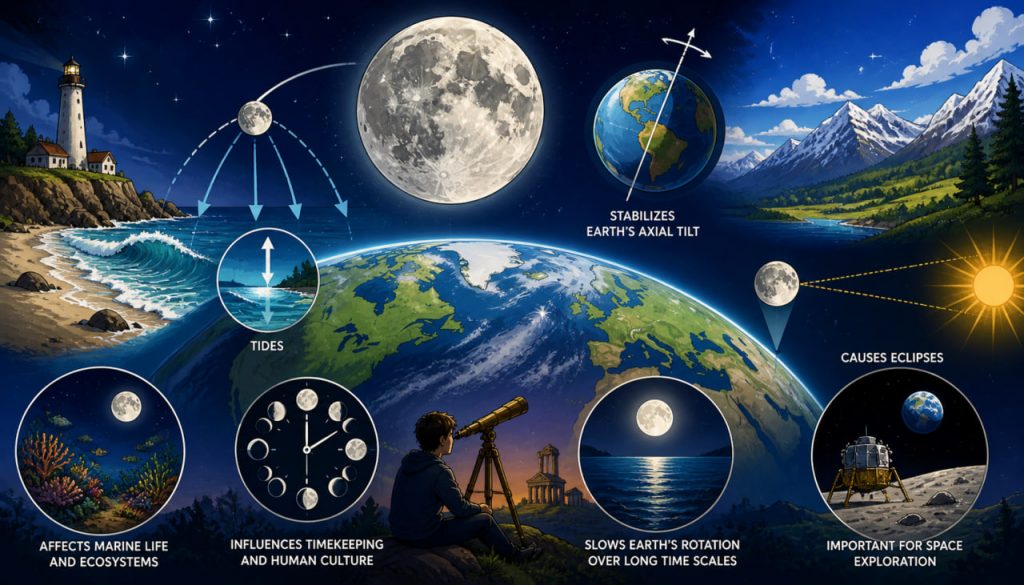
One of the Moon’s most obvious effects on Earth is the creation of ocean tides.
The Moon’s gravity pulls on Earth’s oceans, causing water levels to rise and fall.
This creates:
- High tides
- Low tides
- Coastal tidal cycles
The Sun also influences tides, but the Moon has the stronger effect because it is much closer to Earth.
Tides play a major role in:
- Coastal ecosystems
- Marine life cycles
- Ocean circulation
- Human navigation and fishing
Without lunar tides, many coastal environments would function very differently.
Stabilizing Earth’s Rotation
The Moon also helps stabilize Earth’s axial tilt — the angle at which Earth rotates.
This stabilization is extremely important for climate consistency.
Without the Moon:
- Earth’s tilt could change dramatically over time
- Seasons might become far more extreme
- Climate stability could weaken
Planetary scientist Jacques Laskar explained that the Moon acts as a stabilizing influence preventing chaotic shifts in Earth’s orientation.
This long-term stability may have helped complex life evolve more successfully.
Slowing Earth’s Rotation
The Moon gradually slows Earth’s rotation through a process involving tidal friction.
Billions of years ago:
- Earth rotated much faster
- Days were significantly shorter
Over time, tidal interactions between Earth and the Moon transferred rotational energy, slowing the planet’s spin.
Today, the length of Earth’s day continues increasing very slowly.
This process also causes the Moon to drift slightly farther away from Earth each year.
The Moon and Biological Rhythms
Many living organisms respond to lunar cycles.
Examples include:
- Coral spawning
- Animal migration patterns
- Reproductive cycles in marine species
Some researchers also study possible connections between lunar phases and human sleep patterns, although scientific evidence remains mixed.
The Moon’s influence on biological systems is especially strong in marine ecosystems where tides shape environmental conditions.
The Moon’s Role in Human History
For ancient civilizations, the Moon was essential for:
- Navigation
- Agriculture
- Timekeeping
Lunar calendars were used by many cultures long before modern clocks existed.
The Moon also influenced:
- Mythology
- Religion
- Art
- Literature
Its predictable phases helped humans organize seasonal activities and understand natural cycles.
Could Life Exist Without the Moon?
Some scientists believe Earth’s Moon may have played an important role in the development of life itself.
Possible contributions include:
- Stabilizing climate conditions
- Creating tidal environments important for early evolution
- Influencing ocean mixing and chemistry
Without the Moon, Earth’s environment may have been much less stable over geological time.
Although life might still have emerged, the path of evolution could have been very different.
Lunar Eclipses and Celestial Events
The Moon also creates spectacular astronomical phenomena.
During a lunar eclipse:
- Earth moves between the Sun and Moon
- Earth’s shadow darkens the Moon
Solar eclipses occur when the Moon blocks sunlight from reaching Earth.
These events helped ancient societies develop astronomy and improved humanity’s understanding of the Solar System.
The Moon and Space Exploration
The Moon became humanity’s first destination beyond Earth.
The Apollo missions demonstrated that humans could travel to another celestial body.
Today, the Moon is again becoming a focus of scientific interest because it may help future:
- Space exploration
- Lunar bases
- Missions to Mars
Some scientists believe the Moon could become an important stepping stone for deeper space travel.
Myths and Misconceptions About the Moon
The Moon has long been associated with myths involving:
- Human behavior
- Madness
- Sleep disturbances
While the Moon undeniably affects Earth physically through gravity, many popular beliefs about strong behavioral effects lack scientific confirmation.
Nevertheless, the Moon continues to inspire fascination because of its constant presence in human life.
Why the Moon Matters More Than We Think
The Moon is far more than a beautiful object in the sky.
Its influence affects:
- Earth’s oceans
- Planetary stability
- Biological systems
- Human civilization
Without the Moon, Earth’s climate, ecosystems, and even the evolution of life may have unfolded very differently.
The relationship between Earth and its satellite remains one of the most important partnerships in the Solar System.
Interesting Facts
- The Moon is slowly moving away from Earth by about 3.8 centimeters per year.
- Tides are strongest during full moons and new moons.
- The same side of the Moon always faces Earth due to tidal locking.
- Astronaut footprints on the Moon may remain for millions of years because there is no atmosphere.
- The Moon influences Earth’s rotation speed over time.
Glossary
- Natural Satellite — A celestial object that orbits a planet naturally.
- Axial Tilt — The angle at which a planet rotates relative to its orbit.
- Tidal Friction — Energy loss caused by gravitational interactions between celestial bodies.
- Lunar Eclipse — An event where Earth’s shadow falls on the Moon.
- Tidal Locking — A state where one side of an object always faces the body it orbits.