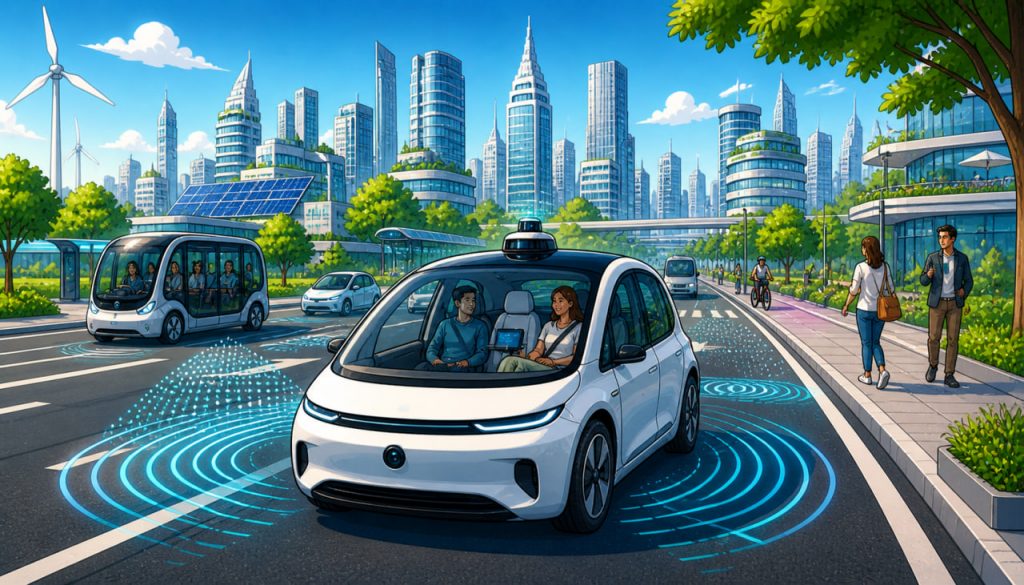
Self-driving cars, also known as autonomous vehicles, represent one of the most exciting technological advancements of the 21st century. These vehicles are designed to navigate and operate without human intervention, using advanced sensors, artificial intelligence, and real-time data processing. As the technology continues to evolve, self-driving cars have the potential to revolutionize transportation, improve safety, and reshape cities.
What Are Self-Driving Cars?
Self-driving cars are vehicles that can operate without direct human control.
They rely on:
- Cameras and sensors
- Radar and lidar systems
- Artificial intelligence algorithms
These systems allow the vehicle to:
- Detect surroundings
- Make decisions
- Navigate roads safely
The goal is to create a car that can drive itself in all conditions.
Levels of Autonomy
Autonomous driving is classified into levels, from 0 to 5.
- Level 0: No automation
- Level 1–2: Partial assistance (e.g., cruise control)
- Level 3: Conditional automation
- Level 4: High automation
- Level 5: Full automation (no driver needed)
Most current vehicles are at Level 2 or Level 3.
How Self-Driving Cars Work
Autonomous vehicles use a combination of technologies.
Sensors
- Detect objects, pedestrians, and road conditions
Artificial Intelligence
- Processes data and makes decisions
Mapping Systems
- Provide detailed information about roads
Connectivity
- Allows communication with other vehicles and infrastructure
These systems work together to simulate human driving behavior.
Benefits of Self-Driving Cars
Self-driving technology offers many potential advantages.
Improved Safety
Human error is a major cause of accidents. Autonomous vehicles can reduce:
- Distracted driving
- Fatigue-related incidents
- Reaction time delays
Increased Accessibility
They can help:
- Elderly individuals
- People with disabilities
- Those unable to drive
Traffic Efficiency
Self-driving cars can:
- Optimize traffic flow
- Reduce congestion
- Improve fuel efficiency
They could make transportation safer and more efficient.
Challenges and Limitations
Despite progress, there are significant challenges.
- Complex road conditions
- Weather interference (rain, snow, fog)
- Ethical decision-making in emergencies
- High development costs
Achieving full autonomy remains difficult.
Legal and Ethical Issues
Autonomous vehicles raise important questions.
- Who is responsible in case of an accident?
- How should a car make moral decisions?
- How should regulations adapt?
Governments and companies are still working to address these issues.
Expert Insight
Elon Musk, CEO of Tesla, has stated:
“Autonomy will make driving much safer than humans, but it requires solving complex real-world problems.”
This reflects both the promise and the challenge of the technology.
Impact on Society
Self-driving cars could transform daily life.
They may:
- Change urban design
- Reduce the need for parking
- Enable shared transportation systems
Industries such as logistics and delivery may also be reshaped.
The Future of Autonomous Vehicles
The future of self-driving cars depends on:
- Advances in AI
- Improved sensor technology
- Regulatory approval
- Public trust
While fully autonomous vehicles are not yet widespread, progress is rapid.
The transition is already underway.
Why This Technology Matters
Transportation is essential to modern life. Improving it can have widespread benefits.
Self-driving cars offer:
- Safer roads
- Greater convenience
- Reduced environmental impact
They represent a major step toward a smarter and more connected world.
Interesting Facts
- Most accidents today are caused by human error.
- Autonomous vehicles use thousands of data points per second.
- Some cities already test self-driving taxis.
- AI systems improve through machine learning.
- Full autonomy (Level 5) is still under development.
Glossary
- Autonomous Vehicle — A car that can drive itself.
- Artificial Intelligence (AI) — Technology that enables machines to make decisions.
- Lidar — A sensor that uses lasers to measure distance.
- Automation Level — Degree of vehicle independence.
- Machine Learning — A system that improves through data.