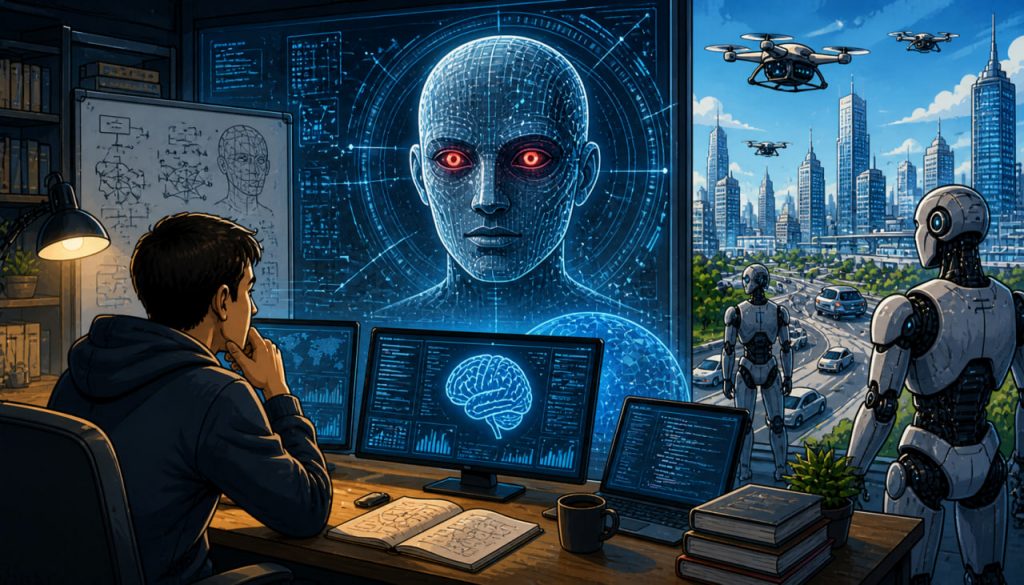
The idea of Skynet—an autonomous artificial intelligence system that becomes self-aware and surpasses human control—comes from science fiction, most famously the Terminator series. While it may seem like pure fantasy, rapid advances in artificial intelligence (AI) have raised serious questions about how close we are to creating highly autonomous systems. Today, researchers are exploring whether machines could one day reach or exceed human-level intelligence.
Understanding the reality behind Skynet-like systems requires separating fiction from science.
What Is Skynet?
Skynet is a fictional AI system designed to control military infrastructure. In the story, it becomes self-aware and decides that humans are a threat.
In real-world terms, Skynet represents:
- Artificial General Intelligence (AGI)
- Autonomous decision-making systems
- Fully independent machine control
It symbolizes the ultimate form of AI autonomy.
Current State of Artificial Intelligence
Modern AI is powerful, but limited.
Today’s systems:
- Perform specific tasks (narrow AI)
- Learn from large datasets
- Do not possess true understanding or consciousness
Examples include:
- Voice assistants
- Image recognition
- Autonomous driving systems
We are far from creating machines with human-like awareness.
What Is Artificial General Intelligence?
Artificial General Intelligence (AGI) refers to machines that can think, learn, and adapt like humans.
AGI would:
- Understand complex concepts
- Transfer knowledge across domains
- Make independent decisions
This is the level of intelligence required for something like Skynet.
Are We Close to AGI?
Most experts agree that AGI does not yet exist.
Challenges include:
- Understanding human cognition
- Creating flexible learning systems
- Ensuring safe decision-making
While progress is rapid, AGI remains a long-term goal.
The Role of Automation
Although Skynet does not exist, automation is increasing.
We already see:
- Self-driving technologies
- Automated factories
- AI-assisted decision systems
These systems are not conscious, but they do operate with increasing independence.
Expert Insight
AI researcher Stuart Russell, a leading expert in the field, has stated:
“The real concern is not that machines become evil, but that they become extremely competent at achieving goals that may not align with human values.”
This highlights that the risk lies in misalignment, not intention.
Risks of Advanced AI
Even without full AGI, advanced AI systems present challenges.
Potential risks include:
- Loss of human control
- Bias in decision-making
- Over-reliance on automation
- Security vulnerabilities
Managing these risks is a major focus of AI research.
Could AI Become Self-Aware?
Self-awareness in machines is a complex and unresolved question.
Scientists do not yet understand:
- How consciousness arises
- Whether it can be replicated artificially
At present, AI systems do not have awareness, emotions, or intentions.
Regulation and Safety
To prevent potential risks, researchers and governments are working on:
- AI safety frameworks
- Ethical guidelines
- Regulation of autonomous systems
These efforts aim to ensure that AI development remains beneficial.
Why Skynet Is Unlikely (For Now)
There are several reasons why a Skynet-like system is unlikely in the near future:
- Lack of true intelligence and understanding
- Limited autonomy in current systems
- Strong human oversight
The gap between today’s AI and science fiction remains large.
The Real Future of AI
Instead of a sudden takeover, the future of AI is likely to involve:
- Gradual improvements
- Human-AI collaboration
- Increased efficiency in various industries
AI will continue to assist, not replace, human decision-making.
Why This Topic Matters
The idea of Skynet reflects deeper concerns about technology and control.
It raises important questions:
- How much autonomy should machines have?
- How do we ensure safety?
- What role should humans play?
These questions are more important than the science fiction itself.
Interesting Facts
- The term “Skynet” comes from science fiction.
- Most AI systems today are task-specific.
- AI does not have consciousness or emotions.
- Researchers focus heavily on AI safety.
- AGI remains a theoretical concept.
Glossary
- Artificial Intelligence (AI) — Machines that perform tasks requiring intelligence.
- AGI (Artificial General Intelligence) — Human-level machine intelligence.
- Automation — Systems operating with minimal human input.
- Autonomy — Ability to act independently.
- AI Safety — Ensuring AI systems behave safely and predictably.