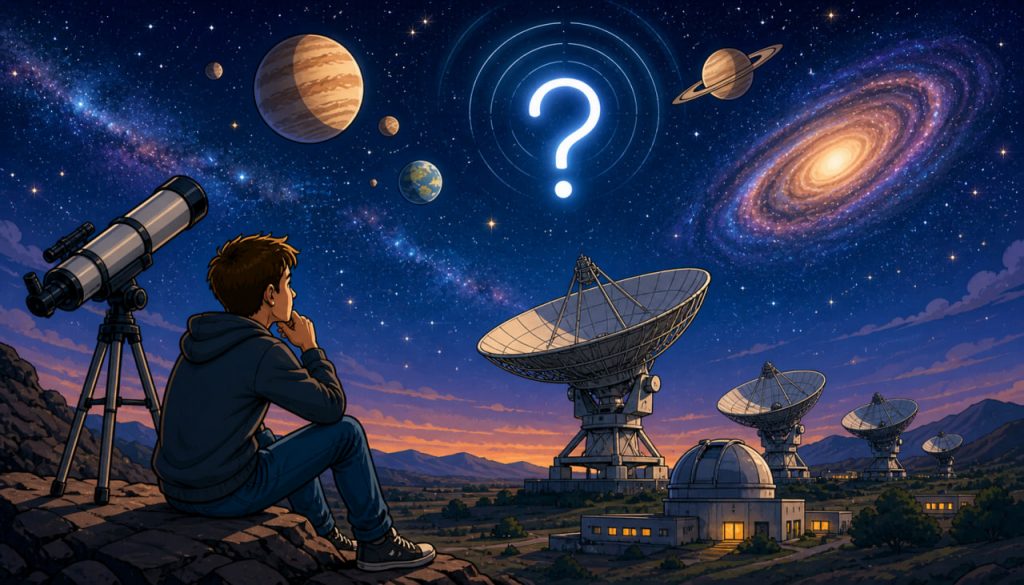
The Fermi Paradox is one of the most fascinating questions in science and philosophy. It highlights a contradiction between the high probability of extraterrestrial life and the complete lack of evidence for it. In simple terms, if intelligent life should exist elsewhere in the universe, why haven’t we found any signs of it?
This paradox forces us to rethink our assumptions about life, intelligence, and the cosmos.
What Is the Fermi Paradox?
The Fermi Paradox is named after physicist Enrico Fermi, who famously asked:
“Where is everybody?”
The paradox arises from two key ideas:
- The universe is incredibly vast, with billions of galaxies and planets
- Life, especially microbial life, may be common
Yet, despite this, we have no confirmed evidence of intelligent extraterrestrial civilizations.
Why We Expect Life in the Universe
Modern astronomy has revealed that:
- There are billions of Earth-like planets
- Many stars have habitable zones
- Organic molecules exist in space
These discoveries suggest that the conditions for life are not rare.
Given enough time, some of these planets should develop intelligent life.
The Great Silence
Despite expectations, the universe appears silent.
We have not observed:
- Signals from alien civilizations
- Advanced technological structures
- Direct evidence of extraterrestrial intelligence
This absence of evidence is known as the “Great Silence.”
Possible Explanations
Scientists have proposed many theories to explain the paradox.
Rare Earth Hypothesis
This idea suggests that complex life is extremely rare.
Even if simple life exists:
- Conditions for intelligence may be uncommon
- Evolution may not always lead to advanced species
The Great Filter
The Great Filter theory proposes that there is a stage in evolution that is extremely difficult to pass.
This filter could occur:
- Before life begins
- During the development of intelligence
- After civilizations become advanced
It may explain why we do not see other civilizations.
Self-Destruction of Civilizations
Another possibility is that advanced civilizations destroy themselves.
This could happen through:
- War
- Environmental collapse
- Technological risks
If this is common, civilizations may not last long enough to be detected.
We Are Early
It is possible that humanity is among the first intelligent species in the universe.
In this case:
- Other civilizations may not have developed yet
- The universe may still be “young” in terms of life
They Are Too Far Away
The vast distances in space make communication difficult.
Even if civilizations exist:
- Signals may take thousands of years to travel
- We may not yet have detected them
They Are Different
Alien life may not resemble what we expect.
Possibilities include:
- Non-technological intelligence
- Forms of communication we cannot detect
- Life that does not rely on biology as we know it
Our assumptions may limit our ability to recognize alien life.
Expert Insight
Astrophysicist Carl Sagan once reflected on this mystery:
“The universe is a pretty big place. If it’s just us, seems like an awful waste of space.”
His perspective emphasizes both the vastness of the universe and the mystery of our apparent isolation.
The Role of Modern Science
Scientists continue searching for answers through:
- Radio signal detection (SETI)
- Space exploration missions
- Study of exoplanets
New technologies are increasing our ability to detect potential signs of life.
Why the Fermi Paradox Matters
The paradox is important because it challenges our understanding of:
- Life in the universe
- Human significance
- The future of civilization
It forces us to ask whether we are alone or simply unable to find others.
Philosophical Implications
The Fermi Paradox raises deep questions:
- Are we unique?
- Is intelligence rare?
- What is the future of humanity?
It connects science with philosophy and existential thought.
Interesting Facts
- There are over 100 billion galaxies in the universe.
- Each galaxy contains billions of stars.
- Thousands of exoplanets have already been discovered.
- SETI has been searching for signals for decades.
- No confirmed extraterrestrial signal has been detected.
Glossary
- Fermi Paradox — The contradiction between expected and observed extraterrestrial life.
- Exoplanet — A planet outside our solar system.
- Great Filter — A hypothetical barrier preventing the development of advanced life.
- SETI — Search for Extraterrestrial Intelligence.
- Habitable Zone — Region around a star where life could exist.