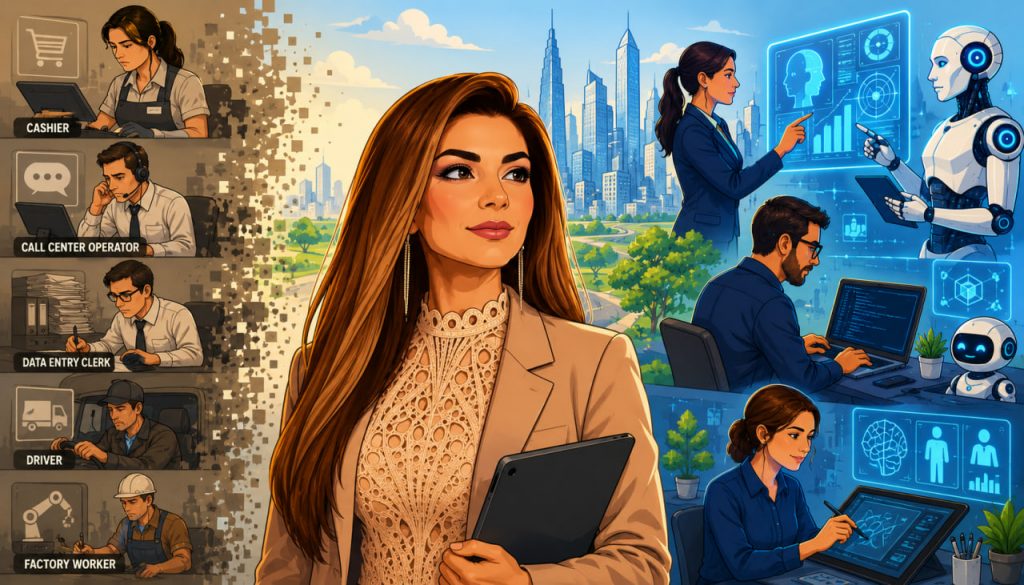
The world of work is changing faster than at any other point in modern history. Artificial intelligence, robotics, automation, and digital platforms are transforming industries that once seemed stable and permanent. Tasks that previously required human workers can now be performed by algorithms, machines, or intelligent systems with increasing speed and accuracy.
Experts predict that by 2030, millions of jobs will change dramatically — and some professions may disappear almost entirely. However, this transformation is not only about job loss. It is also about the emergence of entirely new forms of work, skills, and economic structures.
Understanding these changes is becoming essential for workers, businesses, and society itself.
Why Work Is Changing So Rapidly
Several technological forces are accelerating the transformation of labor:
- Artificial intelligence
- Machine learning
- Robotics
- Cloud computing
- Digital automation
Unlike previous industrial revolutions, modern automation can replace not only physical labor, but also cognitive tasks involving analysis, communication, and decision-making.
According to the World Economic Forum:
“Automation and AI are reshaping the global labor market at unprecedented speed.”
This shift is expected to intensify throughout the 2020s.
Which Professions Are Most Vulnerable?
Jobs involving repetitive and predictable tasks face the highest risk of automation.
These professions often include:
- Routine data processing
- Standardized customer support
- Basic administrative work
- Repetitive manufacturing tasks
Machines and AI systems excel at handling structured operations efficiently and continuously.
Cashiers and Retail Workers
Self-checkout systems and automated stores are already reducing the need for traditional cashiers.
Large retail companies increasingly use:
- Automated payment systems
- AI inventory tracking
- Digital ordering platforms
While human workers may still remain in some roles, the number of routine cashier positions is expected to decline significantly.
Call Center Operators
AI-powered chatbots and voice assistants are becoming increasingly capable of handling customer service requests.
Modern systems can:
- Answer common questions
- Process payments
- Resolve technical issues
- Simulate human conversation
This technology reduces costs for companies and operates 24 hours a day.
However, more complex emotional or strategic communication will still require human specialists.
Drivers and Transportation Jobs
Autonomous vehicle technology could eventually affect professions such as:
- Taxi drivers
- Delivery drivers
- Truck operators
Although fully autonomous transportation still faces technical and legal challenges, automation in logistics is advancing rapidly.
Many experts expect partial automation to become common before full driver replacement occurs.
Clerical and Administrative Positions
AI systems increasingly automate office-related tasks such as:
- Scheduling
- Data entry
- Document processing
- Financial reporting
Software can already perform many administrative functions faster than humans.
This does not necessarily eliminate all office jobs, but it changes the skills required.
Manufacturing and Factory Work
Industrial robots have transformed manufacturing for decades, but modern AI makes automation even more flexible.
Smart factories can now:
- Monitor production automatically
- Detect defects
- Optimize workflows in real time
As robotic systems become cheaper and more adaptive, routine factory work may continue declining.
Why Some Jobs Will Survive
Not all professions are equally vulnerable.
Jobs that rely heavily on:
- Creativity
- Human empathy
- Complex problem-solving
- Leadership
- Social interaction
are much harder to automate fully.
For example:
- Psychologists
- Teachers
- Scientists
- Artists
- Strategic managers
still require uniquely human capabilities.
New Professions Emerging by 2030
While some jobs disappear, entirely new careers are appearing.
Examples include:
- AI trainers
- Prompt engineers
- Cybersecurity analysts
- Virtual environment designers
- Human-AI collaboration specialists
Historically, technological revolutions often create new industries even as they disrupt older ones.
The Importance of Adaptability
The future labor market will likely reward adaptability more than fixed specialization.
Workers may increasingly need:
- Continuous learning
- Digital literacy
- Interdisciplinary skills
- Creative thinking
The idea of learning one profession for life may gradually become outdated.
Futurist Alvin Toffler once predicted:
“The illiterate of the 21st century will not be those who cannot read and write, but those who cannot learn, unlearn, and relearn.”
This idea has become increasingly relevant in the AI era.
The Psychological Impact of Labor Transformation
The disappearance of professions can create anxiety and uncertainty.
Many workers fear:
- Economic instability
- Skill obsolescence
- Loss of professional identity
At the same time, automation may also reduce dangerous or exhausting labor and create opportunities for more creative work.
The challenge for society is managing this transition fairly and responsibly.
Could AI Replace Most Human Work?
Some experts believe AI may eventually automate a large portion of human labor, while others argue that humans will remain essential in many fields.
Most likely, the future will involve:
- Collaboration between humans and AI
- Hybrid workplaces
- Increased productivity through automation
Rather than total replacement, many jobs may evolve into new forms.
Why This Transformation Matters
The metamorphosis of labor is not simply a technological issue — it is a social and economic transformation that affects:
- Education systems
- Governments
- Businesses
- Individual lifestyles
The decisions made during the next decade may shape the structure of work for generations.
Interesting Facts
- Automation fears have appeared during every major industrial revolution.
- AI systems can now generate text, images, and software code.
- Some experts predict millions of jobs will change significantly before 2030.
- Robotics is expanding beyond factories into healthcare and logistics.
- New technologies often create professions that previously did not exist.
Glossary
- Automation — Using technology to perform tasks with minimal human involvement.
- Artificial Intelligence (AI) — Computer systems capable of performing tasks associated with human intelligence.
- Machine Learning — AI systems that improve through data and experience.
- Digital Literacy — The ability to use and understand digital technologies effectively.
- Autonomous Vehicle — A vehicle capable of operating without direct human control.