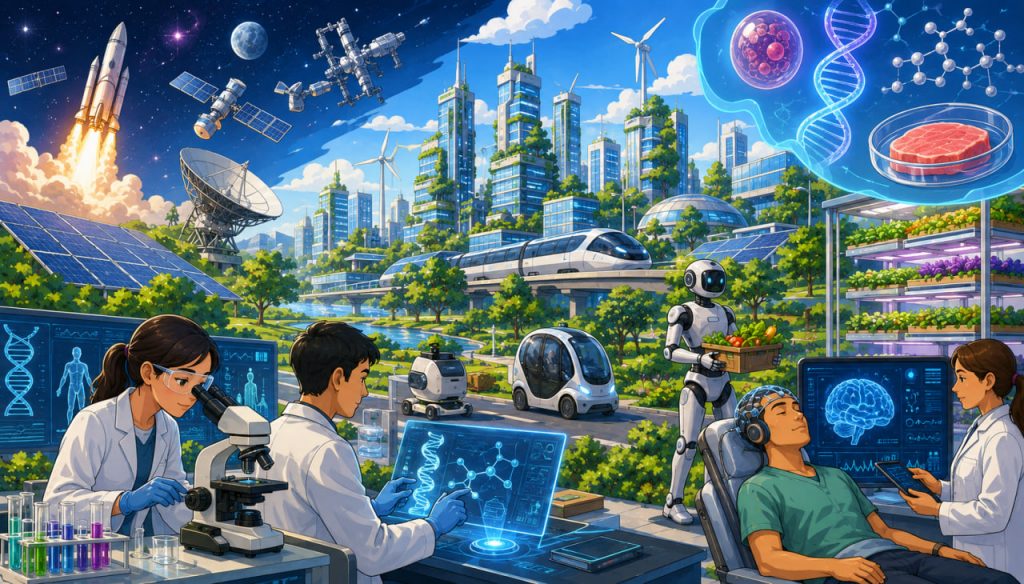
The year 2026 is becoming a remarkable period for science and technology. Advances once considered futuristic are rapidly entering real-world use. Artificial intelligence systems are transforming medicine and research, renewable energy technologies are becoming more efficient, robotics is entering daily life, and biotechnology is moving toward personalized healthcare on an unprecedented scale.
Scientists today work in an era where discoveries spread globally almost instantly, accelerating innovation across nearly every field. Governments, universities, and private companies are investing billions into technologies that may reshape civilization during the next decades.
The scientific innovations emerging in 2026 are not limited to laboratories anymore. Many are already influencing:
- Healthcare
- Transportation
- Energy systems
- Space exploration
- Agriculture
- Artificial intelligence
- Climate technologies
Some experts believe humanity is entering one of the fastest periods of scientific transformation in history.
Artificial Intelligence Becomes a Scientific Partner
Artificial intelligence is no longer used only for automation or data processing. In 2026, AI systems increasingly assist scientists directly.
Modern AI helps researchers:
- Analyze massive datasets
- Discover new materials
- Predict protein structures
- Accelerate drug development
- Simulate complex systems
AI-driven research dramatically reduces the time required for some scientific tasks.
Computer scientist Geoffrey Hinton once stated:
“We are entering a period where AI may become an amplifier of human intelligence.”
This shift is already visible across medicine, chemistry, and engineering.
Personalized Medicine and Genetic Technologies
One of the most important scientific trends involves personalized medicine.
Instead of treating all patients identically, modern medicine increasingly adapts therapies based on:
- Genetics
- Lifestyle
- Biomarkers
- Individual risk factors
Gene-editing technologies continue improving rapidly.
Scientists are researching treatments for:
- Inherited diseases
- Certain cancers
- Rare genetic disorders
Although ethical debates remain important, biotechnology in 2026 is advancing faster than many experts predicted just a decade ago.
Robotics Enters Everyday Life
Robotics is expanding beyond factories into homes, hospitals, and public infrastructure.
Modern robots can now:
- Deliver supplies
- Clean buildings
- Assist elderly people
- Support warehouse logistics
- Perform surgical assistance
Advances in sensors, batteries, and AI make robots increasingly autonomous.
Humanoid robotics is also developing rapidly, although fully human-like robots remain limited in practical deployment.
Renewable Energy Innovations
Energy science continues evolving quickly in 2026.
Major innovations include:
- Improved solar panel efficiency
- Advanced battery storage
- Smart electrical grids
- Green hydrogen systems
- Next-generation wind turbines
Scientists are also researching new battery chemistries that may reduce dependence on rare materials.
Renewable energy infrastructure is becoming smarter and more decentralized, allowing homes and cities to generate and manage energy more efficiently.
Quantum Computing Progress
Quantum computing remains one of the most ambitious scientific fields.
Unlike traditional computers, quantum systems may solve certain highly complex problems much faster.
Potential applications include:
- Drug discovery
- Climate modeling
- Cryptography
- Materials science
- Optimization systems
Although practical large-scale quantum computers are still developing, 2026 shows significant progress in error reduction and stability.
Many researchers believe quantum technologies may eventually transform computing itself.
Space Exploration Expands
Space science is experiencing rapid innovation.
Private and government space programs are working on:
- Lunar missions
- Mars preparation
- Satellite systems
- Space telescopes
- Reusable rockets
New astronomical instruments are improving humanity’s understanding of:
- Exoplanets
- Black holes
- Galaxy formation
- Cosmic evolution
Commercial space technologies are also expanding rapidly, creating a growing space economy.
Climate Technologies and Carbon Removal
Climate innovation is becoming a major global priority.
Scientists are developing technologies for:
- Carbon capture
- Sustainable agriculture
- Climate-resilient crops
- Water recycling
- Energy-efficient buildings
Some companies are experimenting with direct air capture systems designed to remove carbon dioxide directly from the atmosphere.
Environmental engineer Klaus Lackner explained:
“Carbon removal may eventually become necessary alongside emission reductions.”
Climate technologies are increasingly viewed as essential rather than optional.
Smart Cities and Urban Innovation
Cities are becoming more technologically integrated.
Modern urban systems increasingly use:
- AI traffic management
- Smart sensors
- Renewable energy networks
- Automated public transportation
- Digital infrastructure
These technologies aim to improve:
- Efficiency
- Sustainability
- Public safety
- Energy management
Smart cities represent a fusion of data science, engineering, and urban planning.
Biotechnology and Lab-Grown Food
Food science is also changing rapidly.
Researchers are developing:
- Lab-grown meat
- Precision fermentation
- Alternative proteins
- Vertical farming systems
These technologies may reduce pressure on:
- Agricultural land
- Water resources
- Animal farming systems
Although still developing, alternative food production is attracting major global investment.
Brain-Computer Interfaces
Neuroscience and computing are becoming increasingly connected.
Brain-computer interface technologies attempt to allow direct communication between:
- The human brain
- Digital systems
Researchers hope these systems may eventually help people with:
- Paralysis
- Neurological disorders
- Communication limitations
Although early-stage, brain-interface technology represents one of the most futuristic areas of modern science.
Challenges of Rapid Innovation
Despite excitement, scientific progress also creates concerns.
Major debates involve:
- AI ethics
- Privacy
- Job automation
- Genetic engineering risks
- Environmental impacts of technology
Scientists increasingly emphasize the importance of balancing innovation with ethical responsibility.
Technology alone does not guarantee positive outcomes.
Why 2026 Matters in Scientific History
The innovations emerging in 2026 demonstrate how quickly human knowledge is advancing.
Artificial intelligence, biotechnology, renewable energy, robotics, and space exploration are increasingly interconnected fields influencing one another simultaneously.
Historians of science may eventually view this decade as a major turning point in technological civilization.
The coming years may determine how humanity uses these powerful tools to shape the future of society and the planet itself.
Interesting Facts
- AI systems now assist in discovering new drugs and materials.
- Reusable rockets dramatically reduced some space launch costs.
- Quantum computing research is advancing rapidly worldwide.
- Smart cities increasingly use AI for traffic and energy management.
- Scientists are developing food products grown without traditional farming.
Glossary
- Artificial Intelligence (AI) — Computer systems capable of performing tasks requiring intelligent decision-making.
- Quantum Computing — A computing technology based on quantum mechanics.
- Carbon Capture — Technology designed to remove carbon dioxide from emissions or the atmosphere.
- Brain-Computer Interface — A system connecting the human brain with digital devices.
- Personalized Medicine — Medical treatment adapted to individual biological characteristics.