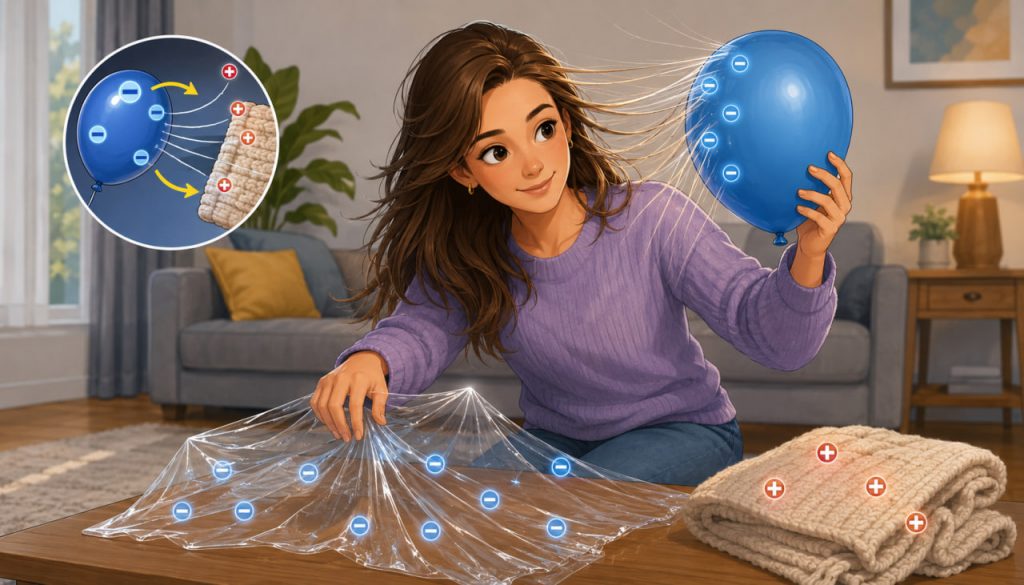
Almost everyone has experienced static electricity caused by plastic. A plastic comb attracting hair, cling film sticking to surfaces, synthetic clothing crackling in dry weather, or tiny electric shocks after touching plastic materials are all common examples of electrostatic charge in everyday life.
Although static electricity may seem harmless or even amusing, the phenomenon is scientifically important and widely studied in physics, engineering, electronics, chemistry, and industrial safety. Electrostatic charge affects:
- Manufacturing systems
- Electronics production
- Medical equipment
- Dust accumulation
- Industrial explosions
- Material science
Plastic materials are especially prone to building electrostatic charge because of their molecular structure and electrical properties.
Modern science continues exploring how electrostatic behavior influences both technology and the environment.
What Is Electrostatic Charge?
Electrostatic charge refers to an imbalance of electrical charges on a material’s surface.
Normally, matter contains balanced numbers of:
- Positively charged protons
- Negatively charged electrons
When electrons move from one material to another, surfaces may become electrically charged.
This process creates static electricity.
Why Plastic Easily Becomes Charged
Plastic is considered an electrical insulator.
Unlike metals, plastics do not allow electrons to move freely through the material.
As a result:
- Charges remain trapped on the surface
- Static electricity accumulates easily
When plastic rubs against:
- Hair
- Fabric
- Paper
- Other plastics
electrons may transfer between surfaces.
This phenomenon is called the triboelectric effect.
Different materials have different tendencies to gain or lose electrons during contact.
The Triboelectric Effect Explained
The triboelectric effect occurs when two materials exchange electrons after friction or contact.
For example:
- Rubbing a balloon on hair transfers electrons
- Plastic wrap may cling to surfaces
- Synthetic carpets may generate static shocks
Some materials tend to gain electrons and become negatively charged, while others lose electrons and become positively charged.
Plastics are particularly effective at accumulating charge.
Physicist Michael Faraday, one of the pioneers of electromagnetism, helped establish many principles underlying electrostatic behavior.
Why Dry Air Makes Static Electricity Worse
Humidity strongly affects electrostatic buildup.
In dry environments:
- Air contains less moisture
- Charges dissipate more slowly
- Static accumulation increases
Water molecules in humid air help electrical charges leak away gradually.
This explains why static shocks become more common during:
- Winter
- Heated indoor conditions
- Dry climates
Plastic surfaces especially retain charge under low humidity conditions.
Everyday Examples of Plastic Static Electricity
Static electricity from plastic appears constantly in daily life.
Common examples include:
- Plastic bags sticking together
- Hair attracted to combs
- Dust clinging to screens
- Electric shocks from synthetic furniture
- Clothes sticking after drying
Most of these effects are harmless, but the same physical principles can become significant in industrial environments.
Electrostatic Problems in Industry
In industrial settings, static electricity can become dangerous.
Electrostatic discharge may:
- Damage electronics
- Ignite flammable gases
- Trigger dust explosions
- Interfere with sensitive equipment
Industries working with:
- Fuel
- Chemicals
- Powders
- Semiconductor manufacturing
must carefully control electrostatic buildup.
Even tiny sparks can become hazardous under certain conditions.
Plastic and Dust Attraction
Charged plastic surfaces attract airborne particles.
This happens because electrostatic forces pull dust toward the charged surface.
As a result:
- Computer screens collect dust
- Plastic packaging attracts particles
- Synthetic materials become dirty more easily
Engineers sometimes design antistatic coatings to reduce these effects.
Electrostatics in Modern Technology
Despite its challenges, electrostatic behavior also has useful applications.
Electrostatic principles are used in:
- Air purification systems
- Laser printers
- Powder coating
- Industrial painting
- Dust collection systems
Some manufacturing technologies intentionally manipulate static charge for precise material control.
This demonstrates how the same phenomenon can be both problematic and useful.
Plastic, Electronics, and ESD Protection
Electrostatic discharge (ESD) is especially dangerous for modern electronics.
Tiny static sparks invisible to humans may damage:
- Microchips
- Computer components
- Sensors
- Semiconductor devices
For this reason, electronics factories use:
- Antistatic flooring
- Grounding systems
- Conductive clothing
- Humidity control
Modern electronics are increasingly sensitive to electrostatic effects.
The Science Behind Small Electric Shocks
When you touch a metal object after accumulating static charge, electrons rapidly transfer between surfaces.
This sudden movement creates:
- A tiny spark
- A brief electric shock
The sensation occurs because nerves respond to the rapid electrical discharge.
Although uncomfortable, these small shocks are usually harmless in everyday situations.
Can Static Electricity Affect Health?
Ordinary static electricity generally does not pose serious health risks.
However:
- Large industrial discharges can be dangerous
- Sensitive medical environments require electrostatic control
- Certain explosive environments demand strict precautions
Researchers also study whether electrostatic particles influence air quality and pollution behavior.
Future Research and Materials Science
Scientists continue developing advanced materials with:
- Reduced static buildup
- Antistatic coatings
- Conductive polymers
- Improved electrostatic control
As electronics and automation become more advanced, electrostatic management grows increasingly important.
Future smart materials may actively regulate charge accumulation automatically.
Why Electrostatic Plastic Behavior Matters
Static electricity may appear simple, but it reveals important physical principles governing matter and electricity.
The behavior of charged plastics influences:
- Everyday life
- Industrial safety
- Electronics
- Manufacturing
- Material science
Understanding electrostatics helps engineers create safer technologies and more efficient systems in an increasingly electronic world.
Interesting Facts
- Plastic is an electrical insulator that easily accumulates static charge.
- Dry air increases static electricity buildup.
- Tiny invisible sparks can damage sensitive electronics.
- Electrostatic principles are used in laser printers and air filters.
- Dust often sticks to plastic because of electrostatic attraction.
Glossary
- Electrostatic Charge — An imbalance of electrical charge on a surface.
- Insulator — A material that does not easily conduct electricity.
- Triboelectric Effect — Charge transfer caused by friction or contact between materials.
- Electrostatic Discharge (ESD) — Sudden transfer of electrical charge between surfaces.
- Coulomb’s Law — A physics law describing electrostatic force between charges.