The internet is one of the most important inventions in human history. In just a few decades, it transformed communication, business, science, entertainment, education, and everyday life. Billions of people now rely on the internet daily for work, social interaction, shopping, banking, and access to information.
Yet the internet did not begin as a global social network or entertainment platform. It started as a scientific and military research project designed to solve communication problems during the Cold War era. Over time, it evolved into a massive interconnected digital system linking nearly every part of modern civilization.
Today, the internet continues changing rapidly due to:
- Artificial intelligence
- Cloud computing
- Smart devices
- Virtual reality
- Satellite networks
- Quantum technologies
Many experts believe the next decades may transform the internet even more dramatically than its first years did.
How the Internet Began
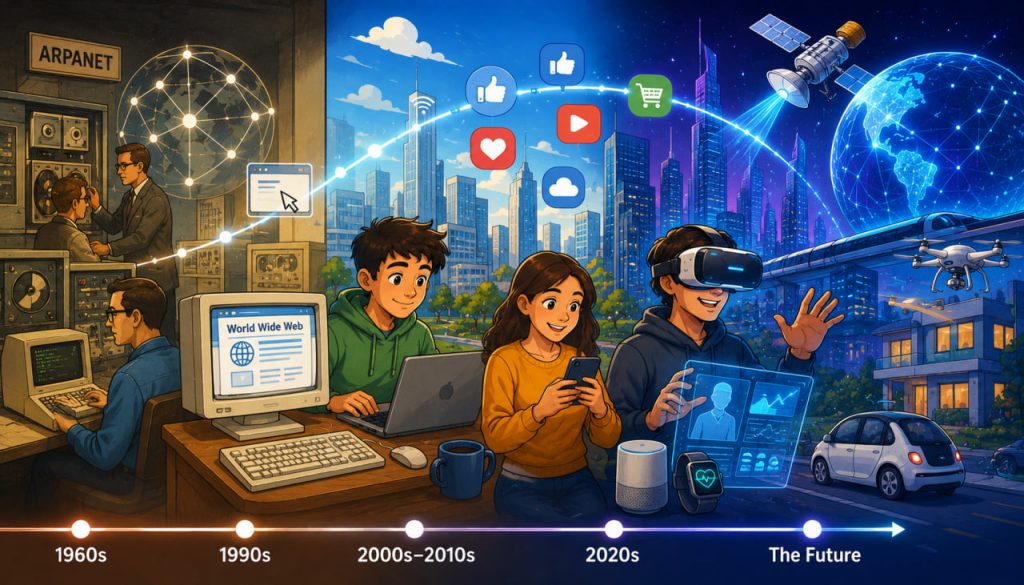
The origins of the internet trace back to the 1960s.
During the Cold War, researchers in the United States explored ways to create communication systems capable of surviving infrastructure failures.
One early project was ARPANET, developed with support from the U.S. Department of Defense.
ARPANET connected computers between universities and research institutions.
The key idea was revolutionary:
- Computers could exchange data through decentralized networks rather than a single central system.
This concept later became the foundation of the modern internet.
The Birth of Digital Networking
Early computer networks were extremely limited compared to modern systems.
Computers were:
- Large
- Expensive
- Slow
- Difficult to connect
Scientists developed communication protocols allowing different machines to exchange information reliably.
One of the most important breakthroughs involved the development of:
- TCP/IP protocols
These standards allowed networks to communicate globally.
Computer scientist Vinton Cerf, often called one of the “fathers of the internet,” explained:
“The internet was designed to survive and adapt.”
Its decentralized structure became one of its greatest strengths.
The World Wide Web Revolution
The internet existed before websites became common.
In 1989, British computer scientist Tim Berners-Lee proposed the World Wide Web, which introduced:
- Hyperlinks
- Web pages
- Browsers
- URLs
This made internet navigation dramatically easier for ordinary users.
The web transformed the internet from a technical research system into a public information platform.
By the 1990s, the internet began expanding globally at enormous speed.
How the Internet Changed Society
The internet rapidly transformed nearly every industry.
Major changes included:
- Instant global communication
- Online shopping
- Digital banking
- Remote work
- Streaming entertainment
- Social media platforms
Information became accessible on an unprecedented scale.
People could suddenly:
- Learn online
- Communicate internationally
- Access scientific research
- Build digital businesses
The internet also accelerated globalization.
Smartphones and the Mobile Internet Era
The rise of smartphones created another major transformation.
Mobile internet access allowed people to stay connected constantly.
Modern smartphones combine:
- Communication
- Navigation
- Photography
- Entertainment
- Commerce
- Social interaction
into a single device connected to global networks.
Today, billions of people access the internet primarily through mobile devices rather than desktop computers.
Cloud Computing and Data Centers
Modern internet services depend heavily on cloud infrastructure.
Massive data centers now power:
- Streaming services
- Social networks
- AI systems
- Online storage
- Business platforms
Cloud computing allows users to access powerful computing resources remotely without owning expensive hardware.
This infrastructure became essential for modern digital economies.
Artificial Intelligence and the Future Internet
Artificial intelligence is increasingly shaping the internet itself.
AI systems now influence:
- Search engines
- Recommendations
- Language translation
- Customer service
- Content moderation
Future internet systems may become even more personalized and automated.
Some experts predict AI assistants could eventually become primary interfaces between humans and online information.
The Internet of Things
The internet is expanding beyond computers and phones.
The Internet of Things (IoT) connects:
- Appliances
- Vehicles
- Sensors
- Smart homes
- Industrial systems
to online networks.
This creates “smart environments” capable of sharing and analyzing data automatically.
Future cities may rely heavily on interconnected digital infrastructure.
Satellite Internet and Global Access
One major challenge has always been internet accessibility.
Many remote regions still lack reliable connections.
New satellite systems aim to expand global internet coverage using:
- Low-orbit satellites
- Advanced wireless infrastructure
This may improve connectivity in:
- Rural areas
- Developing countries
- Remote regions
Global internet access continues expanding rapidly.
Virtual Reality and the Metaverse
Some technology companies are developing immersive digital environments often described as:
- Virtual reality ecosystems
- Metaverse platforms
These systems aim to create interactive online spaces combining:
- Work
- Entertainment
- Social interaction
- Commerce
Although still developing, immersive internet experiences may become increasingly important in future digital culture.
Challenges Facing the Future Internet
Despite its benefits, the internet also creates serious concerns.
Major issues include:
- Cybersecurity threats
- Privacy erosion
- Misinformation
- AI-generated manipulation
- Digital addiction
- Data collection
Governments, companies, and researchers continue debating how to balance:
- Innovation
- Freedom
- Security
- Privacy
The future internet will likely involve both technological progress and growing ethical debates.
Quantum Internet and Future Technologies
Scientists are already researching future internet systems based on quantum technologies.
Potential future developments include:
- Quantum communication
- Ultra-secure encryption
- Faster global networks
Although highly experimental today, these technologies may eventually transform digital communication again.
Why the Internet Matters
The internet became more than a communication tool. It evolved into a global infrastructure supporting:
- Science
- Business
- Education
- Healthcare
- Entertainment
- Government systems
Modern civilization increasingly depends on digital connectivity.
The future internet may become:
- Smarter
- Faster
- More immersive
- More automated
but also more complex and politically important.
Understanding its history helps explain how deeply it already shapes human society.
Interesting Facts
- The internet originally began as a research network during the Cold War.
- The World Wide Web was invented decades after the first computer networks.
- Billions of devices are now connected to the internet worldwide.
- Smartphones dramatically accelerated global internet usage.
- Satellite internet systems are expanding global connectivity rapidly.
Glossary
- Internet — A global system of interconnected computer networks.
- World Wide Web — A system of linked web pages accessed through browsers.
- TCP/IP — Communication protocols allowing internet data exchange.
- Cloud Computing — Remote access to computing resources through the internet.
- Internet of Things (IoT) — A network of connected smart devices sharing data.