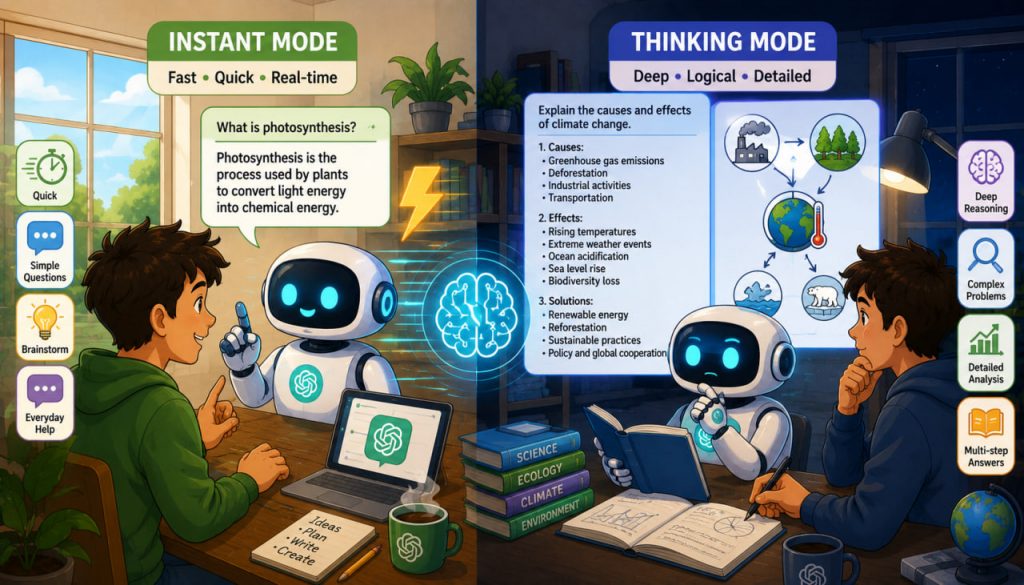
Artificial intelligence systems are evolving rapidly, and modern conversational AI platforms are becoming increasingly sophisticated. Among the most discussed features in advanced AI assistants are different response styles often described as Instant Mode and Thinking Mode.
These modes reflect two different approaches to generating answers:
- Extremely fast real-time responses
- Slower but more deeply reasoned analysis
As AI systems improve, users increasingly expect both:
- Speed
- Accuracy
- Logical reasoning
- Creativity
- Context awareness
Balancing these goals is one of the biggest challenges in modern artificial intelligence development.
Although names and implementations may vary between platforms, the general concepts behind “instant” and “thinking” responses help explain how advanced AI systems prioritize speed versus depth of reasoning.
What Is Instant Mode?
Instant Mode refers to fast-response AI behavior focused on:
- Immediate replies
- Rapid text generation
- Conversational flow
- Real-time interaction
This mode is designed to feel smooth and natural during:
- Casual conversations
- Quick questions
- Brainstorming
- Everyday assistance
Modern AI models can generate responses in seconds because they process enormous amounts of learned language patterns efficiently.
Instant responses are especially useful for:
- Simple explanations
- Translation
- Everyday productivity
- General information
- Interactive communication
The goal is speed and convenience.
What Is Thinking Mode?
Thinking Mode focuses more heavily on:
- Multi-step reasoning
- Complex analysis
- Logical consistency
- Problem-solving depth
- Careful response generation
Instead of prioritizing maximum speed, the system spends more computational effort evaluating information and structuring responses.
Thinking-oriented AI behavior may help with:
- Scientific explanations
- Programming
- Mathematics
- Strategic analysis
- Long-form reasoning
- Complex comparisons
These responses may take slightly longer because the AI attempts to analyze the problem more carefully.
Why Different Modes Exist
Human conversations vary dramatically depending on context.
Sometimes users want:
- Immediate quick answers
Other times they need:
- Deep reasoning
- Detailed analysis
- Accurate structured thinking
AI developers therefore design systems capable of adapting to different situations.
Fast conversational systems improve user experience, while deeper reasoning systems improve reliability for difficult tasks.
The balance between:
- Speed
- Depth
- Accuracy
- Efficiency
is one of the central engineering challenges in modern AI.
How Modern AI Generates Responses
Large language models like ChatGPT operate using neural networks trained on enormous amounts of text data.
These systems learn:
- Language structure
- Patterns
- Relationships between concepts
- Contextual associations
When users ask questions, AI systems predict highly probable sequences of words based on:
- Context
- Training data
- Instructions
- Reasoning processes
More advanced reasoning modes may involve additional internal computational steps before producing final responses.
Instant Mode and User Experience
Fast responses are psychologically important for natural conversation.
Humans generally expect interactive systems to respond quickly.
Instant AI interaction helps create:
- Smooth dialogue
- Higher engagement
- More natural communication
This is especially important for:
- Customer support
- Education
- Creative brainstorming
- Daily productivity tools
Rapid interaction became one of the key reasons conversational AI gained global popularity.
Thinking Mode and Complex Problems
Certain tasks require more than quick pattern generation.
Complex reasoning may involve:
- Evaluating contradictions
- Comparing possibilities
- Multi-step logic
- Error checking
- Context synthesis
Thinking-oriented AI systems are particularly useful in:
- Research assistance
- Technical writing
- Coding
- Scientific analysis
- Long explanations
AI researcher Geoffrey Hinton explained:
“The future of AI depends not only on generating language, but on systems that reason more effectively.”
This idea strongly influences modern AI development.
AI Hallucinations and Reasoning Challenges
One major limitation of AI involves hallucinations — situations where systems generate:
- Incorrect information
- Invented facts
- Logical inconsistencies
Thinking-oriented approaches attempt to reduce such problems through:
- More structured reasoning
- Verification mechanisms
- Additional analysis steps
However, no AI system is perfect.
Human oversight remains important, especially for:
- Scientific content
- Medical information
- Legal analysis
- Critical decisions
Why AI Speed Matters
Computational efficiency strongly affects AI usability.
Faster systems:
- Reduce waiting time
- Improve scalability
- Lower infrastructure costs
- Support real-time applications
However, extremely fast responses may sometimes reduce reasoning depth.
Developers constantly optimize systems to improve both:
- Speed
- Analytical quality
Modern AI engineering increasingly focuses on achieving both simultaneously.
The Future of AI Reasoning
Future AI systems may become dramatically better at:
- Long-term reasoning
- Planning
- Memory
- Scientific analysis
- Context understanding
Researchers are developing systems capable of:
- More reliable logic
- Better factual consistency
- Multi-step problem solving
The distinction between “instant” and “thinking” systems may eventually become more fluid as AI architectures improve.
AI in Everyday Life
AI assistants are increasingly integrated into:
- Smartphones
- Search engines
- Education
- Business systems
- Creative tools
- Programming environments
Users already rely on AI for:
- Writing
- Summarization
- Translation
- Coding assistance
- Research support
Future systems may become even more personalized and context-aware.
Ethical Questions Around AI
As AI becomes more powerful, ethical concerns also grow.
Major debates involve:
- Privacy
- Misinformation
- Automation
- Bias
- Transparency
- Dependence on AI systems
Researchers emphasize that powerful AI systems require careful development and responsible usage.
Technology itself is neither automatically beneficial nor harmful — outcomes depend heavily on human decisions.
Why Understanding AI Modes Matters
Understanding the difference between fast-response and deeper-reasoning AI helps users:
- Choose better tools
- Set realistic expectations
- Use AI more effectively
Some tasks benefit from rapid interaction, while others require slower, more thoughtful analysis.
As AI systems continue evolving, the future may involve assistants capable of dynamically adjusting reasoning depth depending on user needs and task complexity.
Interesting Facts
- Modern AI systems are trained using enormous text datasets.
- Fast AI responses improve conversational realism.
- Advanced reasoning systems may require additional computational steps.
- AI assistants are increasingly used in education and programming.
- Researchers continue working on reducing AI hallucinations and errors.
Glossary
- Artificial Intelligence (AI) — Computer systems capable of performing tasks associated with human intelligence.
- Large Language Model (LLM) — An AI system trained on massive amounts of text to generate language responses.
- Hallucination — Incorrect or invented information generated by AI systems.
- Neural Network — A computational system inspired by structures found in the human brain.
- Reasoning — The process of analyzing information logically to reach conclusions.