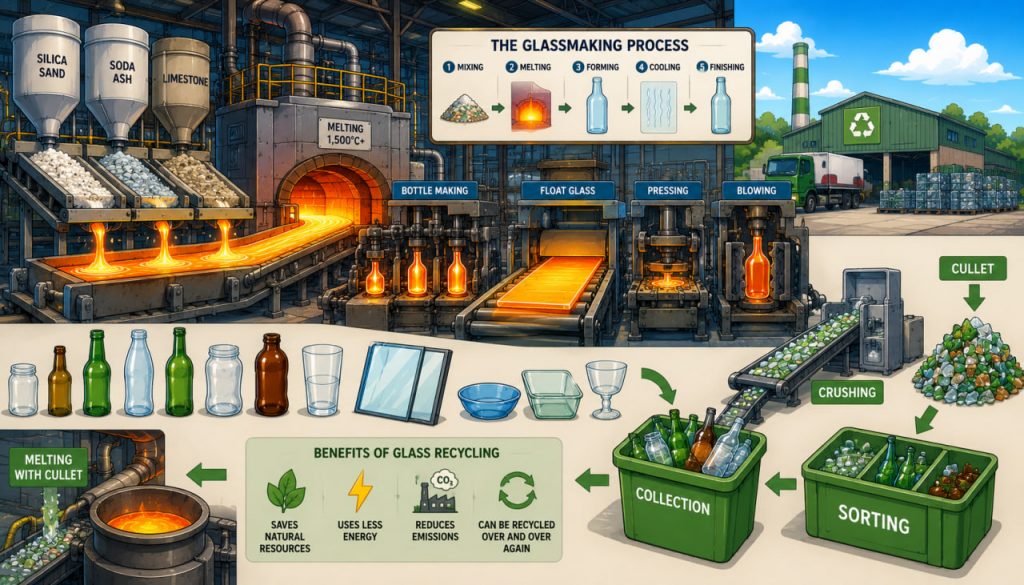
Glass is one of the most important materials in modern civilization. It is used in:
- Windows
- Bottles
- Smartphones
- Laboratory equipment
- Solar panels
- Vehicles
- Electronics
Although glass appears simple and fragile, it is actually a highly engineered material with unique physical and chemical properties. One of the most remarkable aspects of glass is that it can often be recycled repeatedly without major loss of quality.
Modern glass production combines:
- High-temperature industrial processes
- Precision engineering
- Chemistry
- Environmental technologies
At the same time, glass recycling plays an increasingly important role in reducing:
- Industrial waste
- Energy consumption
- Raw material extraction
- Environmental pollution
Understanding how glass is produced and recycled helps explain why this ancient material remains essential in the modern technological world.
What Is Glass?
Glass is an amorphous solid, meaning its internal structure lacks the highly ordered crystal arrangement found in many other materials.
Most common glass is primarily made from:
- Silica sand
- Soda ash
- Limestone
These materials are heated to extremely high temperatures until they melt into a liquid mixture.
After cooling, the material becomes rigid while maintaining transparency.
Glass is valued because it is:
- Transparent
- Chemically stable
- Waterproof
- Durable
- Recyclable
Different types of glass are designed for different industrial applications.
The History of Glassmaking
Humans have used glass for thousands of years.
Early civilizations in:
- Egypt
- Mesopotamia
- Rome
produced decorative and practical glass objects.
Ancient glassmaking techniques were limited and labor-intensive.
Modern industrial glass production expanded dramatically during the Industrial Revolution due to:
- Improved furnaces
- Automation
- Mass manufacturing techniques
Today, billions of glass products are manufactured annually worldwide.
Raw Materials Used in Glass Production
The primary ingredient in most glass is silica sand.
Additional materials help modify glass properties:
- Soda ash lowers melting temperature
- Limestone improves durability
- Metal oxides create colors and special effects
For example:
- Iron may produce greenish tones
- Cobalt creates blue glass
- Selenium may produce red shades
Industrial formulas vary depending on the intended use of the glass product.
How Glass Is Manufactured
Glass production begins by mixing raw materials in precise proportions.
The mixture is then heated inside industrial furnaces at temperatures exceeding:
- 1,500°C (2,700°F)
At these temperatures, the materials melt into a thick liquid.
The molten glass may then be:
- Molded
- Floated into sheets
- Blown into containers
- Pressed into shapes
The production method depends on the final product.
The Float Glass Process
Modern windows are commonly produced using the float glass method.
Molten glass is poured onto liquid tin, where it spreads into smooth flat sheets.
This process creates:
- Highly uniform thickness
- Smooth surfaces
- Optical clarity
Float glass technology revolutionized architecture and modern construction.
Today, skyscrapers and modern buildings rely heavily on advanced glass engineering.
Glass Bottles and Containers
Glass bottles are produced using automated molding systems.
Molten glass is cut into portions called “gobs,” which are shaped using:
- Air pressure
- Metal molds
- High-speed machinery
Mass production systems can manufacture thousands of bottles per hour.
Glass containers remain popular because they:
- Preserve flavor well
- Resist chemical reactions
- Are highly recyclable
Food and beverage industries depend heavily on glass packaging.
Why Glass Recycling Matters
Glass recycling significantly reduces environmental impact.
Recycled glass, called “cullet,” melts more easily than raw materials.
This reduces:
- Energy consumption
- Furnace temperatures
- Industrial emissions
Recycling also decreases demand for:
- Sand mining
- Raw material extraction
- Landfill space
Environmental scientist Carl Zimring explained:
“Glass recycling demonstrates how industrial systems can reduce waste while conserving resources.”
This is one reason many countries encourage large-scale glass recycling programs.
How Glass Recycling Works
Glass recycling begins with collection and sorting.
Glass products are usually separated by:
- Color
- Composition
- Product type
After sorting, the glass is:
- Cleaned
- Crushed into cullet
- Processed for contaminants
The recycled material is then mixed with new raw materials and melted again.
Unlike some plastics, glass can often be recycled repeatedly without major quality loss.
Challenges in Glass Recycling
Despite its advantages, glass recycling also faces challenges.
Some difficulties include:
- Color contamination
- Broken mixed materials
- Transportation costs
- Sorting complexity
Certain glass products such as:
- Mirrors
- Ceramics
- Heat-resistant glass
may not recycle easily together with ordinary container glass.
Efficient recycling systems require advanced infrastructure and public participation.
Specialized Types of Glass
Modern science created many specialized glass products.
Examples include:
- Tempered safety glass
- Bullet-resistant glass
- Fiber optics
- Laboratory glass
- Smartphone screens
Each type contains carefully engineered chemical compositions and manufacturing techniques.
Glass technology continues evolving rapidly.
Glass and Modern Technology
Glass plays a critical role in advanced technology.
Modern applications include:
- Solar panels
- Optical fibers
- Medical equipment
- Spacecraft windows
- Electronic displays
Without advanced glass engineering, many modern technologies would not function properly.
Researchers continue developing stronger, lighter, and smarter glass materials.
Environmental Benefits of Glass
Compared with some materials, glass offers important environmental advantages.
Glass is:
- Reusable
- Chemically stable
- Recyclable
- Long-lasting
However, manufacturing glass still requires large amounts of energy.
Improving recycling systems and furnace efficiency remains important for reducing environmental impact.
Why Glass Remains Essential
Glass combines properties rarely found together in one material:
- Transparency
- Strength
- Heat resistance
- Chemical stability
- Recyclability
From ancient art to modern smartphones, glass continues supporting human civilization in countless ways.
Its ability to be repeatedly recycled also makes it one of the most environmentally valuable industrial materials available today.
Interesting Facts
- Glass can often be recycled repeatedly without major quality loss.
- Modern float glass technology created extremely smooth window glass.
- Ancient civilizations produced decorative glass thousands of years ago.
- Fiber optic internet systems rely heavily on specialized glass.
- Recycled glass melts more easily than raw raw materials.
Glossary
- Silica Sand — The primary raw material used in most glass production.
- Cullet — Crushed recycled glass used in manufacturing.
- Float Glass — Smooth flat glass produced by floating molten glass on liquid tin.
- Amorphous Solid — A material lacking a regular crystal structure.
- Tempered Glass — Heat-treated glass designed for greater strength and safety.