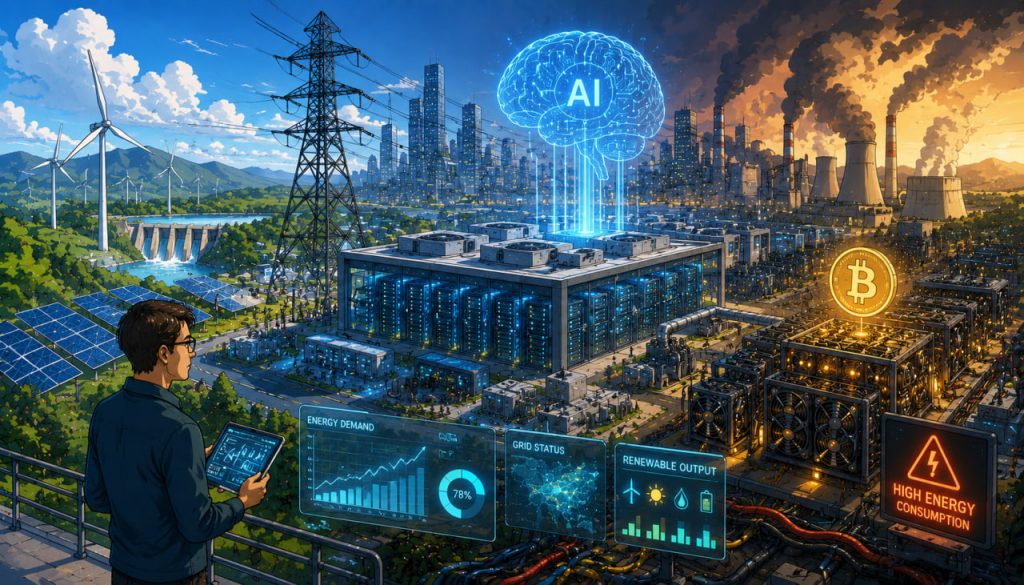
Modern civilization is entering an era of explosive digital growth. Artificial intelligence systems, cloud computing, data centers, electric vehicles, and cryptocurrency mining are consuming increasing amounts of electricity worldwide. At the same time, global populations continue growing, industries are electrifying, and societies are becoming more dependent on digital infrastructure than ever before.
This raises a critical question for the future of humanity:
Will our civilization have enough energy to support artificial intelligence, crypto mining, and future technologies without triggering a global energy crisis?
Scientists, economists, and engineers are actively debating whether current energy systems can keep up with rapidly expanding technological demand.
The challenge is especially important because AI and digital infrastructure require:
- Massive computational power
- Gigantic data centers
- Continuous electricity supply
- Advanced cooling systems
As technology evolves, energy may become one of the defining geopolitical and economic issues of the 21st century.
Why AI Requires So Much Energy
Artificial intelligence systems rely on enormous computational infrastructure.
Modern AI training requires:
- Thousands of advanced processors
- High-performance servers
- Large-scale data centers
- Continuous cooling systems
Training powerful AI models may consume vast amounts of electricity over weeks or months.
After deployment, AI systems also require ongoing energy for:
- User interactions
- Data processing
- Cloud services
- Real-time inference
As AI becomes integrated into:
- Search engines
- Robotics
- Healthcare
- Industry
- Education
global electricity demand may rise substantially.
The Rapid Growth of Data Centers
Data centers are the physical foundation of the modern digital world.
These facilities power:
- AI systems
- Streaming platforms
- Cloud computing
- Social networks
- Financial systems
Modern hyperscale data centers contain enormous numbers of servers operating continuously.
Cooling systems alone consume huge amounts of electricity because processors generate intense heat.
Energy analyst Vaclav Smil noted:
“Modern civilization is fundamentally a system of energy flows.”
Digital civilization increasingly depends on stable high-density electricity infrastructure.
Cryptocurrency Mining and Electricity Consumption
Cryptocurrency mining became one of the most controversial energy topics in recent years.
Some cryptocurrencies rely on computational systems requiring massive energy consumption for:
- Transaction verification
- Blockchain security
- Mining competition
Large mining facilities may consume electricity comparable to small cities.
Critics argue that energy-intensive mining creates:
- Carbon emissions
- Grid pressure
- Resource inefficiency
Supporters respond that some mining operations increasingly use:
- Renewable energy
- Surplus electricity
- Remote energy sources
The debate remains highly controversial.
Can Existing Energy Infrastructure Handle Future Demand?
Global electricity demand is already rising rapidly due to:
- Electrification
- Urbanization
- Industrial growth
- Digitalization
Adding large-scale AI infrastructure may significantly increase pressure on power grids.
Some experts warn about:
- Grid instability
- Blackout risks
- Energy shortages
- Rising electricity prices
Future demand may require enormous investments in:
- Power generation
- Transmission systems
- Energy storage
- Smart grid technologies
Modern civilization may soon need far more electricity than current systems comfortably provide.
Renewable Energy and the AI Era
Renewable energy is increasingly viewed as essential for supporting future digital infrastructure.
Major renewable technologies include:
- Solar power
- Wind energy
- Hydroelectric systems
- Geothermal energy
Many large technology companies now invest heavily in renewable power projects for their data centers.
However, renewable systems face challenges involving:
- Intermittency
- Storage limitations
- Grid balancing
Artificial intelligence itself may eventually help optimize renewable energy networks.
Nuclear Energy Returns to the Discussion
As electricity demand grows, nuclear power is receiving renewed attention.
Supporters argue nuclear energy offers:
- Stable baseload power
- Low carbon emissions
- High energy density
Some experts believe advanced nuclear reactors may become critical for powering future AI infrastructure.
Small modular reactors and next-generation reactor designs are being researched worldwide.
Critics, however, continue raising concerns regarding:
- Cost
- Safety
- Waste management
- Political risks
The debate around nuclear energy is becoming increasingly important again.
AI Could Also Improve Energy Efficiency
Ironically, AI itself may help solve some energy problems.
Artificial intelligence can optimize:
- Power grids
- Industrial efficiency
- Transportation systems
- Building energy use
- Renewable integration
Smart systems may reduce wasted electricity across many sectors.
AI-powered optimization could potentially improve energy efficiency at massive scale.
This creates a paradox where AI both increases and potentially reduces energy demand.
Cooling and Heat Problems
One often overlooked challenge involves heat generation.
Advanced processors used in AI and mining produce enormous heat.
Cooling infrastructure requires:
- Electricity
- Water systems
- Specialized engineering
Some companies are experimenting with:
- Liquid cooling
- Underwater data centers
- Arctic server facilities
Future computing systems may require entirely new cooling technologies.
Geopolitics and Energy Competition
Energy increasingly influences global politics.
Countries compete for:
- Rare minerals
- Energy infrastructure
- Semiconductor manufacturing
- Technological leadership
AI development may intensify geopolitical competition because computational power depends heavily on reliable energy systems.
Future economic dominance may partly depend on:
- Electricity production
- Energy stability
- Technological infrastructure
Energy security is becoming closely connected to digital power.
Could Civilization Face an Energy Crisis?
Some researchers believe future energy shortages are possible if technological growth outpaces infrastructure development.
Potential risks include:
- Overloaded power grids
- Rising electricity costs
- Resource bottlenecks
- Environmental pressures
However, others argue human innovation historically solved many energy challenges through:
- New technologies
- Infrastructure expansion
- Efficiency improvements
The future likely depends on how quickly societies modernize energy systems.
Fusion Energy and the Long-Term Future
Nuclear fusion is often described as a possible long-term solution.
Fusion aims to replicate the energy processes powering stars.
Potential advantages include:
- Extremely high energy output
- Reduced emissions
- Large fuel availability
Although practical commercial fusion remains under development, scientists continue making progress.
If successful, fusion could dramatically reshape future civilization and technological growth.
Why the Energy Question Matters
Energy is the foundation of technological civilization.
Artificial intelligence, cryptocurrency systems, robotics, cloud computing, and future digital infrastructure all depend on massive and reliable electricity supply.
The future of AI may therefore depend not only on software and computing advances, but also on humanity’s ability to build:
- Sustainable energy systems
- Smarter electrical grids
- More efficient infrastructure
The next century may become not only an information age, but also an age defined by the global struggle for energy itself.
Interesting Facts
- Large AI data centers may consume enormous amounts of electricity continuously.
- Some cryptocurrency mining facilities use energy comparable to small cities.
- Modern processors generate intense heat requiring advanced cooling systems.
- Technology companies increasingly invest in renewable energy infrastructure.
- Nuclear fusion research aims to create nearly limitless clean energy in the future.
Glossary
- Data Center — A facility containing servers and computing infrastructure.
- Cryptocurrency Mining — Computational processes used to validate blockchain transactions.
- Renewable Energy — Energy generated from naturally replenishing sources.
- Power Grid — A network delivering electricity from producers to consumers.
- Nuclear Fusion — A process combining atomic nuclei to release large amounts of energy.